BIOCHEMISTRY - L. Stryer - 1984
VOLUME 1
CHAPTER 1. MOLECULES AND LIFE
1.3. Outline of the Book
This book is divided into five parts, which focus on the following core topics.
I. Conformation and Dynamics.
II. Generation and Storage of Metabolic Energy.
III. Biosynthesis of Macromolecular Precursors.
IV. Genetic information.
V. Molecular Physiology.
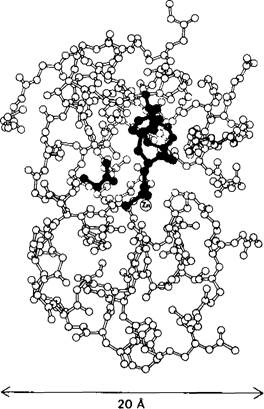
Part I is primarily dedicated to exploring the relationship between three-dimensional Structure and biological activity, using Proteins as a primary example. The Structure and function of Myoglobin and Hemoglobin—Oxygen-transporting proteins in vertebrates—are examined in detail, as they provide an excellent basis for illustrating several General Principles. Hemoglobin is of particular interest because its oxygen-binding affinity is regulated by specific environmental effectors. The molecular pathology of hemoglobin, specifically Sickle-Cell Anemia, is also discussed. In the section on Enzymes, we examine how an enzyme recognizes its substrate and how it can accelerate reaction rates by a factor of a million or more. Enzymes such as Lysozyme, Carboxypeptidase A, and Chymotrypsin are discussed in detail, as their study has revealed many fundamental principles of catalysis. Conformation is viewed from a slightly different perspective in the chapter devoted to two Connective Tissue proteins: Collagen and Elastin. The concluding chapter of Part I serves as an Introduction to Biological Membranes, which are organized protein-lipid complexes. The presence of membranes in biological systems enables the compartmentalization of The Cell.
Class="center">Fig. 1.8. STRUCTURE OF THE enzyme-substrate complex. Glycyltyrosine (shown in red) is bound to carboxypeptidase A (a hydrolytic enzyme). Only one-quarter of the enzyme molecule is shown. [Lipscomb W. H., Proc. Robert А. Welch Found. Conf. Chem. Res., 15, 141 (1971)]
Part II focuses on the generation and storage of metabolic energy. It begins with An Overview of the general strategy of METABOLISM. Cells convert energy derived from fuel molecules into ATP, which in turn drives most endergonic (energy-consuming) processes. In addition to ATP, cells generate reducing equivalents in the form of nicotinamide adenine dinucleotide phosphate (NADPH), which is consumed in biosynthetic pathways. The pathways for ATP and NADPH generation are described in detail. For instance, The production of ATP via The breakdown of glucose requires three sequential processes: Glycolysis, The Tricarboxylic Acid Cycle (also known as The Citric Acid Cycle or Krebs cycle), and Oxidative Phosphorylation. The latter two processes also participate in ATP production through The oxidation of other Energy Sources, namely fats and Certain Amino Acids. This example illustrates THE PRINCIPLE OF molecular economy. Part II also examines the two primary forms of energy storage in cells: Glycogen and triacylglycerols (neutral fats). The concluding chapter of this section is devoted to Photosynthesis, the primary reaction of which is a light-driven Electron transfer from one substance to another against a chemical potential gradient.
Fig. 1.9. Model of CDP-diacylglycerol, an activated intermediate in the synthesis of various Membrane Lipids
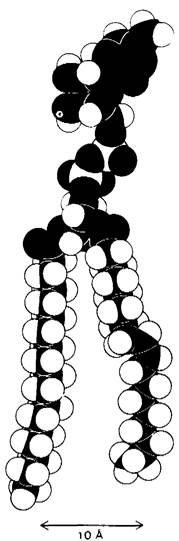
Part III deals with The biosynthesis of macromolecular precursors. It opens with a Discussion of the synthesis of membrane lipids and Steroids. Of particular interest is the synthesis of Cholesterol, a C27!!! steroid in which all carbon atoms are derived from a two-carbon precursor. The following chapter discusses the reactions leading to the synthesis of various Amino Acids and heme. The regulatory mechanisms governing these Metabolic pathways are of fundamental importance. Next, the Biosynthesis of NUCLEOTIDES—the activated precursors of DNA and RNA—is examined. The final chapter focuses on the INTEGRATION OF METABOLIC processes, showing how energy-yielding and energy-consuming reactions are balanced to meet the needs of the Organism.
Fig. 1.10. Electron micrograph of a DNA molecule. (Published with the kind permission of Dr. T. Broker.)
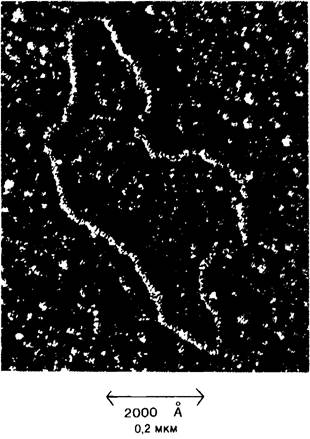
The storage, transmission, and expression of genetic information form the main theme of Part IV. The section begins with experiments demonstrating that DNA is the genetic material, followed by The history of the Discovery of the DNA double helix. This is followed by an explanation of the enzymatic mechanism of DNA Replication. We then turn to the expression of the genetic information encoded in DNA, starting with Evidence for the role of Messenger RNA as an intermediate carrier of information. Next, Transcription—the synthesis of RNA directed by a DNA template—is examined. This leads logically to The Genetic Code: the relationship between The base sequence in DNA (or its transcribed messenger RNA) and the Amino Acid Sequence in the corresponding protein. The genetic code, universal to All living organisms, is remarkable in its simplicity. Three bases make up a codon, which is the code unit corresponding to a single amino acid. Codons in messenger RNA are read sequentially by Transfer RNA molecules, which act as adaptors in Protein Synthesis. We then proceed to The Mechanism of protein synthesis, specifically Translation, during which the four-letter alphabet of Nucleic Acids—where each letter is represented by a corresponding base pair—is translated into the 20-letter alphabet of proteins. Translation takes place on Ribosomes and requires the coordinated interaction of over a hundred different macromolecular components. The subsequent chapter describes the Regulation of Gene Expression in Bacteria, focusing primarily on the lactose and Tryptophan operons of E. coli as the most thoroughly investigated systems to date. We then discuss recent findings on Gene Expression IN higher organisms (eukaryotes), which differ from bacteria (prokaryotes) by having a higher DNA content and a well-defined Nucleus, enabling cellular differentiation. Viral replication and the assembly of Viral Particles are subsequently explored; this process illustrates the general principles by which highly ordered structures are formed from biological macromolecules. Special attention is given to tumor Viruses that induce Cancer in experimental animals. The concluding chapter of Part IV is devoted to the generation of new genes via recombination and explores The Significance of DNA Cloning.
Fig. 1.11. Model of 11-cis-retinal, the light-absorbing moiety in rhodopsin. The light-induced isomerization of this chromophore is the primary event in Vision
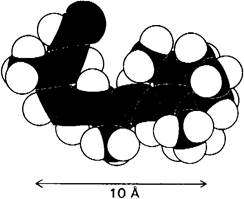
Part V, entitled "Molecular Physiology," bridges biochemistry and physiology. It draws heavily on the concepts developed in earlier chapters of the book, as physiology deals with information, conformation, and metabolic processes operating in concert. The section begins with the Organization of cellular membranes and bacterial cell walls, addressing how a cell determines the intracellular destination of its synthesized proteins. This is followed by the Molecular Basis of the Immune Response, detailing how the organism recognizes foreign substances. The next chapter addresses The conversion of chemical bond energy into coordinated mechanical motion. As recent research has demonstrated, Actin and Myosin—the major Muscle Proteins—function as contractile elements in most Eukaryotic cells. The MOLECULAR MECHANISMS OF hormone action are then discussed, with an emphasis on overarching principles. We subsequently cover the Transport of Molecules and ions, specifically Na+, K+, and Ca2+. Membrane-bound molecular ion pumps transport ions to establish concentration gradients that underlie cellular excitability. The final chapter, dedicated to sensory processes, addresses questions such as: How is an Action Potential propagated along Nerve Cells and across a synapse? How does a single photon excite a rod cell in the retina? How do bacteria sense chemical attractants in their environment and navigate toward them?
One of the most appealing aspects of biochemistry is that it continually deepens and expands our understanding of biological processes across all levels of the living world.
Last update: 06/08/2026
Editorial and Educational Adaptation: This material has been compiled based on the primary/original source text. The project team performed an editorial review, corrected technical inaccuracies, structured sections, and adapted the content for an educational format.
What was processed:
- elimination of formatting defects (OCR errors, structural breaks, corrupted characters);
- editorial organization of content;
- standardization of terminology in accordance with academic sources;
- verification of factual statements against the original source text.
All mentions of the author, publication year, and origin of the primary text have been preserved in accordance with the source.