Principles of Biochemistry Volume 2 - A. Lehninger 1985
Bioenergetics and Metabolism
Metabolism: An Overview
Metabolic pathways are sequences of reactions catalyzed by multienzyme systems
Enzymes are the fundamental units of metabolic activity; each of them catalyzes a specific chemical reaction. METABOLISM, however, is best understood through THE CONCEPT OF multienzyme systems, each catalyzing successive steps of a given metabolic pathway. Such multienzyme systems may comprise from 2 to 20 enzymes acting in concert and in a precise sequence, such that the product of the reaction catalyzed by the first enzyme serves as the substrate for the next reaction catalyzed by the second enzyme, and so on (Fig. 13-4). The products of successive transformations comprising a given metabolic pathway (B, C, D, etc. in Fig. 13-4) are referred to as intermediates or metabolites. At each successive stage of a metabolic pathway, typically only a minor chemical modification takes place—most commonly the removal, transfer, or Addition of an atom, molecule, or functional group. As a result of these ordered, stepwise modifications, the initial biomolecule is converted into the corresponding final product. For the most part, metabolic pathways are linear, though they may also be cyclic (Fig. 13-4). They typically feature branch points where certain reaction products leave the chain of reactions of a given metabolic pathway or, conversely, feed into it. In its most common usage, the term "metabolism" is synonymous with "material and energy exchange"; in a more precise and narrow sense, "metabolism" denotes Intermediary Metabolism, i.e., the Transformation of substances within Cells from the moment of their uptake to The formation of end products.
Class="center">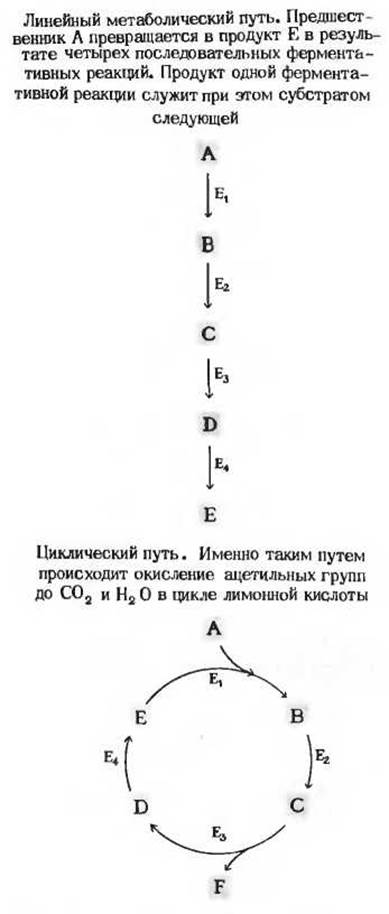
Fig. 13-4. Multienzyme systems.
Last update: 06/08/2026
Editorial and Educational Adaptation: This material has been compiled based on the primary/original source text. The project team performed an editorial review, corrected technical inaccuracies, structured sections, and adapted the content for an educational format.
What was processed:
- elimination of formatting defects (OCR errors, structural breaks, corrupted characters);
- editorial organization of content;
- standardization of terminology in accordance with academic sources;
- verification of factual statements against the original source text.
All mentions of the author, publication year, and origin of the primary text have been preserved in accordance with the source.