Biochemistry - The Chemical Reactions of Living Cells, Volume 3 - D. Metzler 1980
Biochemical Genetics and the Synthesis of Nucleic Acids and Proteins
The Eukaryotic Chromosome and Its Control
Organization
The Genome of such a simple eukaryote as the slime mold *Dictyostelium* contains 11 times more DNA than that of *E. coli*. In *Drosophila*—a "higher" Organism with the lowest amount of DNA—the size of the haploid genome is 24 times that of *E. coli*. The coding capacity of The Human Genome is 600 times greater than that of the bacterium (Table 1-3). Such a large amount of DNA is one of the main factors that make The Study of the eukaryotic genome so challenging. Another difficulty stems from the fact that Gene METABOLISM/31.html">Transcription in eukaryotes can vary dramatically both over time and in response to environmental conditions. Consequently, The regulatory mechanisms governing the phenotypic expression of genes must be highly complex.
The genome of higher organisms consists of a specific number of distinct Chromosomes, each of which apparently contains a single double-stranded DNA molecule. This DNA molecule is closely associated with other components, comprising approximately 75% protein and 10% RNA (Chap. 1, Sec. B, 2). Until recently, very little was known about chromosome organization. However, it is well established that during the prophase of mitosis or Meiosis, elongated chromosomes sometimes resemble strings of beads. These small, DNA-rich beads, known as chromomeres, much like the bands in *Drosophila* polytene chromosomes (Sec. G, 9, c), can be viewed as fundamental units of Genetic information. Their existence suggests that chromosomal DNA is somehow partitioned into discrete units, perhaps analogously to bacterial operons.
Certain bands of polytene chromosomes bulge out to form puffs, the largest of which are called Balbiani rings. Within these puffs, DNA adopts its least compact conformation, and it is widely hypothesized that active transcription takes place here. Since the DNA within a polytene chromosome band contains on average roughly 105 Base Pairs, the resulting mRNA transcripts can be exceptionally large [270]. Indeed, recent studies have shown that a single Balbiani ring is sufficient to generate a 75S-RNA with a molecular mass of 15∙106—35∙106 daltons [271]. This massive RNA molecule is apparently transported intact into the Cytoplasm, where Protein Synthesis is highly active. This raises a fundamental question: is this mRNA the transcript of a single gene and a large non-coding stretch of DNA, or does it contain repetitively encoded information for the synthesis of a single protein? This question is vital for understanding the General Principles of genetic organization in eukaryotic chromosomes. It should be borne in mind, however, that polytene chromosomes represent a specialized type of modification found in terminally differentiated Cells that are incapable of further division.
a. Lampbrush chromosomes
Another specialized type of chromosome, the study of which has greatly expanded our understanding of The eukaryotic Nucleus, is found during the prophase of meiotic division in oocytes. These are the "lampbrush chromosomes," which have been studied in detail in *Xenopus* amphibians. A lampbrush chromosome is a homologous pair of chromosomes, each consisting of two closely apposed chromatids. The chromosomes exist in an extremely linear, decondensed form, with about 5% of their DNA forming approximately 4,000 precisely paired loops visible under the Electron microscope. Each such loop is formed by a double-stranded DNA thread about 50 nm long, corresponding to roughly 150,000 base pairs. The fact that no DNA breaks are ever observed in any of the loops Supports the view that a single continuous DNA molecule runs through all the loops from one end of the chromosome to the other.
Much like the puffs of polytene chromosomes (which they may structurally resemble), lampbrush chromosomes are actively involved in transcription. It is estimated that approximately 3% of their DNA participates in the synthesis of mRNA, which accumulates in the oocyte and Functions during early embryonic development [272]. It would be logical to assume that a single loop in a lampbrush chromosome, much like a single band in a polytene chromosome, acts as a transcriptional unit. However, we are immediately confronted with a paradox: The amount of DNA contained within a single band or loop is sufficient to encode 30—35 average-sized Proteins. Yet, fine-Structure genetic analysis of *Drosophila* chromosomes reveals no more than a single complementation unit per band [273]. This implies that a mere 3% of *Drosophila* DNA actually contains structural genes for protein synthesis. What is the function of the remaining DNA, and why do Mutations within it cause no apparent harm to the organism? Unfortunately, definitive Answers to these questions remain elusive.
b. Repetitive sequences
With the advent of chemical techniques, a clearer picture of chromosome organization is beginning to emerge. In one experimental approach, DNA is sheared into fragments of approximately 10,000 base pairs each, which are then thermally denatured. Upon cooling, the renaturation of the resulting single-stranded fragments was found to proceed in at least two distinct phases. While the double-helix structure is rapidly restored in one fraction of the material, renaturation occurs slowly in the other (Fig. 15-34) [273—275].
Experiments show that rapidly renaturing DNA fragments often differ in nucleotide composition from the bulk of the DNA. Consequently, when fragmented DNA is centrifuged in a CsCl density gradient, the rapidly renaturing fraction tends to separate, forming a distinct "satellite" band. This satellite DNA has been found to consist of short, highly repetitive sequences [276, 277]. For instance, the satellite DNA of the kangaroo rat contains the repeating sequence 5'-GGACACAGCG-3'. This highly repetitive sequence accounts for 11% of the total cellular DNA. Satellite DNA is typically located in chromosomal regions that do not decondense during telophase like the rest of the DNA. The biological function of satellite DNA remains unknown. It has been suggested that repetitive sequences arise evolutionarily through Unequal Crossing over between sister chromatids during mitosis [232a]. Using Restriction Endonucleases, human DNA has been cleaved into various fragments. A comparison of the electrophoretic profiles of male and female DNA fragments demonstrates that the Y chromosome contains a nucleotide sequence repeated thousands of times in a tandem array.
Other evidence indicates that some repetitive sequences are randomly dispersed throughout the genome. This is supported, for example, by the finding that the renaturation of *Drosophila* DNA fragments yields DNA rings that can be visualized under the electron microscope [278]. These rings can form during renaturation As a result of internal fragmentation within repetitive sequences. *Xenopus* chromosomes may contain up to 25% of such repetitive sequences. Electron microscopic data indicate that the random reassociation of DNA fragments leads to The formation of double-stranded regions containing repetitive nucleotide sequences, flanked by single-stranded "tails." The latter typically fail to pair because they consist of unique sequences derived from different genes. In *Xenopus*, the repetitive DNA fragments comprise roughly 300 NUCLEOTIDES, whereas the non-repetitive, or unique, fragments interspersed between them span approximately 800 nucleotides [275].
Much can be learned about DNA organization by examining RNA transcripts. Significant differences were discovered when comparing nuclear and cytoplasmic mRNA in *Dictyostelium* [279]. When residing in The Nucleus, the mRNA chain comprises approximately 1,600 nucleotides, but in the cytoplasm it is shortened to about 1,300 nucleotides. Both nuclear and cytoplasmic mRNA contain short stretches of polyadenylic acid (Sec. B, 5). These segments can be isolated by Enzymatic Hydrolysis and their lengths determined. It turns out that in nuclear mRNA, these stretches consist of approximately 25 adenylic acid residues. Evidently, these poly(A)25 tracts are transcribed from the DNA along with the rest of the mRNA, since the DNA itself contains about 15,000 poly(dT)25 sequences. This number of poly(dT) tracts is sufficient to ensure that every gene contains at least one such region. Similar poly(dT) tracts have been found in the DNA of all Multicellular Organisms. For instance, *Drosophila* DNA contains about 6,000 such sites, which corresponds well with its Complement of 5,000 polytene chromosome bands. The mammalian genome harbors approximately 100,000 poly(dT) sites.
Class="center">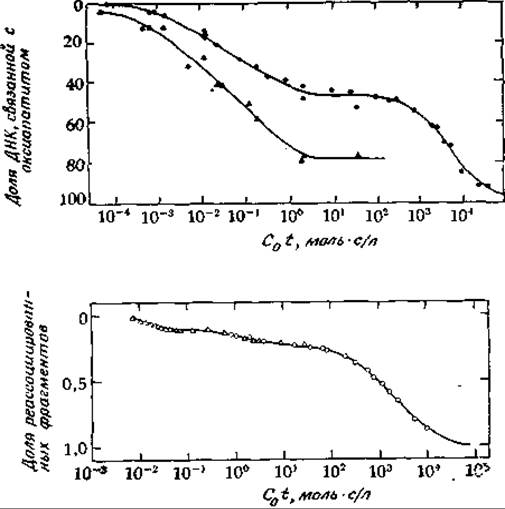
FIG. 15-34. Renaturation kinetics of mammalian DNA. A. Evidence for the presence of repetitive and non-repetitive sequences in the calf genome. The upper curve represents the reassociation of calf DNA fragments with a length of about 400 nucleotides. Incubation was carried out at 60 °C in 0.12 M phosphate buffer, and analysis was performed under the same conditions using the hydroxyapatite method (Chap. 2, Sec. G, 10). The lower curve illustrates the reassociation of a small amount of labeled fragments containing 4,000 nucleotides with a large excess of fragments containing 400 nucleotides. The DNA was sequentially fractionated into three parts: (1) a rapidly reassociating fraction ($C_0t \approx 3 \cdot 10^4$) containing about $10^6$ copies per genome (satellite DNA); (2) an intermediate fraction ($C_0t \approx 0.01$) containing about 66,000 copies (37%); and (3) a slowly reassociating DNA fraction ($C_0t \approx 1000$) lacking repeats (see Fig. 2-29 in Britten R. J., Smith J., Carnegie Inst. Wash. Yearb., 68, 378—391, 1970). B. Reassociation of fragmented denatured mouse DNA in a 48% formamide solution and 5 \times SSC (SSC denotes a solution containing 0.15 M NaCl and 0.015 M sodium citrate) at 37 °C. The renaturation reaction was carried out at two concentrations: (1) 50 $\mu g/ml$ in Glass cuvettes with ground-glass stoppers and a 1 cm optical path length ($\Delta$), and (2) 1 mg/ml in cuvettes with a 1 mm path length ($\bigcirc$). The hypochromic effect was measured at 270 nm. The data are presented as the fraction of DNA renatured within a given time plotted against the product of the initial DNA concentration (in moles of phosphorus per liter) and the renaturation time (in seconds). The sample was found to contain 10% rapidly renaturing satellite DNA, 15% intermediate partially modified DNA, and 75% unique-sequence DNA (McConaughy B. L., McCarthy B. J. Biochem. Genet., 4, 425—446, 1970).
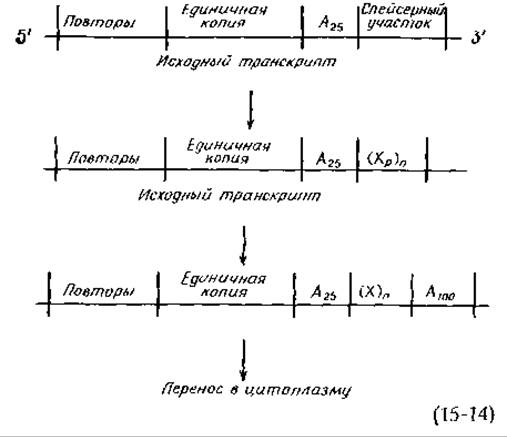
As for cytoplasmic mRNA, despite its smaller size, it contains more poly(A). For example, in *Dictyostelium* mRNA, In addition to the poly(A)25 tracts, there is an equal number of longer poly(A) segments comprising roughly 100 adenylic acid residues, which are apparently added post-transcriptionally. According to a working hypothesis [Equation (15-14)] [280], repetitive sequences, single-copy regions, poly(A)25 tracts, and a "spacer region" are present in every gene. Following transcription, the RNA segment corresponding to the spacer region is cleaved from the mRNA, leaving an unknown number of nucleotides (Xp) downstream of the 3'-terminal poly(A)25, after which about 100 adenylic acid residues are added prior to export into the cytoplasm [278]. It is also believed that other "tandem repeats" may occur, corresponding to "repetitive genes" that must exist in more than one copy to supply The Cell with adequate transcripts.
c. Ribosomal RNA genes
While most genes are present in the chromosome as single copies, the genes for ribosomal RNA and tRNA are present in multiple copies. In *Xenopus*, the genes for the 28S and 18S rRNAs are repeated approximately 450 times per chromosome. At the ends of the long arms of most chromosomes, about 24,000 copies of 5S RNA genes are found [281]. The 28S and 18S RNA Genes are transcribed together with the spacer region located between them. Non-transcribed spacer regions lie between the repeating gene pairs, as clearly visible in the electron micrographs shown in Fig. 15-11. The gene encoding 5S RNA is known for its high GC content; consequently, these regions should be resistant to thermal Denaturation. Indeed, the denaturation map of DNA reveals easily denaturable regions interspersed with shorter 128-base sequences of high GC content that presumably encode 5S RNA. The easily denaturable (AT-rich) spacer regions comprise approximately 630 base pairs. Using specific restriction Enzymes, many of these AT-rich regions have been cleaved into repeating units that themselves contain internal repeats. The primary 15-nucleotide fragment with the sequence $A_4CUCA_3CU_3G$ was found to repeat about 30 times [282].
In *Drosophila*, restriction endonuclease mapping of the 5S RNA gene region on chromosome 2 reveals that this locus contains two tandemly repeating gene clusters, each comprising about 90 genes. The exact orientation of these clusters is not definitively established, but it has been suggested that the two clusters form a long palindrome whose transition into a cruciform configuration may be an intermediate step in Mismatch Repair. This would help maintain cluster homogeneity [282a]. This consideration applies equally to the large number of long palindromes found in eukaryotic DNA [235a].
d. Gene Amplification
Under certain circumstances, a portion of the genome can undergo amplification via the repeated Replication of one or more genes. The most prominent example is the amplification of ribosomal RNA genes in amphibian oocytes. In *Xenopus*, excess DNA accumulates around the nucleolus and subsequently fragments to form 1,000 or more separate nucleoli. Up to 3,000 copies of rDNA can be detected (forming a distinct satellite band upon centrifugation). Amplified rDNA serves as a convenient material for biochemical research. For instance, the structural studies described in the previous section were performed on this exact type of DNA.
The Mechanism of DNA amplification is currently under intensive investigation, though it is not yet fully elucidated [283]. It has been proposed that numerous copies of rDNA are generated via a rolling-circle mechanism, analogous to that illustrated in Equation (15-9). The Biological Significance of rDNA amplification presumably lies in providing the cellular capacity to synthesize large numbers of Ribosomes required for accelerated protein synthesis.
Last update: 06/08/2026
Editorial and Educational Adaptation: This material has been compiled based on the primary/original source text. The project team performed an editorial review, corrected technical inaccuracies, structured sections, and adapted the content for an educational format.
What was processed:
- elimination of formatting defects (OCR errors, structural breaks, corrupted characters);
- editorial organization of content;
- standardization of terminology in accordance with academic sources;
- verification of factual statements against the original source text.
All mentions of the author, publication year, and origin of the primary text have been preserved in accordance with the source.