Principles of Biochemistry Volume 1 - A. Lehninger 1985
Biomolecules
Cells
The eukaryotic nucleus is a highly complex structure
The Nucleus contains almost all of the DNA in a Introduction/5.html">Eukaryotic Cell. In both animal Cells (Fig. 2-7) and plant cells (Fig. 2-8), the nucleus is surrounded by a nuclear envelope consisting of two closely spaced membranes separated by a narrow space. At regular intervals, the two membranes of the nuclear envelope fuse, forming openings about 90 nm in diameter known as nuclear pores. These pores regulate the exchange of various substances between the nucleus and the Cytoplasm.
Class="center">
Fig. 2-8. A. An electron micrograph of a well-formed Nucleus of the eukaryotic alga Chlamydomonas. The dark body in the center of the nucleus is the nucleolus, the site where the major components of Ribosomes are assembled. Partially formed ribosomes can be seen around the periphery of the nucleolus. The nuclear envelope consists of two tightly apposed membranes punctuated by nuclear pores, two of which are indicated by arrows. B. The surface of the nuclear envelope with numerous nuclear pores, through which the internal Contents of the nucleus are visible. This micrograph was obtained by freeze-fracture Replication.
Inside the nucleus lies the nucleolus (Fig. 2-8), which stains more intensely due to its high concentration of ribonucleic acid (RNA). The nucleolus Functions as an RNA "factory," and it is also where the Initial Stages of ribosome synthesis take place.
The rest of the nucleus contains Chromatin, named for its characteristic staining properties (Figs. 2-7 and 2-8). Chromatin is composed of DNA, RNA, and a set of specific Proteins. Between cell divisions, chromatin is randomly distributed throughout the nucleus, but immediately before division, it condenses into discrete granular bodies known as Chromosomes. Eukaryotic cells of a given species contain a strictly defined number of chromosomes; for example, human somatic cells have 46 chromosomes. Following replication, the resulting daughter chromosomes segregate and are distributed to daughter cells through a highly intricate sequence of events called mitosis. The most crucial stages of mitosis are illustrated in Fig. 2-9. Upon completion of mitosis, the chromatin disperses once again throughout the nucleus.
Thus, the well-defined nucleus of a eukaryotic cell possesses a highly complex Structure and performs significantly more sophisticated biological functions compared to the relatively simple nucleoid body of prokaryotes.
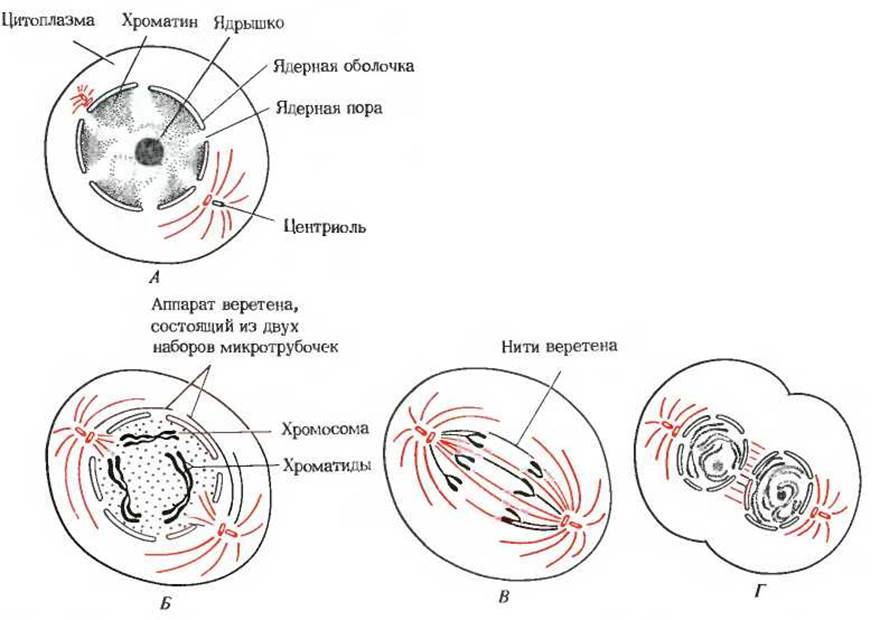
Fig. 2-9. MAIN STAGES OF mitosis in a eukaryotic cell. A. The interphase between cell divisions. Chromatin is dispersed throughout the nucleus. B. Onset of Cell Division. Chromatin condenses into chromosomes and replicates, while the nuclear envelope begins to break down. The spindle apparatus forms at the poles of The Cell, and the nucleolus dissolves. C. Chromosomes migrate to opposite poles, ensuring that each daughter cell receives a complete set of chromosomes. D. Two daughter nuclei. Their nuclear envelopes and nucleoli reform, chromatin disperses throughout the nucleus, and the parent cell divides to form separate daughter cells.
Last update: 06/08/2026
Editorial and Educational Adaptation: This material has been compiled based on the primary/original source text. The project team performed an editorial review, corrected technical inaccuracies, structured sections, and adapted the content for an educational format.
What was processed:
- elimination of formatting defects (OCR errors, structural breaks, corrupted characters);
- editorial organization of content;
- standardization of terminology in accordance with academic sources;
- verification of factual statements against the original source text.
All mentions of the author, publication year, and origin of the primary text have been preserved in accordance with the source.