Genetics - A. V. Sivolob 2008
The Nature of Genetic Material
DNA Repair
Mismatch Repair
Despite error correction during Replication, a certain number of mispaired bases remain in the newly synthesized DNA strands. Obviously, when repairing such mismatches consisting of two non-complementary NUCLEOTIDES, the one belonging to the newly synthesized strand—rather than the template strand—must be replaced.
In bacterial Cells, mismatch repair is mediated by the mutHLSU system. Short CTAG sequences (which are palindromes, reading identically in the 5'- to 3'-direction on both strands) are distributed throughout the bacterial genome at an average distance of 256 Base Pairs, where adenine undergoes post-replicative methylation. However, for a certain period following replication, only the template (parental) strand remains methylated. It is during this window that the repair system operates (Fig. 1.23): the mutS protein recognizes the mismatch and recruits the mutL protein, which in turn interacts with two mutH Proteins bound to tetranucleotide palindromic sites on either side of the mismatch. Within this assembled complex, mutH acquires endonuclease activity and introduces a single-strand nick into the unmethylated strand within one of the sites (one of the two sites is chosen at random). Subsequently, the mutU helicase (identical to the uvrD protein) unwinds The Double Helix, and an exonuclease degrades the strand from the nick past the mismatch and slightly beyond. Finally, the resulting gap is filled by DNA polymerase III, and the single-strand break is sealed by DNA ligase.
Class="center">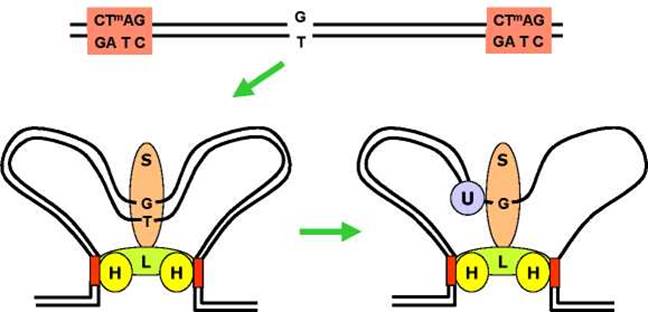
Fig. 1.23. The mutHLSU mismatch repair system
The mutHLSU system is highly conserved, with homologous proteins also present in eukaryotes. Adenine methylation is not used to discriminate between the strands: eukaryotic mismatch repair proteins are associated with the replisome and the newly synthesized DNA strands, meaning they function directly during replication.
Last update: 11/08/2026
Editorial and Educational Adaptation: This material has been compiled based on the primary/original source text. The project team performed an editorial review, corrected technical inaccuracies, structured sections, and adapted the content for an educational format.
What was processed:
- elimination of formatting defects (OCR errors, structural breaks, corrupted characters);
- editorial organization of content;
- standardization of terminology in accordance with academic sources;
- verification of factual statements against the original source text.
All mentions of the author, publication year, and origin of the primary text have been preserved in accordance with the source.