Fundamentals of Bioinformatics - Ogurtsov A.N. 2013
Foundations of Bioinformatics
The concept of "information"
Genetic information
Let us now turn to genetic information, which is carried by DNA molecules. The words "DNA," "genes," and "hereditary information" have become so commonplace that they are often perceived as synonyms. In reality, this is far from the case.
An immensely long DNA molecule consists of four types of NUCLEOTIDES that can be joined in any sequence. Nucleic acid molecules possess a property that Hermann Joseph Muller termed autocatalysis.
If all four nucleotides are added in the proper amounts to a solution containing nucleic acid molecules, and certain additional conditions are met, these molecules will begin aligning nucleotides along their own chain in precisely the same sequence as their own, and then detach the completed copies. This process does not depend on the specific sequence of nucleotides that make up the original DNA molecules. It can be a random sequence, a strictly alternating one, or any other—the copies will always resemble the original, provided no mutation occurs, meaning a random substitution, insertion, or deletion of one or more nitrogenous bases.
If a DNA molecule consists of a random sequence of nucleotides, it is by no means a Gene, since it contains no hereditary information, even though it is capable of self-Replication. Information emerges in segments of a DNA molecule only when, through mutation (or for other reasons), a sequence of nucleotides forms there that can influence the chemical processes occurring in its surroundings. Only then, acting as a "catalyst," can the gene accelerate some processes or inhibit others, thereby altering its chemical environment.
Gradually, greater advantages will be gained by those DNA structures that can increase the concentration of nucleotides and other substances necessary for their reproduction in their immediate vicinity.
Only when this process is complete and segments arise in the "primordial" DNA molecule—each of which stimulates The formation of compounds necessary for DNA duplication or suppresses the synthesis of compounds that hinder it—can we consider that genes have emerged within the DNA molecule, and that the molecule itself has become a carrier of genetic information.
Consequently, genetic information is contained in a set of genes that control the synthesis of compounds ensuring the duplication of DNA molecules under specific conditions.
The appearance of genes is closely linked to The Emergence of the Translation machinery, as well as the formation of envelopes or membranes that isolate the region containing DNA molecules from the external environment. This can already be regarded as the emergence of living entities that can grow, reproduce, and adapt to new conditions thanks to genes that arise and change As a result of Mutations; they die when the genes they contain are destroyed or when they fail to adapt to external conditions. By changing, genes also influence other Organism structures, thereby ensuring the "colonization" of ever-new habitats, the appearance of multicellular plants, Fungi, and animals—in other words, the evolution of life on Earth. As G. Muller wrote, life has the gene at its core.
Thus, the aggregate of genes, or genetic information, regulating the purposeful activity of any living Cell is determined not by the nitrogenous bases of DNA themselves, but by their sequential arrangement.
The distinction between genetic information and the DNA molecule also allows us to introduce METABOLISM/2.html">THE CONCEPT OF carriers of genetic information and to clarify the difference between such carriers and information as such. This is why we say that genetic information is encoded in DNA by a specific sequence of nucleotides. It is precisely this information—that is, the record of The sequence of events that must take place for newly formed Cells to grow and subsequently divide—that constitutes the most vital component of a living cell.
What Muller wrote about 70 years ago can be formulated as follows:
Living matter is an aggregate of objects containing informational structures that possess The properties of autocatalysis and heterocatalysis, which ensure the reproduction of these objects in a diverse range of environmental conditions.
Life is the emergence of ever-new information-containing objects whose material components ensure its reproduction in increasingly diverse and complex situations. Obviously, the more complex these situations are, the more information is required to construct, in accordance with it, a living entity capable of existing in those situations. In the world of inanimate Nature, there are no Examples of informational systems in which information carriers differ qualitatively from the rest of the system's elements.
We are so accustomed to the phrase "genetic information" that we have even forgotten it was introduced into scientific parlance by the physicist Erwin Schrödinger in the mid-1940s. In his book *What Is Life? The Physical Aspect of the Living Cell*, he drew upon the work of N.W. Timoféeff-Ressovsky, K.G. Zimmer, and M. Delbrück, "On The Nature of Gene Mutations and Gene Structure," published in Germany in 1935. This occurred shortly after H. Muller, a student of Thomas Hunt Morgan, first demonstrated not only that genes reproduce themselves and change (mutate), but also that the frequency of their mutation can be influenced, for example, by raising the Temperature or through exposure to ionizing radiation.
In a 1928 article titled "The Gene as The basis of Life," Muller showed that it was genes (entities of unknown nature at the time) capable of auto- and heterocatalysis that initiated The phenomenon of life on our planet. "It is clear that by adopting this point of view, we avoid the logical difficulties associated with THE ORIGIN OF modern protoplasm, with its interaction of parts acting jointly toward the continued growth and precise reproduction of the whole. This system was formed, much like the complex macroscopic form of Higher Plants and animals, ... gradually, step by step, with each step being tested as mutation followed mutation in the primordial autocatalytic genes. In this process, those genes—and only those genes—whose by-products proved most useful for further reproduction survived, multiplied, and mutated anew... According to this view, which appears to best withstand the test of exhaustive analysis, at least a significant portion of protoplasm initially emerged merely as a by-product of gene substance activity; its function... consists solely in nourishing the genes; whereas the primary secrets inherent in all life are hidden deeper, within the gene substance itself... The mutable types of structures in the gene substance have undoubtedly undergone profound changes and complexification in the course of evolution, and protoplasm has certainly evolved under their influence, but other structures—those features of gene architecture responsible for its primary property of autocatalysis—must still be today what they were in times immemorial, before green slime yet bordered the sea coasts." Just over twenty years after this publication, it was established that genes are discrete Regions of the DNA molecule that reproduce by the complementary alignment of four types of nucleotides; genes mutate when errors occur in this process; they direct the synthesis of various Proteins making up protoplasm, switching from time to time between autocatalysis (making copies of themselves—replication) and heterocatalysis (building foreign molecules—Transcription and translation) via the synthesis of RNA and, with its help, protein molecules. Today, all of these are well-known processes.
Are analogies sometimes drawn between the properties of living cells and, for example, crystals? The GROWTH AND REPRODUCTION of crystals are based on The addition of new, identical molecules from solution to an initial "seed," but the probability of this equilibrium process depends on temperature and solution concentration—that is, solely on external parameters. "Privileged conditions" are nowhere "remembered" in a crystal, nor do they "facilitate" crystal "self-reproduction."
The Reproduction of a virus particle also depends on environmental conditions. However, Viruses (like living organisms) are open systems, and they utilize the environment more efficiently for survival and reproduction. This applies, for example, to finding a host cell and multiplying within it. Upon attaching to The surface of a living cell, a virus uses a specialized protein apparatus to inject its DNA or RNA molecule—containing its genes—into it. The viral genes not only reproduce themselves using the molecules synthesized by the infected cell, but also force The Cell to create new protein molecules uncharacteristic of it, which, by surrounding the ready genetic structures of new virus particles, form a viral protein coat adapted for carrying out the next cycle: infecting other cells and multiplying within them.
All theories on the origin of life inevitably confront the question: how did DNA and the information encoded within it arise?
Molecular evolution. Eigen's hypercycles. In 1971, Manfred Eigen formulated a coherent concept of prebiological molecular evolution. Eigen extended the ideas of Darwinian Selection to populations of macromolecules in the "primordial soup." He further demonstrated that the cooperation of molecules into "hypercycles" leads to compartmentalization in the form of discrete cellular units.
A hypercycle is a means of integrating self-replicating units into a new stable system capable of evolution. It is constructed from autocatalysts linked through cyclic catalysis—that is, through an additional layer of autocatalysis superimposed on the system.
The Theory of hypercycles is an abiogenetic theory concerning both the origin of life and its evolution. Hypercycles, which in themselves are still pure chemistry, already exhibit certain traits of living systems: the cycling of matter and energy, the reproduction of information with inheritance, and adaptability to changing conditions. Hypercycles are subject to Darwinian natural selection, though not at the level of species, but at THE MOLECULAR LEVEL; thus, it is a hypothesis regarding the molecular evolution that led to the creation of the first living cell utilizing The Genetic Code for template Protein Synthesis.
Darwinian selection, which serves as a prerequisite for the emergence of hypercycles, can occur at the molecular level within systems possessing the following "Darwinian" properties:
1. Metabolism. The system must be far from equilibrium. The formation and breakdown of molecular species must be independent. Selection must act exclusively on intermediate states that are formed from high-energy precursors and degrade into low-energy waste products. The system must utilize the released energy and substances.
2. Self-replication. The system must be capable of instructing (programming) its own synthesis.
3. Mutability. The system must be capable of mutating. Mutability is always concomitant with self-replication. Copying errors are the primary source of novel information.
The formation and refinement of Eigen's hypercycles during the course of evolution led to the emergence of the translation machinery. This was followed by the formation of The cell membrane, which marked the completion of the prebiological period of evolution.
A hypercycle corresponds to a cycle of biochemical processes in which proteins, Pi, catalyze the formation of polynucleotides, while the latter encode protein Biosynthesis (i = 1,2,...,n). Eigen's scheme of a hypercycle is shown in Figure 38(a). Thin arrows indicate the catalysis of nucleotide polymerization, whereas bold arrows represent the "coding" of protein synthesis. The simplest hypercycle contains only a single protein replicase (polymerase) and one polynucleotide (i = 1); its scheme is presented in Figure 38(6).
Modern protein biosynthesis is a hypercycle, and a rather complex one at that (Figure 38(a)). It includes a polymerase protein, mRNA, a set of adapters, a set of tRNAs, and a ribosome; that is, the number of proteins and Nucleic Acids involved is quite large. Let us estimate the Amount of Information contained in such a hypercycle.
Class="center">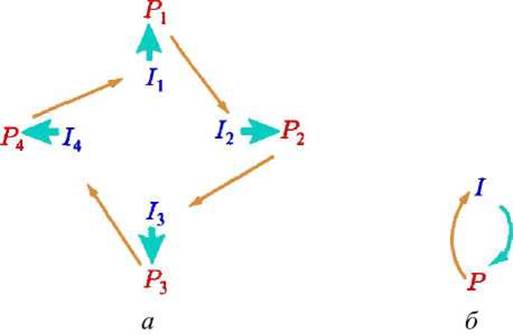
Figure 38 - Hypercycle schemes: a - complex; b - simplest
In a protein consisting of n Amino Acids, the total amount of information is given by: 7 = log220n. For n = 200, I = 860 bits. This value of 7 corresponds to The amount of valuable information in the case where all residues in the protein are fixed (i.e., occupy a specific position), such as in Histones.
In most functional proteins, not all residues need to be fixed. For instance, the replacement of many residues with alternative yet analogous ones—such as those with identical Hydrophobicity (conservative mutations)—does not lead to a loss of function. Consequently, the amount of valuable information ensuring the function of an enzyme protein is generally smaller. For example, the amount of valuable information in the Bacteriorhodopsin protein is 130 bits. The valuable information in polynucleotides should be of the same order of magnitude.
For a rough estimate, let us assume that the amount of valuable information in an average protein is 100 bits.
The amount of valuable information in a system consisting of m different proteins is, accordingly, m times greater. In a modern protein biosynthesis hypercycle, more than a hundred polymers are involved. Therefore, the total amount of valuable information for the entire system is approximately 100-100 = 10000 bits.
The probability of the spontaneous and simultaneous emergence of the entire system is W ≈ 2-10000 ≈ 10-3300. This value is absurdly small.
The point is that any physical quantities (length, mass, time interval, number of particles) in our world are neither infinitely large nor infinitely small.
For example, our Universe is believed to have originated about 14 billion years ago, meaning that "only" on the order of 4.4∙1017 seconds have elapsed since the Big Bang. Even if we take the period of thermal vibrations of atoms in a crystal lattice as our time scale (on the order of 10-12 seconds), "only" ~1030 vibrations have occurred throughout the lifetime of the Universe. By the way, the age of the Earth (as well as the Solar System) is estimated at 4.5 billion years (1.4∙1017 s). Life on Earth originated as early as the Archean eon—approximately 3.5 billion years ago (1017 s).
As another example, the mass of the observable part of the Universe is estimated at 8∙1052 kg (~1050 tons), which corresponds to 12.8∙1077 masses of carbon atoms (or ~1079 masses of hydrogen atoms).
It is generally accepted that all "reasonable" values of physical quantities are expressed by numbers ranging from 10-100 to 10+100. In this regard, the American mathematician Edward Kasner introduced a new concept in 1938—the "googol"—equal to 10+100, such that no physical quantity can exceed a googol in value. The word googol itself, as a name for a number followed by one hundred zeros, was coined by Edward Kasner's nine-year-old nephew, Milton Sirotta, during a walk with his uncle while discussing large numbers.
Accordingly, the " reciprocal googol" refers to the number 10-100. Although formally a finite quantity, the reciprocal googol should practically be treated as an infinitely small quantity. In particular, the question of how a function behaves within an interval on the order of a reciprocal googol is meaningless. The function over such an interval should be replaced by a number (its average over the interval), since any more detailed behavior is fundamentally unobservable.
By the way, the name of the internet search engine Google was coined based on the word "googol".
Thus, the spontaneous emergence of the biosynthesis machinery in its current form is utterly impossible. However, the modern form of the biosynthesis hypercycle appeared as a result of about 3 billion years of evolution, during which the initial, simplest hypercycle was refined and complicated. At the same time, while the early stages involved the chemical copying of molecules, The final stage of the Evolution of the translation machinery saw the selection of a unified copying code—what we observe today as the universal genetic code on Earth. The selection of a single code took place after the formation (and competition) of several distinct populations of hypercycles with various code variants. The variant selected in this manner gradually displaced all other variants of genetic coding.
Review Questions and Exercises
1. Formulate a Definition of the concept of "information" that is most adequate for biological Applications.
2. Why is there no single definition of the concept of "information" that applies across all sciences?
3. Write down Shannon's formula and explain the meaning of the parameters included in it.
4. Illustrate the difference between The concepts of "amount of information" and "value of information" using an arbitrary sentence.
5. What is the fixability of information?
6. What is the invariance of information?
7. What is the transience of information?
8. What is information Variability?
9. What is information translatability?
10. What is information replicability?
11. What is information multiplicativity?
12. What is information effectiveness?
13. What is an operator generated by information?
14. What is information semantics?
15. What is information multipotency?
16. What is information utility?
17. What is information veridicality?
18. What is the value of information? How does it manifest itself? How is the measure of information value determined?
19. What is information reception? What are the two distinct modes of reception?
20. How does information storage (memorization) take place?
21. What is the difference between macroinformation and microinformation?
22. What is the Eigen hypercycle? How is it structured?
23. What are a googol and a reciprocal googol? Where are they used?
24. Estimate the amount of information contained in the protein biosynthesis hypercycle?
Last update: 11/08/2026
Editorial and Educational Adaptation: This material has been compiled based on the primary/original source text. The project team performed an editorial review, corrected technical inaccuracies, structured sections, and adapted the content for an educational format.
What was processed:
- elimination of formatting defects (OCR errors, structural breaks, corrupted characters);
- editorial organization of content;
- standardization of terminology in accordance with academic sources;
- verification of factual statements against the original source text.
All mentions of the author, publication year, and origin of the primary text have been preserved in accordance with the source.