Principles of Biochemistry, Volume 1 - A. Lehninger 1985
Biomolecules
Water
The properties of acids and bases are closely related to the properties of water.
The molecules of hydrochloric, sulfuric, and nitric acids, commonly referred to as strong acids, are completely ionized in dilute aqueous solutions. Similarly, molecules of strong bases such as NaOH and KOH are also fully ionized.
In biology, we more frequently encounter weak acids and weak bases, which do not ionize completely when dissolved in Water. An example of a weak acid is acetic acid (СН3СООН), which gives vinegar its sour taste; an example of a weak base is ammonia (NH3), an aqueous solution of which is used as a household cleaner. Weak acids and bases are common components of biological systems, playing a vital role in METABOLISM and its regulation. The behavior of aqueous solutions of weak acids and bases is much easier to understand if we first establish precise Structure/97.html">Definitions for a few terms.
Acids can be defined as proton Donors, and bases as proton acceptors. A proton donor and its corresponding proton acceptor form a conjugate acid-base pair (Table 4–3). An example of a conjugate acid-base pair is acetic acid (СН3СООН), which acts as a proton donor, and the acetate anion (СН3СОО-), which Functions as a proton acceptor; they are interconverted by the following reversible reaction:
Class="center">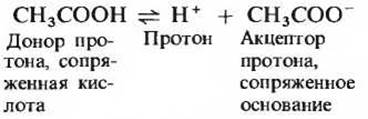
Table 4-3. Some conjugate acid-Base Pairs. Each pair consists of a proton donor and a proton acceptor
|
Proton donor |
Proton acceptor |
|
СН3СООН |
СН3СОО- |
|
Н3РО-4 |
Н2РО2-4 |
|
NH+4 |
КН3 |
A characteristic feature of any acid is its tendency in aqueous solution to dissociate a proton. The stronger the acid, the greater this tendency. The ability of any acid HA to release a proton and form its conjugate base A- is characterized by the Equilibrium Constant of the reversible reaction

equal to
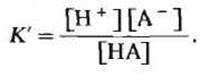
The equilibrium constants for such reactions are more commonly referred to as ionization constants or dissociation constants. Numerical values of the dissociation constants for several acids, frequently designated by the symbol K'a (where the subscript "a" stands for acid), are listed in Table 4–4. Note that these acids differ widely in their proton-donating ability. Stronger acids, such as formic or lactic acid, have higher dissociation constants, whereas weaker acids, such as the Н2РO-4 ion, exhibit lower values. One of the weakest acids listed in Table 4–4 is the NH+4 ion, which has a very weak tendency to release a proton, as reflected by its exceptionally low dissociation constant. Conversely, the conjugate base of this acid, ammonia (NH3), readily accepts a proton.
Table 4-4. Dissociation constants and pK' values of some common acids at 25°C
|
Acid (proton donor) |
K', M |
РК' |
|
НСООН (formic acid) |
1,78 x 10⁻⁴ |
3,75 |
|
СН3СООН (acetic acid) |
1,74 x 10⁻⁵ |
4,76 |
|
СН3СН2СООН (propionic acid) |
1,35 x 10⁻⁵ |
4,87 |
|
СН3СНОНСООН (lactic acid) |
1,38 x 10⁻⁴ |
3.86 |
|
Н3РO4 (phosphoric acid) |
7,25 x 10⁻³ |
2,14 |
|
Н2РO4 (dihydrogen phosphate ion) |
1,38 x 10⁻⁷ |
6,86 |
|
HPO2-4 (monohydrogen phosphate ion) |
3,98 x 10⁻¹³ |
12,4 |
|
Н2СO3 (carbonic acid) |
1,70 x 10⁻⁴ |
3,77 |
|
НСО3 (bicarbonate ion) |
6,31 x 10⁻¹¹ |
10,2 |
|
NH+ (ammonium ion) |
5,62 x 10⁻¹⁰ |
9,25 |
Table 4-4 lists the pK' values determined by the equation
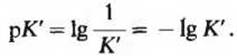
The symbol p, just as in the case of pH, denotes the negative logarithm. The more readily an acid dissociates, the lower its pK' value. As we will soon see, determining the pK' of any weak acid is a straightforward task.
Last update: 06/08/2026
Editorial and Educational Adaptation: This material has been compiled based on the primary/original source text. The project team performed an editorial review, corrected technical inaccuracies, structured sections, and adapted the content for an educational format.
What was processed:
- elimination of formatting defects (OCR errors, structural breaks, corrupted characters);
- editorial organization of content;
- standardization of terminology in accordance with academic sources;
- verification of factual statements against the original source text.
All mentions of the author, publication year, and origin of the primary text have been preserved in accordance with the source.