Basics of Evolution - Korzh O.P. - 2006
Part III. PATHS OF LIFE'S DEVELOPMENT
Chapter 19. Main Directions in the Evolution of Living Organisms
19.4. The Origin of the Seed as a Milestone in the Evolution of Higher Plants
Rhyniophytes gave rise to lycophytes, horsetails, and ferns, which proved to be better adapted to terrestrial life. These plants featured significant evolutionary advancements compared to their ancestral forms: they developed a typical Vascular System, and ferns even acquired true leaves and roots. Their main vulnerability, however, remained their mode of
reproduction, which still required an aqueous environment because, much like in rhyniophytes, male Gametes had to swim to the archegonia for Fertilization. The Morphology/12.html">ALTERNATION OF GENERATIONS (sporophyte — gametophyte) was also preserved, although the gametophyte underwent significant reduction (forming the so-called prothallium).
With the onset of arid conditions during the Permian period and subsequently the Triassic (about 300 million years ago), a mass extinction began of plants whose fertilization depended on Water. At this juncture, seed plants entered the evolutionary arena (Fig. 19.7), accomplishing this process independently of liquid water (an aromorphic trait).
Class="center">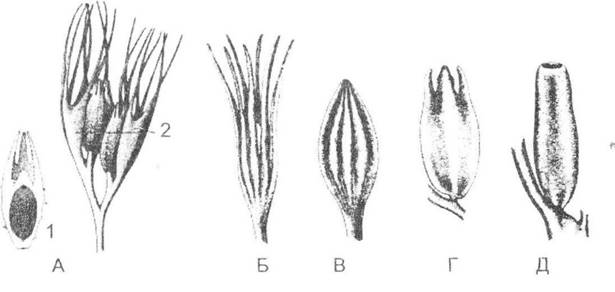
Fig. 19.7. Seed-like structures of Paleozoic plants (from P. Raven, R. Evert, and S. Eichhorn, 1990):
A - Archeosperma arnoldii; B - Genomosperma kidstonii; C - G. lateens; D - Euristoma angulare; E - Stamnostoma huttonense;
1 - Location OF THE megaspore within the seed; 2 - cupules (cup-shaped structures enclosing the megasporangia). One can observe the gradual replacement of finger-like outgrowths (B) by integumentary lobes that eventually fuse completely (E)
All seed plants, like certain ferns, are heterosporous. They produce Two Types of spores: microspores (male) and megaspores (female), which give rise to the male and female gametophytes, respectively. However, in seed plants—unlike seedless plants—the single mature megaspore is retained within the megasporangium, where The Development of the female gametophyte and fertilization take place.
Because a seed possesses a protective coat enclosing an embryo and nutrients to support its development, it represents a vastly more effective means of reproduction than spores.
Internal fertilization, the Development of the embryo inside the ovule, and The Emergence of a highly efficient reproductive unit—the seed—constitute the major biological milestones of seed plants. These innovations enabled the latter to adapt far better to terrestrial conditions and assume a dominant role in the plant kingdom.
Gymnosperms differ substantially from spore-producing plants in both gametophyte development and the fertilization process itself. In all gymnosperms, the female gametophyte develops entirely inside the megasporangium and never comes into contact with the air. Access to it is restricted to the micropyle, creating optimal conditions to protect the female gametophyte from desiccation. As a result, the female gametophyte and its archegonium undergo progressive reduction and simplification, accompanied by the early Formation of the egg Cell.
The male gametophyte also becomes simplified, and its development is greatly accelerated. Unlike in ferns, the first nuclear division of the microspore in gymnosperms occurs while still inside the microsporangium. The male gametophyte achieves its final development on the megasporangium, upon which it depends parasitically. It has completely lost antheridia.
The emergence of gymnosperms was preceded by several key evolutionary events that occurred mainly during the Devonian. In the reproductive sphere, this involved the establishment of heterospory (heterosporous forms are known as far back as the Middle Devonian—about 400 million years ago). The vegetative Structure of plants also underwent changes: approximately at this time, the cambium arose, enabling Secondary Growth, which was soon followed by the appearance of arborescent (woody) forms.
Since the first gymnosperms emerged around 370 million years ago, they cannot be derived directly from true ferns (which existed concurrently, and some of which surpassed primitive gymnosperms in organizational complexity). Consequently, the direct ancestors of gymnosperms should be sought among primitive pteridophytes—heterosporous, woody forms characterized by secondary growth.
Last update: 07/08/2026
Editorial and Educational Adaptation: This material has been compiled based on the primary/original source text. The project team performed an editorial review, corrected technical inaccuracies, structured sections, and adapted the content for an educational format.
What was processed:
- elimination of formatting defects (OCR errors, structural breaks, corrupted characters);
- editorial organization of content;
- standardization of terminology in accordance with academic sources;
- verification of factual statements against the original source text.
All mentions of the author, publication year, and origin of the primary text have been preserved in accordance with the source.