Principles of Biochemistry Volume 3 - A. Lehninger 1985
Molecular Mechanisms of Genetic Information Transfer
DNA: Structure of Chromosomes and Genes
What are the sizes of genes?
It is theoretically possible to calculate the approximate dimensions of genes. We have already seen that the double-stranded DNA molecule of E.
Class="center">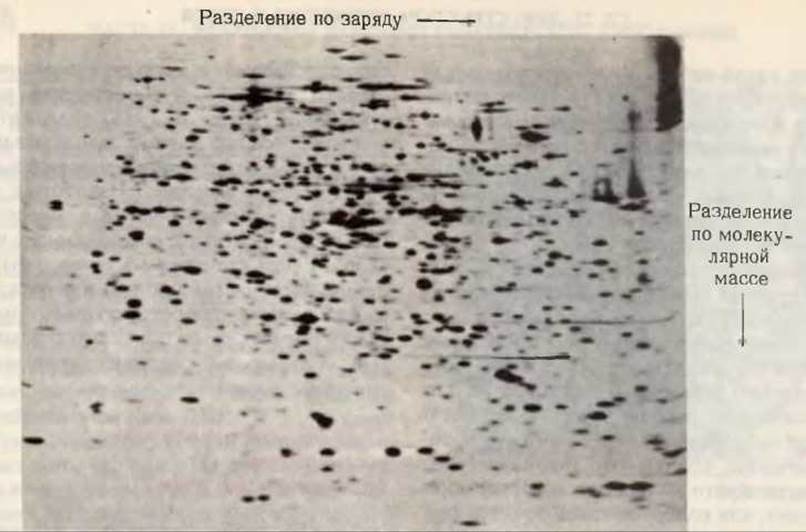
Fig. 27-25. Fractionation of E. coli Proteins.
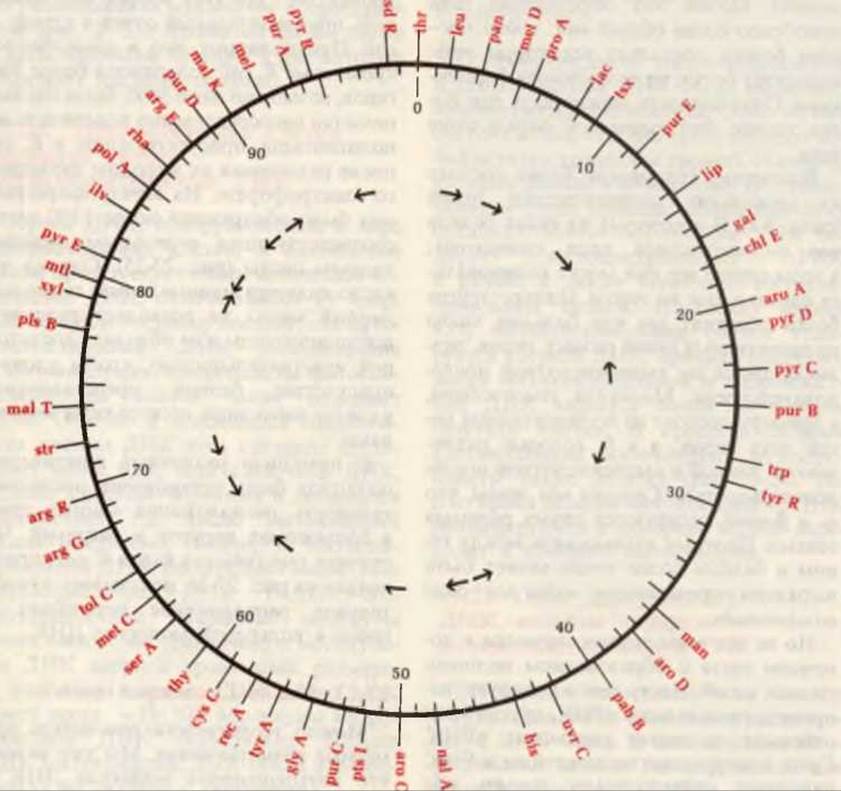
Fig. 27-26. Circular chromosome map of E. coli K12. The outer circle shows the conventional names of 52 genes whose relative positions on the chromosome are precisely known; they serve as reference points for mapping other genes. The numbers inside the circle correspond to the time (in minutes) required for The transfer of the male chromosome into the female Cell during E. coli sexual conjugation. The thr Gene is chosen as the zero point. Arrows indicate the direction of penetration of the male chromosome into The Cell. Out of the 3,000 E. coli genes, about 1,000 have been mapped to date.
The photograph shows a two-dimensional chromatogram of The polypeptide chains present in an E. coli extract. Over 1,100 different Polypeptides can be detected on the chromatogram. There are likely significantly more in the extract, but not all of them are resolved. Attempts are currently underway to separate and count all polypeptides present in various human Cells.
coli consists of approximately 4 ∙ 106 nucleotide pairs. Assuming this bacterium contains 3,000 genes, the average size of each would be (4 ∙ 106) : 3000 ≈ 1300 nucleotide pairs. This is probably an overestimate, as it does not account for the presence of DNA signals, intergenic spacers, and other DNA regions of yet unknown function.
Gene sizes can also be estimated approximately by a more direct method. It is now well established that each amino acid in a polypeptide chain is encoded by a short sequence of three consecutive NUCLEOTIDES in one of the strands of prokaryotic DNA (Fig. 27-27). Because METABOLISM/28.html">The Genetic Code is comma-free, the DNA-coding triplets are arranged sequentially in accordance with the Amino Acid Sequence of the encoded polypeptide. Figure 27-27 illustrates the principle determining the structural sequence-based relationship between DNA, RNA, and protein. Since a single polypeptide chain can contain from 50 to 2,000 (or even more) amino acid residues (Section 6.5), a gene encoding such a polypeptide chain must accordingly consist of 150 to 6,000 (or more) nucleotide residues. Assuming that an average protein polypeptide chain contains 350 residues, it corresponds to an average gene comprising 1,050 nucleotide pairs; in other words, the four million nucleotide pairs contained in E. coli DNA are sufficient to encode (4 ∙106) : 1050 ≈ 3800 genes.
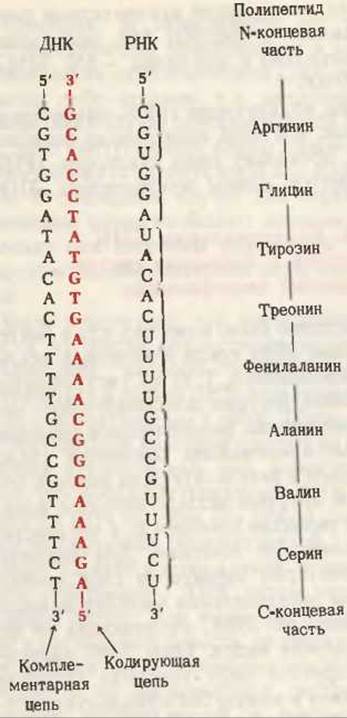
Fig. 27-27. Colinearity of DNA and mRNA nucleotide sequences and The amino acid sequence of polypeptide chains. DNA nucleotide triplets determine the amino acid sequence in a protein; this process is mediated by mRNA, whose nucleotide triplets (codons) are complementary to the triplets of the coding DNA strand.
The fact that Base Pairs in a DNA double helix are spaced 0.34 nm apart (Section 27.6) allows us to calculate the length of an average polypeptide gene: 0.34 ∙ 1050 = 357 nm ≈ 0.36 µm. Since the Molecular Weight of a single nucleotide pair averages 650, the molecular weight of an average E. coli gene is ~ 650 ∙ 1050 = 680,000.
Genes encoding tRNAs are significantly smaller than those encoding polypeptides, because each nucleotide of tRNA is encoded by a nucleotide of DNA.
Last update: 06/08/2026
Editorial and Educational Adaptation: This material has been compiled based on the primary/original source text. The project team performed an editorial review, corrected technical inaccuracies, structured sections, and adapted the content for an educational format.
What was processed:
- elimination of formatting defects (OCR errors, structural breaks, corrupted characters);
- editorial organization of content;
- standardization of terminology in accordance with academic sources;
- verification of factual statements against the original source text.
All mentions of the author, publication year, and origin of the primary text have been preserved in accordance with the source.