Principles of Biochemistry Volume 1 - A. Lehninger 1985
Biomolecules
Enzymes
The amount of an enzyme can be determined by its activity
The amount of an enzyme in a given solution or tissue extract can be determined based on its catalytic activity. To do this, it is necessary to know: 1) the overall equation of the catalyzed reaction, 2) which analytical method is most suitable for determining substrate consumption or product formation, 3) whether the enzyme requires Cofactors such as Metal Ions or Coenzymes, 4) the dependence of enzyme activity on Substrate Concentration, i.e., the KM value for the given substrate, 5) the pH optimum of the enzyme, and 6) the Temperature range in which the enzyme is stable and highly active. Typically, enzyme activity is measured at the optimal pH, at a specific temperature convenient for one reason or another (usually in the range of 25 to 38 °C), and at a substrate concentration close to saturating. Under these conditions, the initial reaction rate is usually proportional to the Enzyme Concentration, at least within a given range of enzyme concentrations (Fig. 9-7).
Class="center">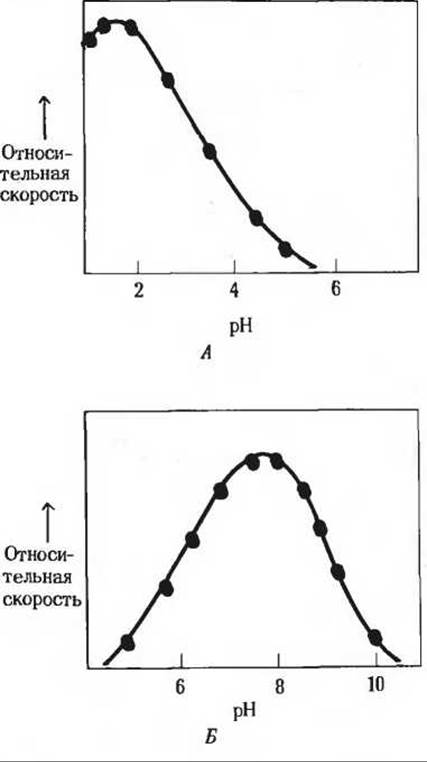
Fig. 9-6. Curves characterizing the dependence of enzyme activity on pH. Such curves are constructed based on data obtained by measuring the initial rates of reactions occurring in Buffer solutions with different pH values. A. Curve describing the pH dependence of Pepsin activity, which hydrolyzes specific peptide bonds in Proteins during their Digestion IN THE Stomach. The pH of gastric juice lies between 1 and 2. B. Curve describing the pH dependence of glucose-6-phosphatase activity from Liver Cells, which is responsible for the release of glucose into the Blood. Normally, the pH of the Cytosol of liver cells is about 7.2.
By international agreement, one unit of enzyme activity is defined as the amount of enzyme that catalyzes The conversion of 1 µmol of substrate (1 µmol = 10-6 mol) in 1 min at 25 °C under optimal conditions of enzyme action. Specific activity is defined as the number of units of enzymatic activity per milligram of protein. Specific activity is a measure of the purity of an enzyme preparation: it increases during Enzyme Purification and becomes maximal and constant when the enzyme is in a pure state.
The turnover number of an enzyme is defined as the number of substrate molecules converted per unit of time per enzyme molecule (or Active Site) under conditions where the enzyme concentration is the sole rate-limiting factor (Table 9-6). Carbonate dehydratase (Carbonic anhydrase)—an important enzyme present in high concentrations in red Blood Cells—is one of the most active Enzymes, with a turnover number of 36,000,000 per minute per enzyme molecule. This enzyme catalyzes the reversible Hydration of carbon dioxide dissolved in Water to form carbonic acid (a reaction that proceeds very slowly in the absence of the enzyme)
CO2 + Н2O H2CO3.
Table 9-6. Turnover numbers of some enzymes (number of substrate molecules converted per minute at 20-38 °C)
|
Carbonic anhydrase |
36000000 |
|
β-Amylase |
1 100000 |
|
1 100000 |
12500 |
|
Phosphoglucomutase |
1 240 |

Figure 9-7. Quantitative DETERMINATION OF ENZYME Activity. This Procedure is carried out in three steps: 1) Determination of kM (Fig. 9-4 and Box 9-2), 2) measurement of initial velocities (A) at various enzyme concentrations and at a substrate concentration near saturation, for example, at a concentration equal to 10∙KM,
3) plotting a graph (B) with enzyme concentration on the abscissa and initial velocity on the ordinate. Using the linear portion of the curve, one can determine the amount of enzyme in an unknown sample that yields a given initial velocity. In this example, the unknown sample gives an initial velocity of 2.5 μmol/min and contains 5.8 units of enzyme activity.
Hydration of CO2 in erythrocytes is an important step in The transport of CO2 from the Tissues where it is produced to the Lungs, where it is released and exhaled into the environment (Sec. 4.11, Ch. 24).
Last update: 06/08/2026
Editorial and Educational Adaptation: This material has been compiled based on the primary/original source text. The project team performed an editorial review, corrected technical inaccuracies, structured sections, and adapted the content for an educational format.
What was processed:
- elimination of formatting defects (OCR errors, structural breaks, corrupted characters);
- editorial organization of content;
- standardization of terminology in accordance with academic sources;
- verification of factual statements against the original source text.
All mentions of the author, publication year, and origin of the primary text have been preserved in accordance with the source.