Human Biochemistry Volume 2 - Murray R. 1993
Special Topics
Nutrition, Digestion, and Absorption
Digestion in the Oral Cavity
Digestive Action of Saliva
Saliva, secreted by the Salivary Glands, consists of 99.5% Water. It acts as a lubricant during chewing and swallowing. Adding water to dry food creates a medium for dissolving food particles and initiating the digestive action of Hydrolases. Chewing comminutes the food, increases its solubility, and enlarges the surface area exposed to enzymatic action. Salivary secretion is an active process triggered by membrane K+-ATPase, which, unlike Na+/K+-ATPase, is insensitive to ouabain. HCO-3 enters the plasma in exchange for Cl-, and this process is coupled with the secretion of H+ into the gastric lumen.
Class="center">Table 53.9. Major Trace Elements. Main Properties
|
Elements |
Deficiency Disease or Symptoms |
Toxicity Disease or Symptoms1) |
Source2) |
||
|
Chromium |
Trivalent chromium is a component of the "glucose tolerance factor" |
Impaired glucose tolerance; secondary symptoms during parenteral Nutrition |
|||
|
Cobalt |
Component of vitamin B12 |
Same as for vitamin B12 |
Vitamin B12 deficiency |
Animal products |
|
|
Copper |
Oxidases: cytochrome c oxidase, ferroxidase, etc. |
Transported by albumin; bound to ceruloplasmin |
Anemia (hypochromic, microcytic); occurs in malnutrition, Menkes syndrome |
Rarely observed; associated with Wilson's disease |
|
|
Iodine |
Thyroxine, triiodothyronine |
Stored in The Thyroid Gland as part of thyroglobulin |
Children: cretinism Adults: goiter and hypothyroidism, Myxedema |
Thyrotoxicosis, goiter |
Iodized salt, seafood |
|
Iron |
Heme-containing Enzymes (Hemoglobin, Cytochromes, etc.) |
Transported as transferrin; stored as ferritin or hemosiderin; lost via desquamated Cells and bleeding |
Anemia (hypochromic, microcytic) |
Siderosis; hereditary hemochromatosis |
Cookware |
|
Manganese |
Hydrolases, Decarboxylases, and transferases. Synthesis of Glycoproteins and Proteoglycans |
Unknown in humans |
Inhalation poisoning causes psychiatric symptoms and parkinsonism |
||
|
Molybdenum |
Oxidases (xanthine oxidase) |
Occurs during parenteral nutrition |
|||
|
Selenium |
Glutathione peroxidase |
Synergistic antioxidant with vitamin E |
Certain deficiency symptoms associated with low soil content; occur during parenteral nutrition, protein-energy malnutrition |
High doses cause alopecia, dermatitis, and irritability |
|
|
Zinc |
Cofactor of many enzymes: Lactate dehydrogenase, alkaline phosphatase, Carbonic anhydrase, etc. |
Hypogonadism, growth retardation, impaired wound healing, decreased taste and smell acuity; secondary symptoms in acrodermatitis enteropathica, parenteral nutrition |
Gastrointestinal irritation, vomiting |
||
|
Fluoride3) |
Increases bone and tooth hardness |
Dental caries; Osteoporosis(?) |
Dental fluorosis |
Drinking water |
Upon contact with HCl, Proteins in The Stomach are denatured, losing their tertiary Structure As a result of Hydrogen bond disruption. This causes unwinding of the polypeptide chain and increases protein accessibility to Proteolytic Enzymes (proteases). Low pH also destroys most microorganisms entering the gastrointestinal tract.
B. Pepsin. The primary digestive function of the stomach is to initiate Protein Digestion. Pepsin is produced by chief cells as an inactive zymogen, pepsinogen. Pepsinogen is activated into pepsin by H+ ions, which cleave off a protective polypeptide to "unmask" active pepsin, as well as by pepsin itself, which triggers rapid activation of additional pepsinogen molecules (autocatalysis). Pepsin converts denatured protein into proteoses and then into peptones—large polypeptide derivatives. It is an endopeptidase because it hydrolyzes peptide bonds within the main polypeptide backbone rather than at the N- or C-terminal sequences, which is characteristic of exopeptidases. Furthermore, the enzyme specifically attacks peptide bonds formed involving aromatic Amino Acids (e.g., Tyrosine) or dicarboxylic amino acids (e.g., glutamate).
C. Rennin (chymosin). This enzyme causes milk to curdle. It is extremely crucial for digestive processes in infants, as it prevents milk from leaving the stomach too rapidly. In the presence of calcium, rennin causes irreversible changes in milk casein, converting it to paracasein, which is then acted upon by pepsin. Rennin appears to be absent in the adult human stomach. It is widely used in cheese production.
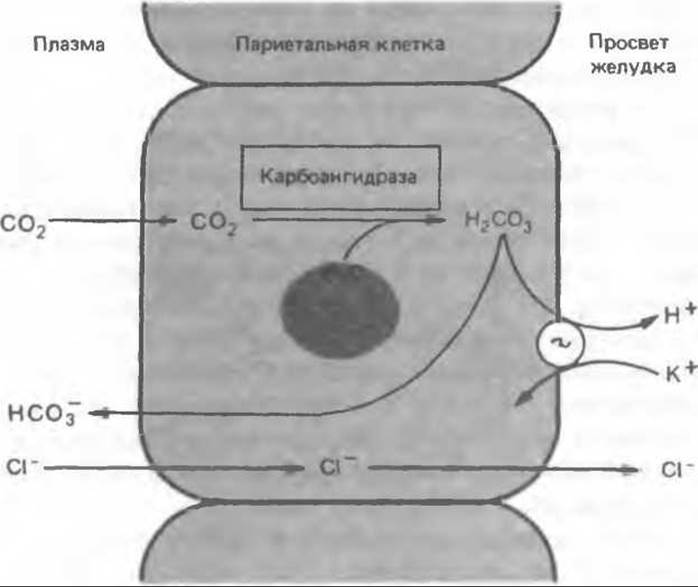
Fig. 53.1. Hydrochloric acid production in the stomach. ~, K +-ATPase.
D. Lipase. The warm environment of the stomach is important for liquefying the bulk of dietary Lipids; emulsification takes place, facilitated by peristaltic contractions of the stomach. Although a lipase capable of hydrolyzing short- or medium-chain triacylglycerols is present in the stomach, the lipolytic action of gastric juice does not play a significant physiological role. At the same time, lingual lipase activity can persist in the stomach at low pH for 2–4 hours and is capable of digesting approximately 30% of dietary triacylglycerols. Lingual lipase is more active against triacylglycerols containing short-chain Fatty acids and exhibits greater Specificity in attacking the ester bond at the sn-3 position than at position 1. Milk fat contains short- and medium-chain fatty acids that tend to be esterified at the sn-3 position. Thus, milk fat represents an exceptionally good substrate for this enzyme. The released hydrophilic short-chain Fatty acids are absorbed by the gastric wall and enter the portal vein, whereas long-chain fatty acids dissolve in fat droplets.
Last update: 06/08/2026
Editorial and Educational Adaptation: This material has been compiled based on the primary/original source text. The project team performed an editorial review, corrected technical inaccuracies, structured sections, and adapted the content for an educational format.
What was processed:
- elimination of formatting defects (OCR errors, structural breaks, corrupted characters);
- editorial organization of content;
- standardization of terminology in accordance with academic sources;
- verification of factual statements against the original source text.
All mentions of the author, publication year, and origin of the primary text have been preserved in accordance with the source.