Biochemistry - The Chemical Reactions of Living Cells Volume 2 - D. Metzler 1980
Coenzymes - specialized natural reagents
Keto acids and other unusual electrophilic centers
Decarboxylases
Some Enzymes that would seemingly be expected to have Pyridoxal phosphate in their active sites actually contain bound $\alpha$-keto acids instead. We will examine these and several presumably related enzymes with unusual Functions in this section.
In certain biological species, Histidine [56] and S-adenosylmethionine [57] decarboxylases contain a covalently bound keto acid within their active sites. These enzymes are inhibited by carbonyl Reagents and borohydride. When 3H-labeled borohydride was used to reduce
Class="center">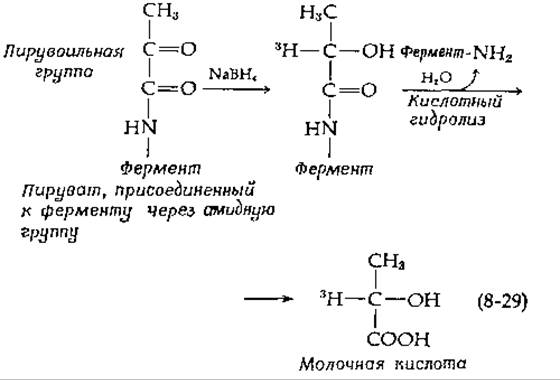
Reduction with borohydride in the presence of histidine leads to The formation of a covalent bond between this substrate and the bound Pyruvate. Thus, similarly to PLP-containing decarboxylases, a Schiff base is formed with the substrate. Decarboxylation apparently utilizes the ability of the amide carbonyl group to act as an electron sink [equation (8-30)].
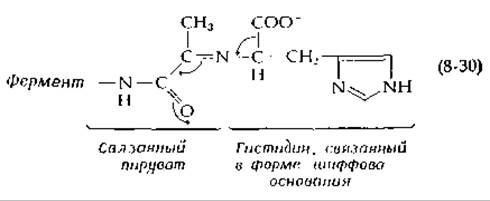
When microorganisms producing histidine decarboxylase were grown on a medium containing 14C-labeled Serine, 14C was incorporated into the bound pyruvoylic group. Thus, Serine serves as the precursor for the bound pyruvate. The enzyme is synthesized by the Cells as a longer proenzyme with a Molecular Weight of ~37,000, which is then cleaved into two polypeptide chains. One polypeptide, with a molecular weight of ~28,000, contains an N-terminal pyruvoyl residue, while the other, with a molecular weight of ~9,000, contains a C-terminal serine [58]. Activation proceeds spontaneously upon incubation of the proenzyme for 24–48 hours at pH 7 and 37°C. Substituted serine residues in a mildly alkaline environment readily undergo $\alpha,\beta$-elimination to yield dehydroalanine residues. The conversion of the proenzyme into active histidine decarboxylase could occur via such an elimination followed by selective hydrolysis [equation (8-31)] [58].
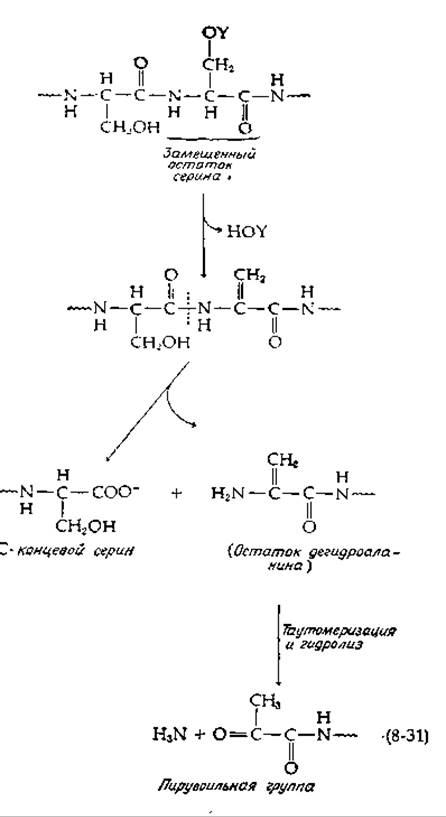
This histidine decarboxylase is also unusual in that the enzyme molecule contains 5 subunits each of the 9,000- and 28,000-molecular-weight chains and exhibits fivefold rotational Symmetry. The proenzyme is likewise a pentamer.
Last update: 06/08/2026
Editorial and Educational Adaptation: This material has been compiled based on the primary/original source text. The project team performed an editorial review, corrected technical inaccuracies, structured sections, and adapted the content for an educational format.
What was processed:
- elimination of formatting defects (OCR errors, structural breaks, corrupted characters);
- editorial organization of content;
- standardization of terminology in accordance with academic sources;
- verification of factual statements against the original source text.
All mentions of the author, publication year, and origin of the primary text have been preserved in accordance with the source.