Harper's Illustrated Biochemistry, Volume 1 - Murray R. 1993
Structure and Function of Proteins and Enzymes
Enzymes: Mechanism of Action
Metal Ions
Over 25% of all Enzymes contain tightly bound metal ions or are active only in their presence. To study the Functions of metal ions, Methods such as X-ray crystallography, nuclear magnetic Resonance (NMR), and electron paramagnetic resonance (EPR) are employed. Combined with data on the formation and breakdown of metal-containing complexes and Reactions Involving the coordination sphere of metal ions, the insights gained from these methods provide a deeper understanding of the Role of Metal ions in Enzymatic Catalysis. This role is discussed below.
Metalloenzymes and Metal-Activated Enzymes
Metalloenzymes contain a specific number of functionally important metal ions that remain bound to the enzyme molecule throughout purification. Metal-activated enzymes bind metals less tightly and require The addition of metals to the medium for their activity. Thus, the distinction between metalloenzymes and metal-activated enzymes is based on the affinity of a given enzyme for its specific metal ion. The mechanisms underlying the Involvement of metal ions in catalysis appear to be similar in both cases.
Enzyme–Metal–Substrate Ternary Complexes
For ternary (three-component) complexes comprising a catalytic center (Enz), a metal ion (M), and a substrate (S) with a 1:1:1 stoichiometry, four different formation pathways are possible:
Class="center">
In the case of metal-activated enzymes, all four pathways are realized. For metalloenzymes, The formation of an Enz—S—M complex is impossible; otherwise, they could not retain the metal during purification (they exist in the Enz—M form). Three general rules can be formulated:
1. Most (though not all) Kinases (ATP:phosphotransferases) form substrate-bridged complexes of the Enz—nucleoside—M type.
2. Phosphotransferases that use Pyruvate or phosphoenolpyruvate as a substrate, Other Enzymes catalyzing reactions involving phosphoenolpyruvate, as well as carboxylases, form metal-bridged complexes.
3. A given enzyme may be capable of forming a bridged complex of one type with one substrate and of another type with a different substrate.
Enzyme-Bridged Complexes (M—Enz—S)
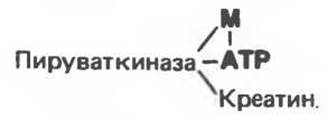
Metals in enzyme-bridged complexes appear to play a structural role by maintaining the active conformation (Glutamine Synthetase is an example) or by forming a bridge with another substrate (as in pyruvate kinase). In pyruvate kinase, the metal ion not only plays a structural role but also holds one of the substrates (ATP) and activates it:
Substrate-Bridged Complexes
The formation of substrate-bridged ternary complexes, observed during the interaction of enzymes with nucleoside triphosphates, appears to be associated with the displacement of H2O from the coordination sphere of the metal, which is then occupied by ATP

The substrate then binds to the enzyme to form a ternary complex:
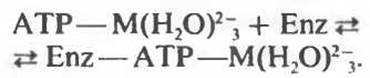
In phosphotransferase reactions, metal ions are believed to activate phosphorus atoms and form a rigid polyphosphate–adenine complex in the appropriate conformation, which is incorporated into the active four-component complex.
Metal-Bridged Complexes
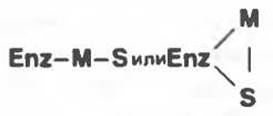
Crystallographic data and Primary Structure analysis indicate that in the active sites of many Proteins, a Histidine residue participates in metal binding (Examples include Carboxypeptidase A, cytochrome c, rubredoxin, metmyoglobin, and methemoglobin; see Chapter 6). The rate-limiting step in the formation of binary (two-component) Enz—M complexes in many cases is the displacement of Water from the coordination sphere of the metal ion. The metal-ion activation of many peptidases is a slow process lasting several hours. This slow reaction presumably consists of a conformational rearrangement of the Enz—M binary complex, leading to the Formation of the active conformation. This process can be represented as follows:
Metal binding:

Rearrangement to form the active conformation (Enz*):

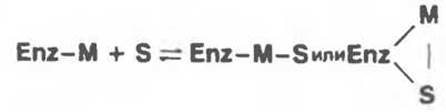
In the case of metalloenzymes, the formation of a ternary bridge-metal complex must proceed via the addition of a substrate to the binary complex:
The Role of Metals in Catalysis
Metal ions can participate in any of the four known mechanisms by which Enzymes accelerate chemical reactions: 1) general Acid-Base Catalysis; 2) Covalent Catalysis; 3) reactant approximation (proximity effect); 4) induction of strain in the enzyme or substrate. In addition to iron ions functioning in heme proteins, Mg2+, Мn2+, and Са2+ are most frequently involved in enzymatic catalysis, although other ions (such as K+) play an important role in the Introduction/43.html">Action of Certain enzymes.
Metal ions, much like protons, act as Lewis acids (electrophiles) and can form a δ-bond with their ligands through a shared electron pair. Metal ions can also be regarded as "superacids" because they are stable in neutral solution, frequently bear a positive charge (> 1), and are capable of forming π-bonds. Furthermore (unlike protons), metals can serve as a three-dimensional matrix that properly orients the catalytic groups of the enzyme or substrate.
Metal ions can function as electron acceptors, forming δ- or π-bonds and thereby activating electrophiles or nucleophiles (general acid-base catalysis). Metals can activate nucleophiles by donating electrons or by acting as nucleophiles themselves. The coordination sphere of the metal can facilitate the contact between the enzyme and the substrate (proximity effect) or induce a strained state in the enzyme or substrate via chelation. A metal ion can mask a nucleophile, preventing Side Reactions. Finally, it can provide stereochemical control over the course of the enzymatic reaction, as the coordination sphere of the metal can act as a three-dimensional template that holds the reacting groups in the required spatial orientation (Table 9.1).
Table 9.1. Examples illustrating the role of metal ions in the METABOLISM/10.html">Mechanism of enzyme Action1)
|
Enzyme |
Role of the metal ion |
|
Histidine deaminase |
Masking of the nucleophile |
|
Kinases, lyases, pyruvate decarboxylase |
Activation of the electrophile |
|
Activation of the nucleophile |
|
|
Cobamide enzymes |
Metal acts as a nucleophile |
|
Pyruvate carboxylase, carboxypeptidase, Alcohol dehydrogenase |
Removal of π-electrons |
|
Metal serves as a donor of π-electrons |
|
|
Pyruvate kinase, pyruvate carboxylase, adenylate kinase |
Metal ion binds ligands and orients them relative to each other |
|
Phosphotransferase, D-xylose isomerase, Hemoproteins |
Induction of a strained state |
1) Adapted from Mildvan A. S.: Metals in enzyme catalysis. Vol. 2, p. 456 in: Enzymes, Boyer P. D., Lardy H., Myrbäck К. (editors). Academic Press, 1970.
Crane F. Hydroquinone dehydrogenases, Annu. Rev. Biochem., 1977, 46, 439.
Fersht A. Enzyme Structure and Mechanism, 2nd ed., Freeman, 1985.
Kraut J. Serine proteases: Structure and mechanism of catalysis, Annu. Rev. Biochem., 1977, 46, 331.
Mildvan A. S. Mechanism of enzyme action, Annu. Rev. Biochem., 1974, 43, 357.
Purich D. L. (ed.) Enzyme kinetics and mechanisms. Parts A and B. In: Methods in Enzymology, Vol. 63, 1979; Vol. 64, 1980, Academic Press.
Wimmer M.J., Rose I. A. MECHANISMS OF ENZYME-catalyzed group transfer reactions, Annu. Rev. Biochem., 1978, 47, 1031.
Wood H.G., Barden R.E. Biotin enzymes, Annu. Rev. Biochem., 1977, 46, 385.
Last update: 06/08/2026
Editorial and Educational Adaptation: This material has been compiled based on the primary/original source text. The project team performed an editorial review, corrected technical inaccuracies, structured sections, and adapted the content for an educational format.
What was processed:
- elimination of formatting defects (OCR errors, structural breaks, corrupted characters);
- editorial organization of content;
- standardization of terminology in accordance with academic sources;
- verification of factual statements against the original source text.
All mentions of the author, publication year, and origin of the primary text have been preserved in accordance with the source.