Protein Chemistry - Part 1 - General Protein Chemistry - Ashmarin, I. P. 1968
Chemical Composition of Proteins
Chemical Reactions of Amino Acids
Reactions Involving the Simultaneous Participation of $\alpha$-Amino and $\alpha$-Carboxyl Groups
Ninhydrin reaction. The most important method for detecting Amino Acids on chromatograms and in solution is their reaction with ninhydrin, which proceeds upon heating with the release of gaseous CO2, ammonia, and an aldehyde.
If the pH of the reaction medium exceeds 4, a deep blue color develops, the intensity of which can be measured colorometrically. The color formation is due to the fact that the ammonia produced in The First stage of the reaction interacts with the reduction product of ninhydrin and a second ninhydrin molecule, resulting in The formation of a blue-violet complex (known as "Ruhemann's purple"):
Class="center">
The reaction of aspartic acid with ninhydrin releases two molecules of carbon dioxide. Proline and hydroxyproline yield a yellow color and do not produce ammonia.
Formation of diketopiperazines. Amino acids readily lose Water to form anhydride-like derivatives, which differ for $\alpha$- and $\gamma$-amino acids. When one water molecule is eliminated from two $\alpha$-amino acid molecules, a partial anhydride—a dipeptide—is formed, whereas the elimination of two water molecules yields full anhydrides, which are cyclic compounds termed diketopiperazines:

The formation of such rings served as the basis for the diketopiperazine theory of Cell/13.html">Protein Structure, which was proposed in 1914 by N. D. Zelinsky and subsequently developed by his students, V. S. Sadikov and N. N. Gavrilov. According to this theory, a protein molecule consists of interconnected microstructures built from cyclic groupings with attached tri- and tetrapeptide side chains. Modern data indicate that diketopiperazines are formed during Protein Hydrolysis. Consequently, most researchers do not consider the diketopiperazine theory of protein structure to be experimentally proven.
$\gamma$-Amino acids readily eliminate water to form internal anhydrides—cyclic compounds known as lactams:
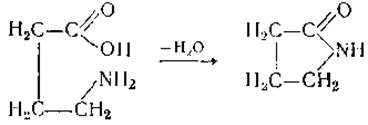
Metal complexes. When an amino acid in an aqueous solution is treated with copper carbonate or acetate, the solution turns blue, and beautiful blue crystals precipitate upon evaporation. The compounds formed in solution are likely complexes in which copper is bonded not only to the carboxyl group but also to nitrogen via secondary valency bonds. The formation of such complexes can be represented as follows:

The preparation of copper complexes is used to mask $\alpha$-amino groups during certain reactions (for example, in the Acetylation of the $\varepsilon$-amino group of Lysine), in the Quantitative determination of amino acids by polarographic and radiometric Methods, and for other purposes.
Last update: 06/08/2026
Editorial and Educational Adaptation: This material has been compiled based on the primary/original source text. The project team performed an editorial review, corrected technical inaccuracies, structured sections, and adapted the content for an educational format.
What was processed:
- elimination of formatting defects (OCR errors, structural breaks, corrupted characters);
- editorial organization of content;
- standardization of terminology in accordance with academic sources;
- verification of factual statements against the original source text.
All mentions of the author, publication year, and origin of the primary text have been preserved in accordance with the source.