Biochemistry in Tables, Schemes and Graphs - S.D. Zhamsaranova 2009
Enzymes
Mechanism of Enzyme Action
The initial event in enzyme action is its specific binding to a Ligand, namely the substrate (S). This occurs within the Active Site, which is formed by several specific amino acid R-groups oriented in space in a precise manner.
Enzymatic reactions are multi-step processes.
At The First stage, an induced complementary fit is established between the enzyme and the substrate. As a result, an enzyme-substrate complex (ES) is formed, within which the subsequent chemical transformation of the substrate takes place, yielding a product and leading to a decrease in complementarity. Following product dissociation, the enzyme returns to its original state.
Class="center">
MECHANISM OF ACTION and conformation of the Active Site of the digestive enzyme Elastase (a Serine protease) involved in the Hydrolysis of Polypeptides.

In the first stage, the carbonyl group of the peptide to be cleaved is attacked by the oxygen atom of the serine hydroxyl group. The proximity of the protonated imidazole ring of Histidine—whose protonation is maintained by the nearby carboxyl group of an aspartate residue—significantly enhances the Stability of the ionized form of the serine hydroxyl residue (due to electrostatic charge-attraction energy). In a substantial fraction of the enzyme molecules, this hydroxyl exists as an anion, which dramatically increases its nucleophilic activity.

During the second catalysis stage, the intermediate ester formed earlier is hydrolyzed by the action of Water, freeing the active site for the next catalytic cycle.

As a result of the anionic attack, the peptide bond is cleaved; one portion of the peptide leaves the active site of the serine enzyme, while the other is transferred to the serine residue, forming an acyl-enzyme intermediate.

Kinetics of Enzymatic REACTIONS
MICHAELIS-MENTEN MODEL
Chemical equation for the simplest single-substrate reaction:

Here S stands for substrate, E for enzyme, ES for the enzyme-substrate complex, and P for product.

Dependence of the initial velocity of an enzymatic reaction on Substrate Concentration.
The higher the [S], the higher the reaction rate. This relationship is hyperbolic. The limiting value approached by the hyperbola is Vmax for the given reaction, which characterizes the maximum catalytic capacity of the enzyme:
Vmax is the limiting velocity that the reaction approaches as the substrate concentration is increased indefinitely.

Km is the substrate concentration required to bind half of the available enzyme and achieve half of the maximum velocity.
Km is the MICHAELIS CONSTANT. It is numerically equal to the substrate concentration at which the reaction rate is half of its maximum value. This reaction is described by the Michaelis-Menten Equation:
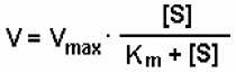
Km and Vmax are two kinetic constants used to characterize enzyme efficiency, including in vivo.
Effect of pH ON ENZYME REACTION VELOCITY

Dependence of enzyme activity on pH (activities are normalized to unity for ease of comparison). 1 — Pepsin, 2 — Ribonuclease, and 3 — arginase.
Last update: 06/08/2026
Editorial and Educational Adaptation: This material has been compiled based on the primary/original source text. The project team performed an editorial review, corrected technical inaccuracies, structured sections, and adapted the content for an educational format.
What was processed:
- elimination of formatting defects (OCR errors, structural breaks, corrupted characters);
- editorial organization of content;
- standardization of terminology in accordance with academic sources;
- verification of factual statements against the original source text.
All mentions of the author, publication year, and origin of the primary text have been preserved in accordance with the source.