Chemistry and Biology of Proteins - F. Haurowitz 1953
Proteins with Enzymatic Properties
Kinetics of Enzymatic Reactions
Recall that The rate of a reaction such as A → B + C depends on [A], the concentration of substance A, and that the rate of the reverse reaction B + C → A depends on [B] ∙ [C], the product of the concentrations of the reaction products. At equilibrium B + C ⇄ A, the forward reaction rate equals the reverse reaction rate. Consequently, we can write:
Class="center">
Similar reasoning applies to The formation of the enzyme-substrate complex. If we denote an enzyme molecule by E and a substrate molecule by S, the Formation of the enzyme-substrate complex can be represented by the following equation:
Е + S → ES.
The enzyme-substrate complex ES is unstable. It either undergoes the reverse reaction, ES → Е + S, dissociating back into its initial components, or it cleaves According to the equation ES → Е + Р, where Р is the reaction product. The rate of the catalyzed reaction depends primarily on [ES], the concentration of the enzyme-substrate complex. By analogy with the formula given above for the Equilibrium Constant, we can write in this case as well:

where K is the equilibrium constant of the reversible reaction Е + S ⇄ ES. However, this reaction is never truly reversible because the product of the ES reaction dissociates into the free enzyme E and reaction products P, according to the equation ES → Е + Р. The rate of this reaction is proportional to the concentration of ES; therefore, we can write v1 = k3 [ES], where vp is the rate of dissociation of the enzyme-substrate complex. Since the enzyme-substrate complex ES can dissociate into either E + S or E + P, a steady state [34] must be established, the equilibrium constant of which will be:

As a rule, due to the instability of the enzyme-substrate complex ES, we can determine neither the concentration of ES nor that of E. If we denote the total amount of enzyme by Etot, the total Enzyme Concentration [Etot] will equal the sum of the concentrations [E] and [ES]. Then the concentration of the free enzyme [E] will be [Etot] — [ES]. Substituting this expression into formula (16) given above, we obtain:
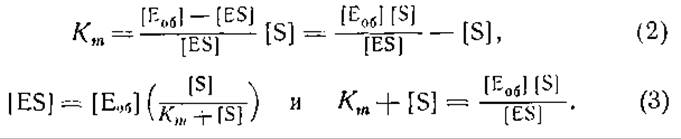
According to Michaelis and Menten [35], the rate of an enzymatic reaction is proportional to [ES], the concentration of the enzyme-substrate complex. As the latest equation shows, the concentration of the enzyme-substrate complex is, in turn, proportional to [Etot], the total enzyme concentration. Indeed, it has been found that the rate of most enzymatic reactions is proportional to the total enzyme concentration.
The constant Km is known as the Michaelis constant. If Km = [S], then [ES] = [Etot]/2; in other words, the reaction rate equals half the maximum reaction rate proceeding in the presence of a large excess of substrate, when [ES] ≈ [Etot]. This equation is used to determine Km by measuring the reaction rate at various substrate concentrations. The Michaelis constant (Km) corresponds to the Substrate Concentration S at which the reaction rate is half of its maximum value.
It follows from equation (3) that [ES] depends on Km and [S]. If at equilibrium [ES] is infinitely small compared to [S] and [Etot], the reaction rate will depend solely on [S]. In this case, at low substrate concentrations, the reaction will proceed as a first-order reaction. If, however, virtually all the enzyme turns out to be bound to the substrate as ES and the substrate concentration is sufficiently high, the concentration of the enzyme-substrate complex will remain unchanged, and the reaction rate will be constant. Under these conditions, we are dealing with a zero-order reaction [36]. Strictly speaking, most enzymatic reactions are neither first-order nor zero-order reactions, but proceed according to some intermediate order [34, 36, 37]. This depends partly on the decrease in substrate concentration during the reaction and partly on the formation of various types of enzyme-substrate compounds. Thus, catalase and peroxidase, as noted above, form green and red complexes with the substrate, with the dissociation rates of the green and red complexes being different [32, 33]. Further complications arise from the association of enzyme-substrate complexes with hydrogen ions [38] or other ions and molecules. For instance, the rate of Pepsin-catalyzed egg albumin Hydrolysis depends on the hydrogen ion concentration of the solution; the reactive intermediate in this case is not ES, but H+ES [38]. If ions participate in the formation of the enzyme-substrate compound, the rate of the catalyzed reaction depends on the Dielectric Constant of the solvent; it is known that organic Solvents, such as methyl or ethyl alcohol, decrease the dielectric constant of the solution and the degree of ionization, thereby reducing the rate of the catalyzed reaction [39].
All previous considerations are based on the assumption that the Rate of Enzymatic reactions depends on [ES], the concentration of the enzyme-substrate complex. This assumption, however, is not entirely correct. We must introduce an additional assumption: that the ES molecule requires a certain degree of activation before it undergoes dissociation into the enzyme and reaction products [34, 38]. Let us denote the activated enzyme-substrate complex as ES*. Then the catalyzed reaction will proceed through the following phases:

If a solution contains substances capable of binding to the enzyme, competition will arise between these substances and the substrate for binding to the enzyme. Consequently, these substances will act as inhibitors. To study the KINETICS OF ENZYMATIC reactions in the presence of inhibitors, one uses the same calculations applied in studying The kinetics of enzyme-substrate complex formation [40]. Recall that the Enzymatic hydrolysis of sucrose by invertase is inhibited by one of the reaction products, namely fructose (see p. 281), which acts as an inhibitor in this case.
Various Inhibitors of the enzyme-substrate compound formation reaction (such as ions, solvents, reaction products, etc.) often cause the enzymatic reaction rate to deviate from the theoretical value calculated from equation (3).
Last update: 06/08/2026
Editorial and Educational Adaptation: This material has been compiled based on the primary/original source text. The project team performed an editorial review, corrected technical inaccuracies, structured sections, and adapted the content for an educational format.
What was processed:
- elimination of formatting defects (OCR errors, structural breaks, corrupted characters);
- editorial organization of content;
- standardization of terminology in accordance with academic sources;
- verification of factual statements against the original source text.
All mentions of the author, publication year, and origin of the primary text have been preserved in accordance with the source.