BIOINORGANIC AND BIOORGANIC CHEMISTRY - M.V. Yatskov - 2014
III. NATURAL CATALYSTS, REGULATORS AND STIMULATORS OF BIOCHEMICAL PROCESSES
3.1. Enzymes
3.1.1. Rate of Enzymatic Reactions
The rate (v) of an enzymatic reaction, like any chemical reaction, is determined by:
Class="center">
where s is The amount of the substance being fermented or the Substrate Concentration.
Since in most cases the amount of enzyme cannot be measured in absolute units, such as milligrams or moles, it is expressed in arbitrary enzyme units
[E] = micromol/min or [s]. In 1972, the Commission on Biochemical Nomenclature suggested expressing The rate of an enzymatic reaction in moles per second and introduced a new unit of enzyme activity, the katal. 1E = 16.67 nkat (nanokatals).
For a catalytic reaction nA + mB → pC According to the law of mass action
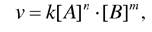
where k is determined experimentally from the molecularity of the reaction.
An enzymatic reaction with one-way substrate conversion is expressed as

where E is the enzyme, S is the substrate, ES is the enzyme-substrate complex or Michaelis complex, P is the product, k + 1 is the rate constant for complex formation, k-1 is the rate constant for complex dissociation, and k + 2 is the rate constant for the dissociation of the complex into enzyme and products.
The ratio of these constants is conventionally combined into a single value Km, which is called the Michaelis constant
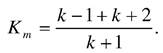
Its dimension is that of substrate concentration in mol/L. To characterize the formation process of the Michaelis complex, the substrate constant or the dissociation constant of the Michaelis complex (Ks) is used
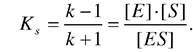
To determine the rate of an enzymatic reaction, Km (the Michaelis constant) is used, which in most cases is equal to the dissociation constant or the substrate constant, Km = Ks. Thus, the rate of an enzymatic reaction is most simply described by the kinetic equation
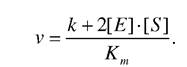
Graphically, this dependence of the enzymatic reaction rate (v) on the substrate concentration (S) at a constant Enzyme Concentration can be represented by a curve known as the graphical Michaelis-Menten Equation.
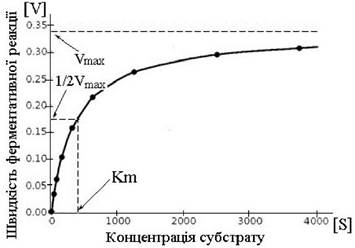
It can be seen from the graph that upon reaching a certain substrate concentration [S], the reaction rate should reach its maximum value (Vmax) and does not change with a further increase in [S].
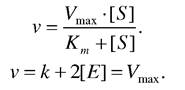
This graph is used to determine the Michaelis constant under the condition that  then Km = [S]. The Michaelis constant is numerically equal to the substrate concentration at which the initial reaction velocity is equal to half of the maximum velocity.
The Michaelis-Menten equation is used not only to determine the relationship between substrate concentration and velocity, but also to evaluate the dependence of V on cofactor concentration. In cases where enzyme activity is manifested only in the presence of a cofactor, this equation can be applied to study how the enzymatic reaction rate depends on cofactor concentration. This relationship is established as follows

The enzyme-cofactor complex can subsequently bind the substrate, leading to The formation of a ternary complex

The concentration of this complex determines the overall rate of the enzymatic reaction. Km can be used to characterize the affinity of an enzyme for both its substrate and cofactor. The substrate interacts with the enzyme exclusively at a precisely defined site known as the active center or Active Site of the enzyme. The active site refers to that specific region of the enzyme protein molecule that binds the substrate and dictates the catalytic Properties of the molecule. The active center determines the Specificity and catalytic activity of the enzyme, bringing together all contact groups involved in forming the activated complex.
METABOLISM/8.html">Properties of Enzymes
Enzymes share common properties with Proteins: they have a high molecular weight; are capable of undergoing Hydrolysis to Amino Acids; form colloidal solutions in Water; and are unstable in the presence of high temperatures, acids, alkalis, and heavy Metal Ions, which cause Denaturation. A characteristic feature is the dependence of their activity on H+ ion concentration, as well as on Temperature.
Effect of Hydrogen Ion Concentration on Enzymatic Reaction Rate
Each enzyme exhibits maximal activity at a specific pH value known as the pH optimum. Even a slight change in pH slows down enzymatic activity or halts it entirely.
Effect of temperature on Reaction Rate
As temperature rises to 30-500C, the rate of an enzymatic reaction reaches its maximum, but at temperatures of 600C and above, the rate drops sharply. Consequently, the optimal temperature for enzymatic reactions ranges from 40 to 500C, at which enzyme activity increases in accordance with the van 't Hoff rule. This property is widely utilized in the food and pharmaceutical industries, as well as in technological processes involving Fermentation and the Breakdown of Proteins and CARBOHYDRATES.
The protein nature of enzymes determines one of their most distinctive properties—selectivity. This means that each enzyme catalyzes a single chemical reaction or a specific type of chemical reaction, making enzymes specific to a particular substrate. As a result, they select only a few pathways from a range of thermodynamically possible Chemical Reactions, thereby not only accelerating the metabolic process but also directing its course.
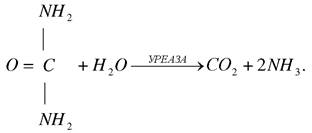
A classic example of absolute specificity is urease (EC 3.5.1.5), which hydrolyzes urea and does not act on Other Compounds, including urea derivatives. Amylase breaks down Polysaccharides (starch) and has no effect on Disaccharides (sucrose).
Chemical properties of Enzymes
Action of Amylase
Amylase is an enzyme that catalyzes the hydrolysis of the α-1,4-glycosidic bonds in starch and Glycogen into intermediate products known as dextrins. Starch has The ability to form blue-colored complexes with iodide, whereas amylodextrin forms purple, erythrodextrin reddish-brown, and achrodextrin yellow complexes.
Action of Sucrase
Sucrase catalyzes the hydrolysis of sucrose into glucose and fructose

The resulting Monosaccharides are identified using Fehling's test. Sucrose lacks a free aldehyde group and therefore possesses no reducing properties, whereas glucose does.
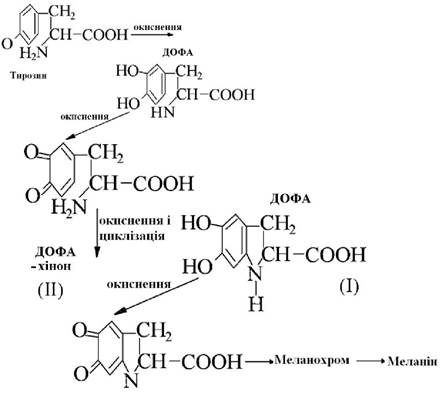
Action of Tyrosinase
The conversion of Tyrosine into melanin (a black nitrogen-containing pigment) via a red-colored intermediate forms 3,4-dihydroxyphenylalanine (DOPA), which upon oxidation is converted into 2,3-dihydro-5,6-dihydroxy-β-indolecarboxylic acid (I). Compound (I), upon oxidation, is transformed into 2,3-dihydro-5,6-diketo-β-indolylcarboxylic acid (II), which is a red pigment.
Last update: 06/08/2026
Editorial and Educational Adaptation: This material has been compiled based on the primary/original source text. The project team performed an editorial review, corrected technical inaccuracies, structured sections, and adapted the content for an educational format.
What was processed:
- elimination of formatting defects (OCR errors, structural breaks, corrupted characters);
- editorial organization of content;
- standardization of terminology in accordance with academic sources;
- verification of factual statements against the original source text.
All mentions of the author, publication year, and origin of the primary text have been preserved in accordance with the source.