Biochemistry: The Chemical Reactions of Living Cells, Volume 2 - D. Metzler 1980
Enzymes: Protein Catalysts of the Cell
Enzyme Specificity
Stereochemical Numbering
In some molecules (such as citrate), identical groups are located at the ends of the main carbon chain. Since both ends are recognized by the enzyme, It is important to determine which terminal carbon atom in citrate should be designated as C-1 and which as C-5. Hirschmann [45] proposed a stereochemical numbering system in which carbon atoms are numbered starting from the end of the chain located at the pro-S-position.
Class="center">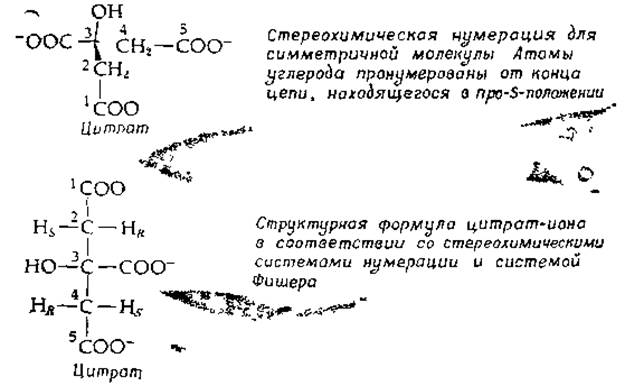
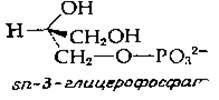
Citrate containing a 14C atom at position 1 (see schemes) is designated as sn-citrate [1-14C]. This is the form of labeled citrate synthesized in living Cells from oxaloacetate and [1-14C]acetyl-coenzyme A (Chapter 9, Section B, 1). The first step in the further METABOLISM of citrate involves the removal of the OH group from the C-3 atom along with the HR proton from the C-4 atom, catalyzed by the enzyme aconitase. It should be noted that the proton removed is specifically from the C-4 atom, not the C-2 atom. Glycerophosphate used by cells for phospholipid synthesis always contains a phosphate group at the —CH2OH group in the pro-R-position and is therefore sn-3-glycerophosphate:
Last update: 06/08/2026
Editorial and Educational Adaptation: This material has been compiled based on the primary/original source text. The project team performed an editorial review, corrected technical inaccuracies, structured sections, and adapted the content for an educational format.
What was processed:
- elimination of formatting defects (OCR errors, structural breaks, corrupted characters);
- editorial organization of content;
- standardization of terminology in accordance with academic sources;
- verification of factual statements against the original source text.
All mentions of the author, publication year, and origin of the primary text have been preserved in accordance with the source.