Human Biochemistry, Volume 1 - Murray R. 1993
Structure and Functions of Proteins and Enzymes
Enzymes: Mechanism of Action
Enzymes as General Acid and General Base Catalysts
Following substrate binding at the Active Site, charged (or charge-capable) Functional groups of side chains can participate in catalysis as acid or base catalysts.
Class="center">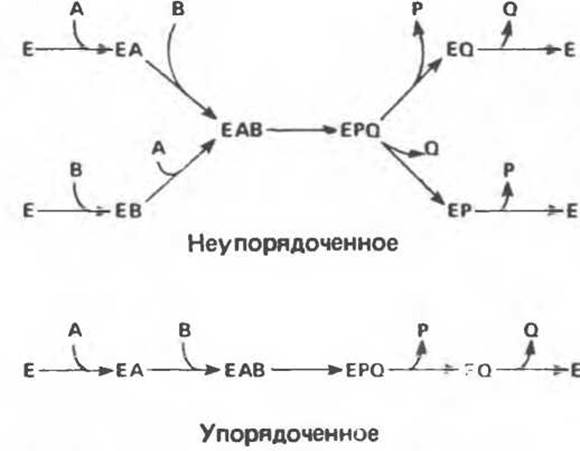
Fig. 9.8. Random and ordered addition of substrates A and B to the enzyme, and release of products P and Q from the enzyme-E complex.

Fig. 9.9. Schematic diagram of the ping-pong mechanism in Enzymatic Catalysis.

Fig. 9.10. Ping-pong mechanism in Transamination. E—CHO and E—СН2 NH2 are the enzyme complexes with Pyridoxal phosphate and pyridoxamine phosphate, respectively. (Ala — Alanine, Pyr — Pyruvate, KG — a-ketoglutarate, Glu — glutamate.)
We distinguish two broad categories of enzymatic Acid-Base Catalysis: general acid-base catalysis and specific acid-base catalysis.
Reactions whose rate changes with varying concentrations of H+ or H3O+ ions, but is independent of the concentration of other acids or bases present in the solution, are considered to proceed via specific acid or specific base catalysis. Reactions whose rate depends on the presence in solution of any acids (proton Donors) and any bases (proton acceptors) are considered to proceed via general acid or general base catalysis.
To determine whether a given enzymatic reaction involves general or specific acid-base catalysis, one needs to measure the reaction rate under the following conditions: 1) at various pH levels but a constant buffer concentration; 2) at a fixed pH but varying buffer concentrations.
If the reaction rate at a constant buffer concentration changes with pH, specific base catalysis (at pH > 7) or specific acid catalysis (at pH < 7) is taking place. Conversely, if the reaction rate at a fixed pH increases with increasing buffer concentration, general base catalysis (at pH > 7) or general acid catalysis (at pH < 7) is operative.
As an example of specific acid catalysis, let us consider The conversion of substrate S into product P. The reaction proceeds in two steps: a rapid step involving a reversible proton transfer:
S + H3О ⇄ SH+ + Н2О,
is followed by a slower, rate-determining step for the overall process—the Conversion of the protonated substrate into the product:
SH+ +H2О ⇄ P + H3О+.
By increasing the concentration of hydronium ions [Н3О+], we increase the concentration of SH+, the conjugate acid form of the substrate. Since SH+ is the substrate in the rate-determining step, the overall reaction rate will also increase. Mathematically, this can be expressed as follows:

where P is the product, t is time, k is the specific rate constant, and [SH+] is the concentration of the conjugate acid form of the substrate.
Since the concentration of SH+ depends simultaneously on the concentrations of S and Н3О+, the general rate expression for a specific acid-catalyzed reaction takes the form

Note a characteristic feature of specific acid catalysis: the rate expression includes only the [S] and [Н3О+] terms.
In addition to the specific acid catalysis described above, let us now consider catalysis by the imidazolium ion of an imidazole buffer. Because imidazole is a weak acid (pKa = 7), it is a poor proton donor; therefore, the reaction
S + Imidazole-H+ → SH+ + Imidazole
proceeds slowly and determines The rate of the overall reaction. Note that the fast and slow steps are reversed in specific versus general acid catalysis. The rate expression for general acid catalysis is often quite complex and is therefore not discussed here.
Last update: 06/08/2026
Editorial and Educational Adaptation: This material has been compiled based on the primary/original source text. The project team performed an editorial review, corrected technical inaccuracies, structured sections, and adapted the content for an educational format.
What was processed:
- elimination of formatting defects (OCR errors, structural breaks, corrupted characters);
- editorial organization of content;
- standardization of terminology in accordance with academic sources;
- verification of factual statements against the original source text.
All mentions of the author, publication year, and origin of the primary text have been preserved in accordance with the source.