Principles of Biochemistry Volume 1 - A. Lehninger 1985
Biomolecules
Enzymes
Enzymes exhibit specificity toward their substrates
Some Enzymes exhibit near-absolute Specificity toward certain substrates and do not interact even with structurally very similar molecules. A prime example of this is the enzyme aspartase, found in many plants and Bacteria. It catalyzes the reversible addition of ammonia across the double bond of fumaric acid to form L-aspartate (Fig. 9-8). However, under the action of aspartase, ammonia does not add to any other unsaturated acid. Aspartase also shows strict specificity toward optical and geometric isomers: it does not act on D-aspartate and does not add ammonia to maleate, the geometric cis-isomer of fumarate.
On the other hand, Some enzymes are known to exhibit relatively broad specificity, interacting with many substances that share common structural features. For example, Chymotrypsin catalyzes the Hydrolysis of many Peptides and Polypeptides, but cleaves only those peptide bonds in which the carbonyl group is contributed by phenylalanine, Tyrosine, or Tryptophan residues (Table 6-6). A somewhat different situation occurs with intestinal phosphatase, which catalyzes the hydrolysis of A wide variety of phosphoric acid esters, although their Cleavage rates vary greatly. Studies of enzyme substrate specificity led to METABOLISM/2.html">THE CONCEPT OF complementarity between the substrate molecule and a specific site On the surface of the enzyme molecule, fitting together like a lock and key. The substrate molecule binds to this site, known as the active or catalytic site, and undergoes transformation during the catalytic event.
Class="center">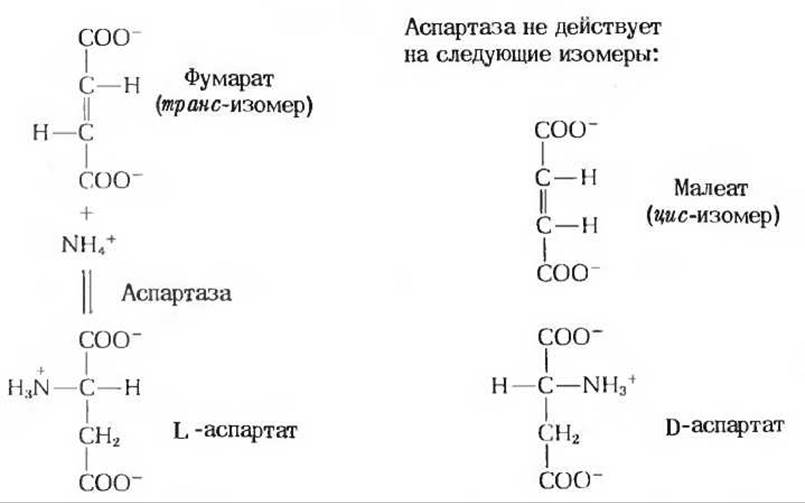
Fig. 9-8. Reaction catalyzed by aspartase, and the substrate Specificity of the enzyme.
Aspartase is absolutely specific for fumarate in the forward reaction and for L-aspartate in the reverse reaction. It attacks neither maleate (the cis-isomer of fumarate) nor D-aspartate.
Studies of Enzyme Specificity have revealed that a substrate molecule must possess two key structural features. First, it must contain a specific chemical bond that the enzyme can attack, and second, it must contain a functional group, known as a binding group, capable of binding to the enzyme and orienting the substrate molecule within the Active Site so that the bond to be cleaved is correctly positioned relative to the catalytic group of the enzyme. Fig. 9-9 illustrates the substrate specificity of chymotrypsin, which typically hydrolyzes only those peptide bonds in Proteins and simple peptides where the carbonyl group is contributed by aromatic amino acid residues, i.e., tryptophan, tyrosine, and phenylalanine residues. However, testing dozens of different synthetic substrates revealed that chymotrypsin can also cleave simple amide and ester bonds. Furthermore, the aromatic R-groups of tyrosine, tryptophan, and phenylalanine, for which chymotrypsin shows specificity in polypeptides, were found to serve merely as hydrophobic binding groups. This is supported by the fact that chymotrypsin can cleave synthetic peptides in which the aromatic rings of Natural Amino Acids are replaced by larger hydrophobic alkyl groups.
Studies of enzyme substrate specificity, as well as the Inhibition of enzymatic reactions, provide information about The Structure of active sites.
Last update: 06/08/2026
Editorial and Educational Adaptation: This material has been compiled based on the primary/original source text. The project team performed an editorial review, corrected technical inaccuracies, structured sections, and adapted the content for an educational format.
What was processed:
- elimination of formatting defects (OCR errors, structural breaks, corrupted characters);
- editorial organization of content;
- standardization of terminology in accordance with academic sources;
- verification of factual statements against the original source text.
All mentions of the author, publication year, and origin of the primary text have been preserved in accordance with the source.