Principles of Biochemistry Volume 1 - A. Lehninger 1985
Biomolecules
Enzymes
Some enzymes are regulated by reversible covalent modification
Another important Class of regulatory Enzymes consists of those in which the transition from the active to the inactive form occurs via Covalent Modification of the enzyme molecule. A prominent example of this class is Muscle and Liver Glycogen phosphorylase, which catalyzes the reaction:

The glucose-1-phosphate produced in this reaction can subsequently undergo Cleavage to form either lactic acid (in muscle) or free glucose (in liver). Glycogen phosphorylase exists in two forms: phosphorylase a (the active form) and phosphorylase b (the relatively inactive form; Fig. 9-22). Phosphorylase a is a dimer composed of two identical subunits, each containing a specific Serine residue phosphorylated at its hydroxyl group. These phosphoserine residues are essential for maximum enzymatic activity. The phosphate groups attached to the serine residues can be removed from phosphorylase a by an enzyme called phosphorylase phosphatase, which catalyzes the hydrolytic Cleavage of the bond between the phosphate and the serine residue.

In this reaction, phosphorylase a is converted into phosphorylase b, which catalyzes glycogen breakdown much less effectively. Thus, the active form of glycogen phosphorylase is converted into the relatively inactive form As a result of the cleavage of two covalent bonds between phosphoric acid residues and two specific serine residues in the enzyme molecule.
Phosphorylase b can be reactivated—that is, converted back into active phosphorylase a. This reaction is carried out by another enzyme called phosphorylase kinase, which catalyzes the Transfer of phosphate groups from ATP to the hydroxyl groups of specific serine residues in phosphorylase b (Fig. 9-22):

Thus, glycogen breakdown in Skeletal Muscle and liver is regulated by altering the quantitative ratio of the active and inactive forms of the enzyme. The transition from one form to the other is accompanied by changes in The quaternary Structure of the enzyme, which also affect its catalytic site. Naturally, this leads to A change in the catalytic activity of the enzyme.
Although in most known cases Introduction/15.html">Regulation of enzyme action via covalent modification occurs through phosphorylation and dephosphorylation of specific serine residues, as just described for glycogen phosphorylase, Other Methods of covalent modification also exist, such as the methylation of Certain amino acid residues or the attachment of adenylyl groups. Additional Examples of covalent modification of regulatory enzymes will be discussed in subsequent chapters.
Some more complex regulatory enzymes are modulated through both covalent and noncovalent mechanisms. Such enzymes catalyze reactions that represent the most crucial steps in METABOLISM; consequently, they interact with numerous regulatory metabolites that mediate both allosteric and covalent modifications of these enzymes. An example of such an enzyme is the glycogen phosphorylase just discussed. Although regulation of this enzyme is achieved primarily through covalent modification as described above, noncovalent (allosteric) interaction with adenylate, which acts as an activating modulator of phosphorylase b, is also possible (Ch. 20).
Another example is Glutamine Synthetase from E. coli, one of the most complex regulatory enzymes known to date. It interacts with numerous allosteric modulators and is also regulated by reversible covalent modification (Ch. 23). Both of these enzymes will be discussed further in relation to their roles in metabolism.
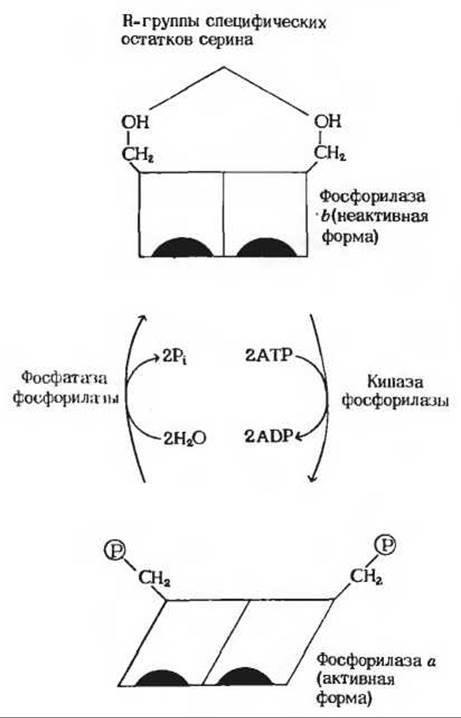
Fig. 9-22. Regulation of Glycogen phosphorylase activity via covalent modification. In the active form of the enzyme (phosphorylase a), specific serine residues (one in each subunit) are phosphorylated. Upon Enzymatic cleavage of the phosphate groups, catalyzed by phosphorylase phosphatase, phosphorylase a is converted into the relatively inactive phosphorylase b. Phosphorylase b can be reactivated and converted back into phosphorylase a by the action of phosphorylase kinase, which catalyzes the phosphorylation of the serine hydroxyl groups using ATP.
Last update: 06/08/2026
Editorial and Educational Adaptation: This material has been compiled based on the primary/original source text. The project team performed an editorial review, corrected technical inaccuracies, structured sections, and adapted the content for an educational format.
What was processed:
- elimination of formatting defects (OCR errors, structural breaks, corrupted characters);
- editorial organization of content;
- standardization of terminology in accordance with academic sources;
- verification of factual statements against the original source text.
All mentions of the author, publication year, and origin of the primary text have been preserved in accordance with the source.