Harper's Illustrated Biochemistry, Volume 1 - Murray R. 1993
Bioenergetics and Metabolism of Carbohydrates and Lipids
Regulation of Carbohydrate Metabolism
Regulation of Glycogen Metabolism (Fig. 22.5)
Glycogen METABOLISM is regulated by altering the activities of Glycogen synthase and phosphorylase, which are controlled allosterically by substrates and regulated by Hormones. An increase in cAMP concentration leads to the activation of phosphorylase via phosphorylase kinase, while simultaneously converting glycogen synthase into its inactive form (see Ch. 19); both processes involve cAMP-dependent protein kinase. Thus, the inhibition of Glycogenolysis promotes Glycogenesis, and vice versa. A key aspect of glycogen Metabolism regulation is that the dephosphorylation of phosphorylase a, phosphorylase kinase, and glycogen synthase b is catalyzed by a single enzyme of broad Specificity—protein phosphatase-1. In turn, protein phosphatase-1 is inhibited by cAMP-dependent protein kinase via inhibitor-1 (Fig. 22.5). Consequently, the suppression of glycogenolysis and The stimulation of glycogenesis occur simultaneously, as both processes rely on The activity of cAMP-dependent protein kinase. Phosphorylase kinase and glycogen synthase can also be phosphorylated and dephosphorylated at several secondary sites by various Kinases and Phosphatases. This secondary phosphorylation affects the susceptibility of the primary sites to phosphorylation and dephosphorylation. Multi-site phosphorylation is likewise observed in Pyruvate dehydrogenase.
Liver. The concentration of phosphorylase a is the primary determinant in regulating Liver glycogen metabolism. This enzyme not only catalyzes the rate-limiting step of glycogenolysis but also inhibits protein phosphatase-1 activity, thereby controlling glycogen synthesis (Fig. 22.5). Following a meal, Blood glucose levels rise, leading to the allosteric inhibition of phosphorylase. Conversely, 5-AMP, which accumulates when ATP levels drop (see above), activates phosphorylase. Catecholamines, including epinephrine, stimulate glycogenolysis through a cAMP-independent pathway mediated by a1-adrenergic receptors. In this mechanism, stimulation occurs via the direct activation of phosphorylase kinase b by Ca2+ ions and calmodulin. Vasopressin, oxytocin, and angiotensin II also trigger cAMP-independent glycogenolysis involving Calcium Ions or phosphatidylinositol bisphosphate Hydrolysis products. The administration of Insulin induces the rapid inactivation of phosphorylase followed by the activation of glycogen synthase; glucose must be present for insulin to exert its effect.
Class="center">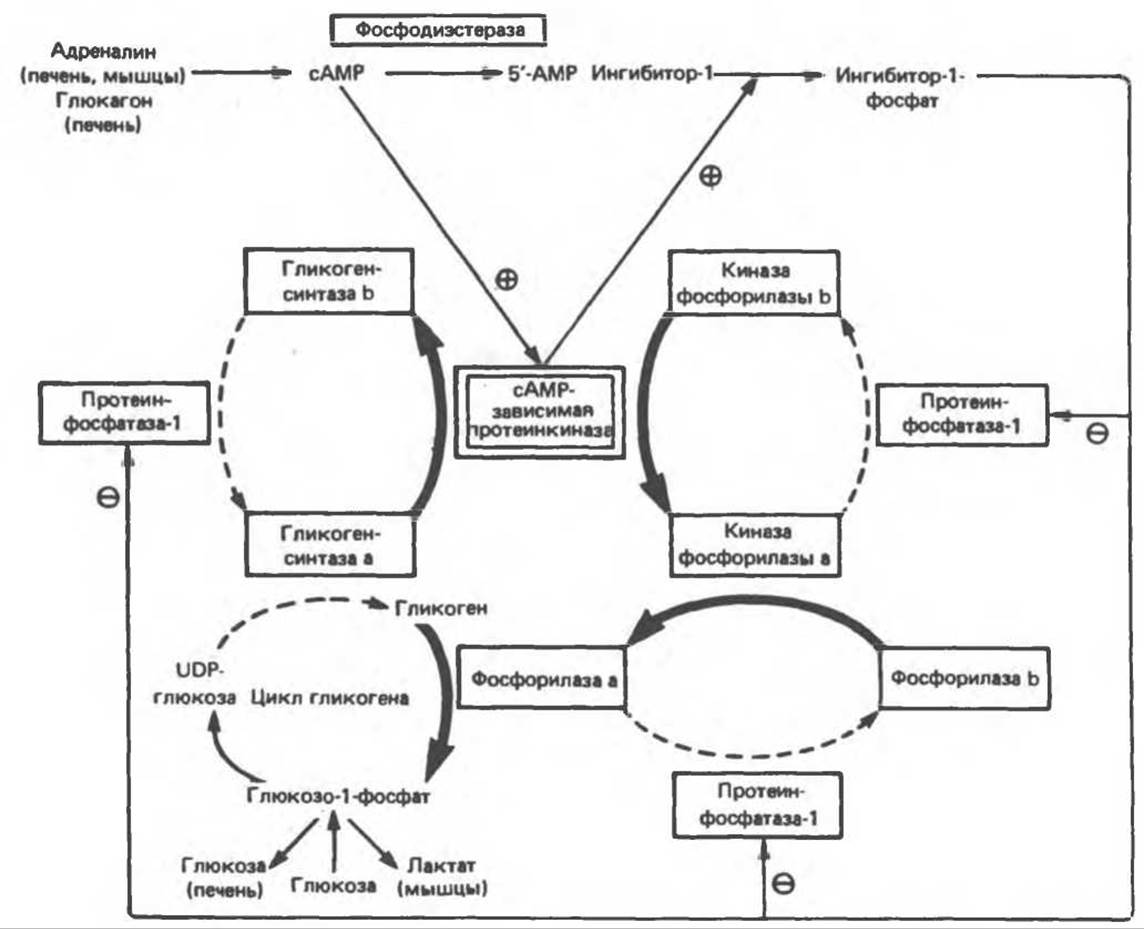
Fig. 22.5. REGULATION OF GLYCOGENOLYSIS and glycogenesis by cAMP-dependent protein kinase. An increase in cAMP concentration stimulates reactions that drive glycogenolysis (indicated by bold arrows) and inhibits reactions that suppress it (indicated by dashed arrows). Conversely, a decrease in cAMP concentration—mediated by phosphodiesterase—reverses this state, ultimately stimulating glycogenesis.
The action of branching and debranching Enzymes is not subject to regulation.
Significance of Futile Substrate Cycles
At many regulatory checkpoints in Glycolysis and glycogen metabolism, cyclic phosphorylation and dephosphorylation loops can occur due to the action of paired enzymes, such as glucokinase/glucose-6-phosphatase, Phosphofructokinase-1/fructose-1,6-bisphosphatase, pyruvate kinase/pyruvate carboxylase/phosphoenolpyruvate carboxykinase, and glycogen synthase/phosphorylase. Unchecked operation of these cycles would constitute futile cycles, with ATP hydrolysis as their sole net result. This is prevented by sophisticated regulatory mechanisms that ensure one enzyme in the cycle is inhibited while the other is activated, meeting the metabolic demands of specific Tissues or the Organism as a whole. Nevertheless, the periodic operation of certain cycles can hold specific physiological significance. For instance, the cycle catalyzed by glucokinase and glucose-6-phosphatase is positioned at a crucial juncture of glucose metabolism, allowing it to regulate metabolite flux during periods of high substrate influx.
Last update: 06/08/2026
Editorial and Educational Adaptation: This material has been compiled based on the primary/original source text. The project team performed an editorial review, corrected technical inaccuracies, structured sections, and adapted the content for an educational format.
What was processed:
- elimination of formatting defects (OCR errors, structural breaks, corrupted characters);
- editorial organization of content;
- standardization of terminology in accordance with academic sources;
- verification of factual statements against the original source text.
All mentions of the author, publication year, and origin of the primary text have been preserved in accordance with the source.