Human Biochemistry, Volume 1 - Murray R. 1993
Bioenergetics and Carbohydrate and Lipid Metabolism
Glycogen Metabolism
Glycogenesis
Glycogen Biosynthesis (Fig. 19.1)
Glucose is phosphorylated to glucose-6-phosphate, which is the same reaction that serves as the first step of Glycolysis. This reaction is catalyzed by hexokinase in Muscles and by glucokinase in the Liver. Glucose-6-phosphate is converted into glucose-1-phosphate in a reaction catalyzed by phosphoglucomutase. This enzyme (E) exists in a phosphorylated form, and its phosphoryl group (P) participates in a reversible reaction involving glucose-1,6-bisphosphate as an intermediate:
Class="center">E — P + Glucose-6-phosphate ↔ E + Glucose-1,6-bisphosphate ↔ E — P + Glucose-1-phosphate.
Next, glucose-1-phosphate reacts with uridine triphosphate (UTP) to form the active nucleotide uridine diphosphate glucose (UDPGlc)1 (Fig. 19.2).
The reaction between glucose-1-phosphate and uridine triphosphate is catalyzed by the enzyme UDPGlc pyrophosphorylase:
UTP + Glucose-1-phosphate ↔ UDPGlc + PPi.
Subsequent Hydrolysis of inorganic pyrophosphate, catalyzed by inorganic pyrophosphatase, drives the reaction equilibrium to the right.
The action of glycogen synthase (or glucosyltransferase) forms a glycosidic bond between the C atom of the activated glucose within UDPGlc and the C4 atom of the terminal glucose residue in glycogen, releasing uridine diphosphate (UDP). Initiating this reaction requires a glycogen molecule to act as a "primer." This primer can be synthesized on a peptide chain backbone in a manner similar to the Synthesis of Other Glycoproteins (see Chapter 54):

1 Other nucleoside diphosphate sugars, such as UDPGal, are also known. Furthermore, the same sugar can be linked to different NUCLEOTIDES. For example, glucose can be attached to uridine (as in the example above), guanosine, thymidine, adenosine, and cytidine nucleotides.
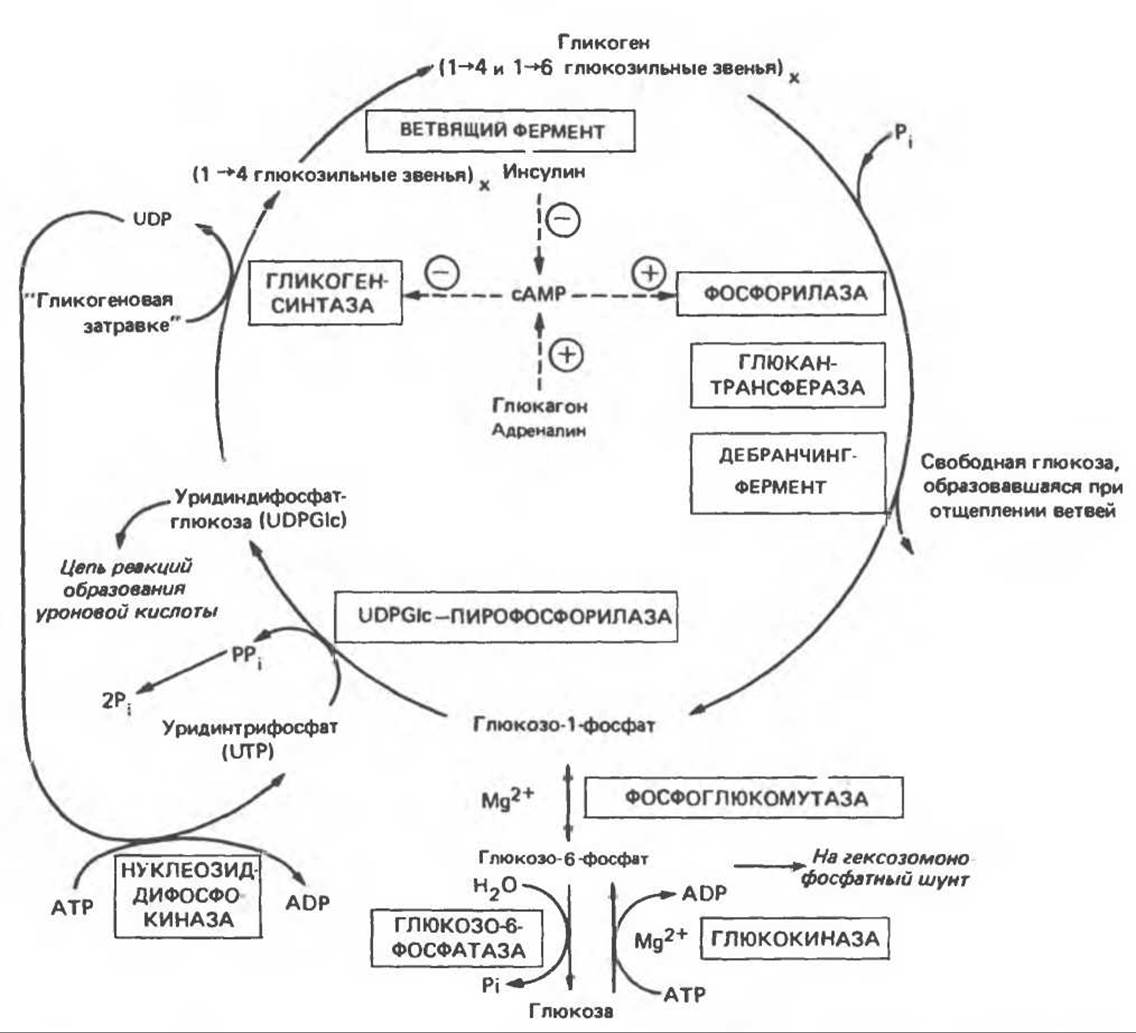
Fig. 19.1. Diagram of glycogenesis and Glycogenolysis in the liver. The incorporation of a single glucose molecule into glycogen consumes two high-energy phosphate bonds. ⊕ — stimulation; ⊝ — inhibition. Insulin lowers cAMP levels only when the elevation in cAMP was induced by Glucagon or adrenaline; i.e., insulin acts as an antagonist to the latter.

Fig. 19.2. Uridine diphosphate glucose (UDPGlc).
Branching Mechanism
The addition of glucose residues to the glycogen primer chain occurs at the outer, non-reducing end of the molecule; the Branches of the glycogen "tree" are elongated through the successive formation of (1→4)-bonds (Fig. 19.3). Once the linear stretch of the chain reaches a length of at least 11 glucose residues, the branching enzyme (amylo-[1→4]→[1→6]-transglucosylase) transfers a fragment of the (1→4)-chain (comprising a minimum of 6 glucose residues) to an adjacent chain, attaching the transferred fragment via a (1→6)-bond, thereby creating a branch point in the molecule. The branches grow through the sequential addition of (1→4)-glucosyl units and further branching.
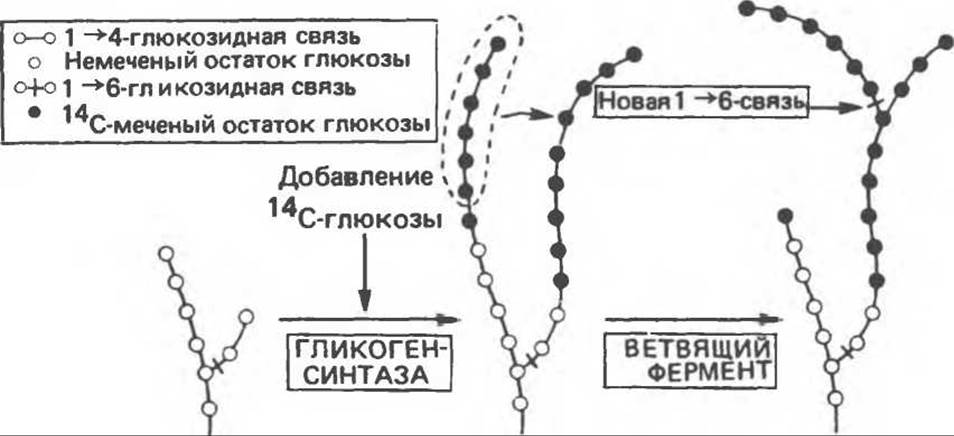
Fig. 19.3. Glycogen biosynthesis. The branching mechanism was elucidated using [14C]glucose.
The action of the branching enzyme was studied in animals by administering 14C-labeled glucose in their diet, followed by analysis of liver glycogen at specified time intervals (Fig. 19.3).
Last update: 06/08/2026
Editorial and Educational Adaptation: This material has been compiled based on the primary/original source text. The project team performed an editorial review, corrected technical inaccuracies, structured sections, and adapted the content for an educational format.
What was processed:
- elimination of formatting defects (OCR errors, structural breaks, corrupted characters);
- editorial organization of content;
- standardization of terminology in accordance with academic sources;
- verification of factual statements against the original source text.
All mentions of the author, publication year, and origin of the primary text have been preserved in accordance with the source.