Human Biochemistry, Volume 1 - Murray R. 1993
Bioenergetics and Carbohydrate and Lipid Metabolism
Regulation of Carbohydrate Metabolism
Regulation of Glycolysis, Gluconeogenesis, and the Pentose Phosphate Pathway
Induction and Repression of Enzyme Synthesis
The most thoroughly studied changes in enzyme activity thought to occur under various metabolic conditions are summarized in Table 22.1. The data presented in this table pertain primarily to Liver Enzymes. The enzymes in question catalyze nonequilibrium reactions that are physiologically irreversible. Often, the "forward" effects are more pronounced because The activity of enzymes catalyzing the reverse reactions simultaneously Changes in the opposite direction (Fig. 22.2). It should be noted that all Key Enzymes participating in a given metabolic pathway are activated or inhibited in a coordinated manner, as evidenced by the data in Table 22.1. Enzymes involved in glucose utilization—namely, those of Glycolysis and Lipogenesis—become more active when glucose is abundant; under these conditions, the activity of enzymes catalyzing glucose formation via Gluconeogenesis decreases. Insulin secretion, which varies depending on Blood glucose concentration, regulates the activity of enzymes involved in glycolysis. Along with glucocorticoids, insulin also controls the activity of enzymes catalyzing gluconeogenesis reactions. Activity changes caused by enzyme synthesis can be prevented by agents that block Protein Synthesis, such as puromycin and ethionine.
Class="center">Table 22.1. Regulatory and adaptive Enzymes of the rat (primarily liver enzymes)
|
Activity during |
||||||
|
Enzymes |
high-carbohydrate diet |
starvation and diabetes |
Inducer |
Repressor |
Activator |
Inhibitor |
|
Glycolytic and glycogenic enzymes |
||||||
|
Hexokinase |
Glucose-6-phosphate 1) |
|||||
|
Glucokinase |
↑ |
↓ |
Insulin |
|||
|
Glycogen synthase system |
↑ |
↓ |
Insulin |
Insulin |
||
|
↑ |
↓ |
Insulin |
AMP1), fructose-6-phosphate1), Pi1), fructose-2,6-bisphosphate1) |
Citrate (Fatty acids, Ketone Bodies)1), ATP1), glucagon (cAMP) |
||
|
Pyruvate kinase |
↑ |
↓ |
Insulin, fructose |
Fructose-1,6-bisphosphate1) |
ATP, Alanine, glucagon (cAMP), adrenaline |
|
|
Pyruvate dehydrogenase |
↑ |
↓ |
CoA, NAD, insulin2), ADP, pyruvate |
Acetyl-CoA, NADH, ATP (fatty acids, ketone bodies) |
||
|
Gluconeogenic enzymes |
||||||
|
Pyruvate carboxylase |
↓ |
↑ |
Glucocorticoids, glucagon, adrenaline |
Insulin |
Acetyl-CoA1) |
ADP1) |
|
Phosphoenolpyruvate carboxykinase |
↓ |
↑ |
Glucocorticoids, glucagon, adrenaline |
Insulin |
Glucagon ? |
|
|
Fructose-1,6-bisphosphatase |
↓ |
↑ |
Glucocorticoids, glucagon, adrenaline |
Insulin |
Glucagon (cAMP) |
Fructose-1,6-bisphosphate1), AMP1), fructose-2,6-bisphosphate |
|
Glucose-6-phosphatase |
↓ |
↑ |
Glucocorticoids, glucagon, adrenaline |
Insulin |
||
|
Enzymes of the Pentose Phosphate Pathway and lipogenesis |
||||||
|
Glucose-6-phosphate dehydrogenase |
↑ |
↓ |
Insulin |
|||
|
6-Phosphogluconate dehydrogenase |
↑ |
↓ |
Insulin |
|||
|
Malic enzyme |
↑ |
↓ |
Insulin |
|||
|
ATP-citrate lyase |
↑ |
↓ |
Insulin |
ADP |
||
|
Acetyl-CoA carboxylase |
↑ |
↓ |
Insulin ? |
Citrate1), insulin |
Long-chain acyl-CoA, cAMP, glucagon |
|
|
Fatty acid synthase |
↑ |
↓ |
Insulin |
|||
1) Allosteric.
2) In adipose tissue, but not in the liver.

Fig. 22.2. Key enzymes involved in the Regulation of glycolysis, gluconeogenesis, and Glycogen METABOLISM in the liver. The hormone action sites indicated in the diagram do not imply a direct effect on the respective enzyme. The Effect of cAMP on phosphofructokinase-1 and fructose-1,6-bisphosphatase is mediated by a combination of covalent modification and allosteric effects (see Fig. 22.4). High concentrations of alanine inhibit glycolysis at the step catalyzed by pyruvate kinase, thereby acting as a "gluconeogenic signal."

Fig. 22.3. Regulation of pyruvate dehydrogenase (PDH) activity. Allosteric effects are indicated by wavy arrows. A — regulation by end-product inhibition; B — regulation by interconversion of active and inactive enzyme forms.
Both dehydrogenases of The pentose phosphate pathway can be classified as adaptive enzymes because their activity increases in well-fed animals as well as upon administration of insulin to diabetic animals. In diabetes and starvation, these enzymes show low activity. The malic enzyme and ATP-citrate lyase behave similarly, leading to the Conclusion that they are involved in lipogenesis rather than gluconeogenesis.
Covalent Modification
Pyruvate dehydrogenase activity can be regulated both by phosphorylation, catalyzed by an ATP-specific kinase and resulting in decreased activity, and by dephosphorylation via a phosphatase, which increases dehydrogenase activity. As the [acetyl-CoA]/[CoA], [NADH]/[NAD+], and [ATP]/[ADP] ratios increase, the kinase becomes more active. Consequently, pyruvate dehydrogenase and glycolysis are inhibited during Fatty acid oxidation, during which these ratios rise (Fig. 22.3). During starvation, dehydrogenase activity decreases, whereas in adipose tissue (though not in the liver) it increases in response to insulin. Glucagon inhibits glycolysis and activates hepatic gluconeogenesis by increasing cAMP concentration, which in turn leads to the Activation of a cAMP-dependent protein kinase; the latter phosphorylates and inactivates pyruvate kinase. Glucagon also affects the concentration of fructose-2,6-bisphosphate and, consequently, the flux through glycolysis and gluconeogenesis, as discussed below.
Allosteric Modification
Allosteric control is operative in The regulation of several enzymes of Carbohydrate Metabolism. During The Biosynthesis of oxaloacetate from bicarbonate and pyruvate in gluconeogenesis—a reaction catalyzed by pyruvate carboxylase—acetyl-CoA acts as an allosteric activator. Acetyl-CoA alters protein conformation, thereby lowering the Km value for bicarbonate. This effect is crucial for the autoregulation of intermediate metabolism, since acetyl-CoA derived from pyruvate activates pyruvate carboxylase, thus promoting oxaloacetate formation and its subsequent oxidation in The Citric Acid Cycle. The activation of pyruvate carboxylase and the inhibition of pyruvate dehydrogenase caused by acetyl-CoA generated during fatty acid oxidation help explain the suppressive effect of fatty acid oxidation on pyruvate oxidation and its stimulatory effect on hepatic gluconeogenesis. In both The Liver and Kidneys, the regulation of pyruvate dehydrogenase and pyruvate carboxylase activities is reciprocal, thereby shifting the metabolic fate of pyruvate from carbohydrate oxidation (beginning with glycolysis) toward gluconeogenesis (Fig. 22.2). Fatty acid oxidation Supports gluconeogenesis by supplying the ATP required for the Reactions Catalyzed by pyruvate carboxylase and phosphoenolpyruvate carboxykinase.
Phosphofructokinase (phosphofructokinase-1) is another enzyme regulated by feedback mechanisms. This enzyme plays a pivotal role in the regulation of glycolysis. Phosphofructokinase-1 is inhibited by citrate and ATP, and activated by AMP. AMP Functions as an indicator of the cellular energy status. Due to the presence of adenylate kinase in the liver and many other Tissues, rapid equilibrium is achieved in the reaction
ATP + AMP ↔ 2ADP
Thus, when ATP is consumed in energy-requiring reactions and ADP is produced, the concentration of AMP increases. Because the resting concentration of ATP can exceed that of AMP by up to 50-fold, a relatively small fractional decrease in ATP concentration can result in a manifold increase in AMP concentration. Consequently, a large rise in AMP concentration acts as a metabolic amplifier for minor shifts in ATP concentration. This mechanism renders phosphofructokinase-1 highly sensitive to subtle changes in the energy state of The Cell, allowing Regulation of the carbohydrate flux through glycolysis prior to entry into The Citric Acid cycle. The elevated AMP concentration also explains why glycolysis is accelerated under oxygen-depleted conditions when ATP levels drop. At the same time, AMP activates phosphorylase, thereby enhancing Glycogenolysis. The inhibition of phosphofructokinase-1 by citrate and ATP provides another pathway explaining the suppressive effect of fatty acid oxidation on glucose oxidation; this inhibition also accounts for the Pasteur Effect, whereby the aerobic oxidation of substrates in the citric acid cycle inhibits the anaerobic breakdown of glucose. Furthermore, the inhibition of phosphofructokinase-1 leads to the accumulation of glucose-6-phosphate, which restricts glucose entry into extrahepatic tissues via allosteric inhibition of hexokinase.
Role of Fructose-2,6-Bisphosphate
Fructose-2,6-bisphosphate is the most potent allosteric activator of phosphofructokinase-1 and inhibitor of hepatic fructose-1,6-bisphosphatase. It diminishes the inhibitory effect of ATP on phosphofructokinase-1 and increases the enzyme's affinity for fructose-6-phosphate. Conversely, the inhibition of fructose-1,6-bisphosphatase by fructose-2,6-bisphosphate involves an increase in the Km for fructose-1,6-bisphosphate. The concentration of fructose-2,6-bisphosphate is regulated by the levels of fructose-6-phosphate and Hormones (Fig. 22.4). Fructose-2,6-bisphosphate is synthesized through the phosphorylation of fructose-6-phosphate catalyzed by phosphofructokinase-2. This enzyme is bifunctional (possessing both kinase and fructose-2,6-bisphosphatase activities) and is under allosteric control by fructose-6-phosphate (elevated fructose-6-phosphate levels, as observed during glucose excess, stimulate kinase activity while inhibiting phosphatase activity). On the other hand, when glucose levels drop, glucagon stimulates The production of cAMP; cAMP activates a cAMP-dependent protein kinase, which in turn inhibits phosphofructokinase-2 and activates fructose-2,6-bisphosphatase via phosphorylation. Thus, in the presence of excess glucose, the concentration of fructose-2,6-bisphosphate rises, activating phosphofructokinase-1 and inhibiting fructose-1,6-bisphosphatase, which stimulates glycolysis. During glucose deprivation, glucagon lowers the concentration of fructose-2,6-bisphosphate, leading (Fig. 22.4) to decreased phosphofructokinase-1 activity and increased fructose-1,6-bisphosphatase activity, thereby promoting gluconeogenesis. This regulatory mechanism explains how glucagon-stimulated glycogenolysis results in glucose release while concurrently repressing its glycolytic conversion.
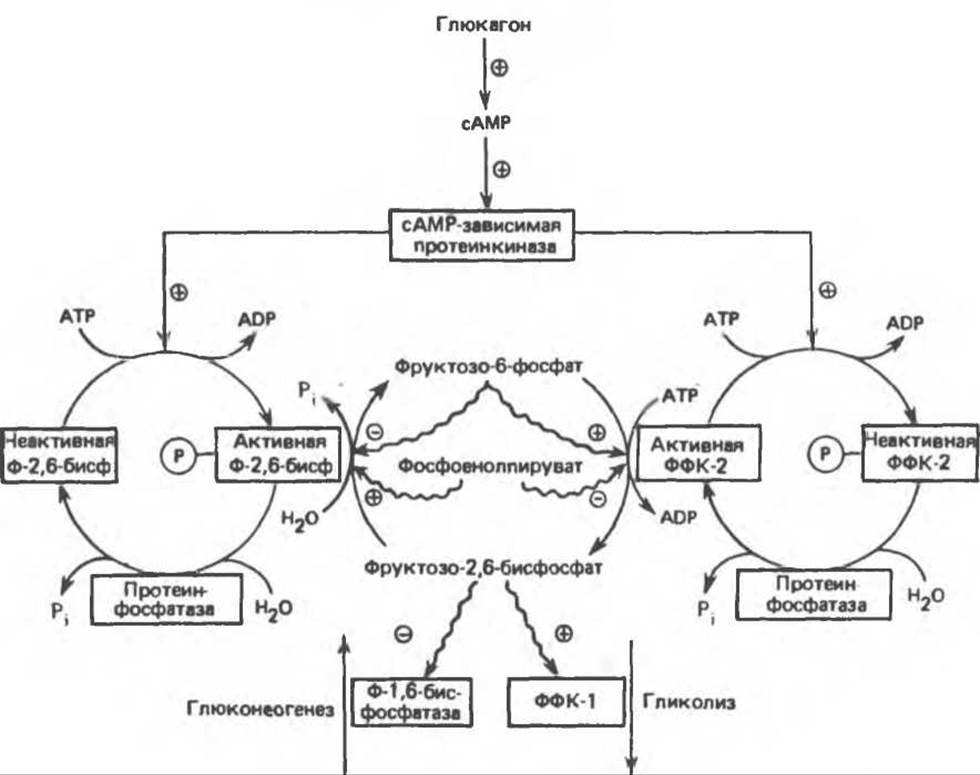
Fig. 22.4. Regulation of glycolysis and gluconeogenesis in the liver by fructose-2,6-bisphosphate. F-1,6-bisphosphatase, fructose-1,6-bisphosphatase; F-2,6-bisphosphatase, fructose-2,6-bisphosphatase; PFK-1, 6-phosphofructo-1-kinase; PFK-2, 6-phosphofructo-2-kinase. Allosteric actions are indicated by arrows.
Last update: 06/08/2026
Editorial and Educational Adaptation: This material has been compiled based on the primary/original source text. The project team performed an editorial review, corrected technical inaccuracies, structured sections, and adapted the content for an educational format.
What was processed:
- elimination of formatting defects (OCR errors, structural breaks, corrupted characters);
- editorial organization of content;
- standardization of terminology in accordance with academic sources;
- verification of factual statements against the original source text.
All mentions of the author, publication year, and origin of the primary text have been preserved in accordance with the source.