Biotechnology - Yu.O. Sazykin 2006
General Biotechnology
Molecular mechanisms of intracellular regulation and their application in biotechnological production
Induction and repression of enzyme synthesis
In accordance with its specialization, any Cell (whether microbial, plant, or animal) maintains Homeostasis and undergoes its developmental cycle while serving specific needs of the multicellular Organism. Pursuing the goal of maximizing the yield of a target product, a biotechnologist manipulates these processes to meet production requirements. Modern biotechnological production of Pharmaceuticals, alongside strain improvement, demands continuous optimization of the Fermentation process conditions themselves.
It is well known that a microbial cell serving as a producer of pharmaceutical substances contains several thousand Enzymes and is frequently employed as the basis for creating recombinant producers.
A significant portion of microbial enzymes consists of constitutive enzymes, which are always present in The Cell at strictly defined concentrations characteristic of each individual enzyme, such as the enzymes of Glycolysis. However, the evolution of life on Earth and The Need for organisms (microorganisms) to adapt to diverse and frequently changing environmental conditions have led to The Emergence of so-called adaptive or inducible enzymes. The genes encoding such enzyme Proteins are expressed only when a relatively rare substrate appears in the environment that can be utilized as an energy source. Inducible enzymes quite often form within the cell upon the appearance of antimicrobial substances whose Structure can undergo enzymatic inactivation.
Enzyme induction is a dramatic increase in The rate of its synthesis (by millions of times within a few seconds) in response to the appearance of an inducer.
Schematically, The Mechanism of induction can be explained using METABOLISM/2.html">THE CONCEPT OF regulation of Enzyme synthesis induction and repression proposed in the 1960s by F. Jacob and J. Monod (Fig. 7). Simultaneously, the authors of this concept developed the "Operon model," according to which the genetic-level system regulating enzyme synthesis comprises several components. First among these is the structural Gene, which encodes The structure of the enzyme protein; sometimes these may be several sequentially arranged structural genes that encode enzymes participating in a common metabolic pathway.
Class="center">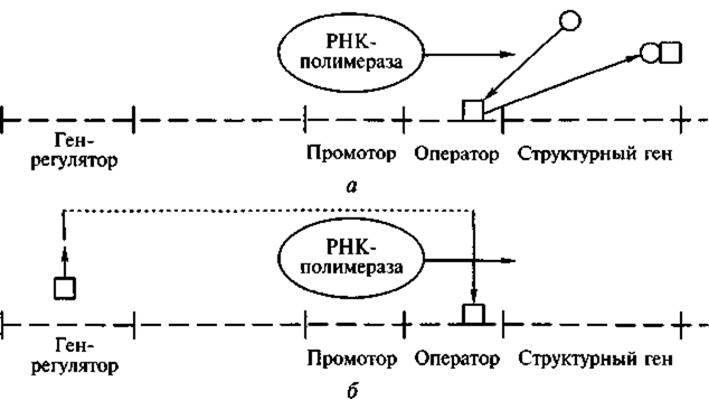
Fig. 7. Schematic representation of enzyme induction (a) and repression (b):

Within the operon, the structural gene is preceded by a DNA segment known as the operator, which controls The activity of the structural genes. It is precisely this region to which the repressor protein binds; its structure is determined by a regulator gene located outside the operon and potentially residing on a different chromosome, for instance, in a Introduction/5.html">Eukaryotic Cell. Crucially, the operator is situated between a region called the promoter and the structural gene. The RNA polymerase molecule attaches to the promoter region and subsequently moves along the structural gene, transcribing its sequence into Messenger RNA. The latter serves as a template for a specific protein within the ribosomal system.
If the repressor protein occupies the operator site, the movement of RNA polymerase is blocked, and the structural gene (or sequentially arranged structural genes) is not transcribed. This phenomenon is known as repression.
For repression to give way to induction, the repressor protein must be removed from the operator site. RNA polymerase is then able to move from the promoter through this region and subsequently along the structural gene (or multiple structural genes).
The removal of the repressor is achieved through its inactivation by the inducer. At the same time, induction can also be viewed as the Prevention of repressor binding to the operator.
Overall, the MECHANISMS OF ENZYME synthesis Induction and Repression are complex and diverse. Crucially, utilizing these mechanisms assists biotechnologists in solving A wide variety of tasks—for instance, maintaining the optimal level of cellular enzyme systems involved in The Biosynthesis of the target product and adjusting it throughout the entire fermentation cycle.
Of considerable interest is the construction of recombinant producers whose activity is enhanced through The phenomenon of induction. For example, in The Genome of the microorganism Escherichia coli, an operon is engineered with a shared promoter and operator region for two structural genes: the gene for inducible beta-galactosidase and the downstream gene encoding the A or B chain of human Insulin. The recombinant producer is cultivated in a fermentation medium containing lactose, the utilization of which requires the rapid synthesis of beta-galactosidase. The resulting Amino Acid Sequence (produced rapidly and in large quantities) initially corresponds to beta-galactosidase and subsequently to the insulin A (or B) chain. Following the isolation of this fusion protein, the insulin fragment is cleaved from the enzyme and used to assemble the complete hormone molecule.
Last update: 06/08/2026
Editorial and Educational Adaptation: This material has been compiled based on the primary/original source text. The project team performed an editorial review, corrected technical inaccuracies, structured sections, and adapted the content for an educational format.
What was processed:
- elimination of formatting defects (OCR errors, structural breaks, corrupted characters);
- editorial organization of content;
- standardization of terminology in accordance with academic sources;
- verification of factual statements against the original source text.
All mentions of the author, publication year, and origin of the primary text have been preserved in accordance with the source.