Biotechnology - Yu.O. Sazykin 2006
General Biotechnology
Molecular mechanisms of intracellular regulation and their application in biotechnological production
Feedback inhibition and overcoming this phenomenon
Metabolic pathways leading to the intracellular synthesis of low-molecular-weight compounds—both Primary and secondary metabolites—typically involve several Enzymes that participate in assembling the carbon Skeleton of the metabolite.
The list of metabolites and their proportions within the intracellular pool are strictly balanced; however, if cultivation conditions change, these parameters will shift across different Stages of the Cell's development cycle. All of this serves The Cell's own interests, which do not always align with the Goals and Objectives of the biotechnologist, who aims to maximize the synthesis of a specific metabolite. Sometimes this metabolite is the target product, and sometimes it is its precursor. To achieve this goal, one must overcome the intracellular regulation mechanism that prevents the producer Organism from operating in the biotechnologist's interest. Such an evolutionarily developed mechanism is feedback inhibition, i.e., the suppression of The activity of the first enzyme in the metabolic pathway by the end product.
Analyzing The phenomenon of feedback inhibition, we can see that evolution has arrived at a logical solution to a vital problem for the cell. For example, as soon as the concentration of the end metabolite becomes sufficient to meet the cell's needs, the metabolite begins to exert a negative effect on its own Biosynthesis. As a result, the activity of the first enzyme is suppressed, which halts the production not only of the metabolite itself but also of all its intermediate precursors.
Thus, this regulatory mechanism operates with great precision: if the cell does not currently need the end metabolite, it has no need for its precursors either. Since the end metabolite has stopped being produced while continuing to be consumed, its concentration within the cell naturally decreases. As soon as it reaches a certain lower threshold, the Synthesis of the metabolite rapidly resumes because the metabolite, acting as an inhibitor of its own biosynthesis, interacts (via Hydrogen Bonds) with the allosteric site of the initial enzyme in the metabolic chain. Consequently, the enzyme retains the potential to quickly return to its active state, which occurs once the allosteric site is freed from the inhibitor due to a drop in its concentration.
A biotechnologist can overcome The Mechanism of feedback inhibition and compel a cell to continuously synthesize a metabolite. First, the resulting metabolite can be continuously removed from the nutrient medium, thereby lowering its intracellular concentration. This is achieved by adding a sorbent to the medium: as a result, the concentration of the dissolved metabolite (the target product) decreases, and the feedback inhibition mechanism is not triggered. Second, Introduction/32.html">Genetic Engineering Methods can be employed to construct a producer strain with a mutation in the allosteric site of the initial enzyme in the metabolic pathway. In this case, Conformational Changes in the allosteric site must remain unaffected by the inhibitor. Consequently, feedback inhibition will no longer limit the synthesis of the given metabolite. Third, special control over the COMPOSITION OF THE media used in Fermentation is required. The amount of the metabolite (target product) in these media must be limited, which will prevent any potential negative impact on its own biosynthesis within the producer Cells. A very illustrative example is the failure in The biosynthesis of penicillin (using the producer Penicillium chrysogenum) on a complex, Lysine-rich medium used as an additive to certain inexpensive and readily available complex media. Lysine is a primary metabolite, whereas penicillin is a secondary one. One of the precursors of lysine is aminoadipic acid, which is a component of the so-called LLD-tripeptide from which the penicillin molecule is formed through a series of subsequent reactions. Therefore, by inhibiting its own biosynthesis via feedback inhibition, lysine simultaneously suppresses the biosynthesis of aminoadipic acid and, consequently, that of penicillin (Fig. 8). Thus, biotechnologists working in the antibiotic industry face the pressing challenge of selecting media with a limited lysine content or developing industrial strains of Penicillium chrysogenum with a disrupted lysine feedback inhibition mechanism.
Class="center">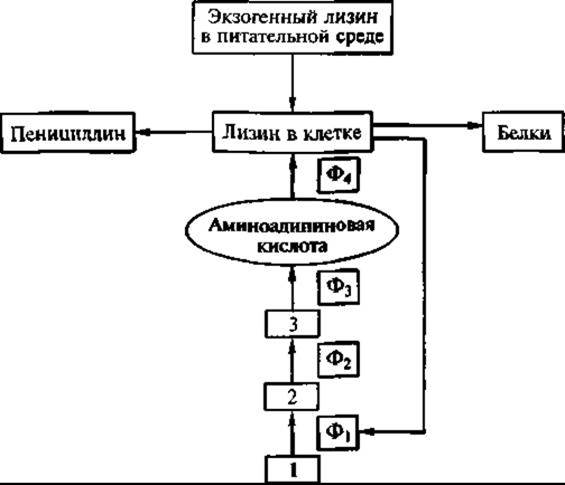
Fig. 8. Scheme of penicillin production suppression by lysine:
E1 — initial enzyme of the metabolic pathway; E2, E3, E4 — enzymes involved in the metabolic pathway; 1, 2, 3 — precursors of aminoadipic acid
Last update: 06/08/2026
Editorial and Educational Adaptation: This material has been compiled based on the primary/original source text. The project team performed an editorial review, corrected technical inaccuracies, structured sections, and adapted the content for an educational format.
What was processed:
- elimination of formatting defects (OCR errors, structural breaks, corrupted characters);
- editorial organization of content;
- standardization of terminology in accordance with academic sources;
- verification of factual statements against the original source text.
All mentions of the author, publication year, and origin of the primary text have been preserved in accordance with the source.