MEDICAL BIOLOGY, HUMAN ANATOMY, PHYSIOLOGY AND PATHOLOGY - Ya.I. Fedonyuk 2010
ANATOMY, PHYSIOLOGY, PATHOLOGY
SECTION 2. THE MUSCULOSKELETAL SYSTEM (THE MECHANICS OF MOVEMENT)
THE SKELETON OF THE HEAD. THE SKULL
The BONES OF THE HEAD collectively form the Skull (cranium). It serves as a protective enclosure for the Brain and certain Sensory Organs (Vision, smell, taste) (Fig. 2.7). In addition, the cranial bones provide structural support for the initial segments of the respiratory tract (Nasal cavity) and the Digestive System (Oral Cavity). Consequently, the skull is divided into the neurocranium (braincase) and the viscerocranium (facial Skeleton). The neurocranium is formed by two paired bones — the temporal and parietal bones — and four unpaired bones — the frontal, ethmoid, sphenoid, and occipital bones. The bones of the facial skeleton include six paired bones: the Maxilla, nasal, lacrimal, zygomatic, and palatine bones, as well as the Inferior nasal concha, and two unpaired bones: the Mandible and Vomer. The Hyoid bone is also classified among the facial bones.
Class="center">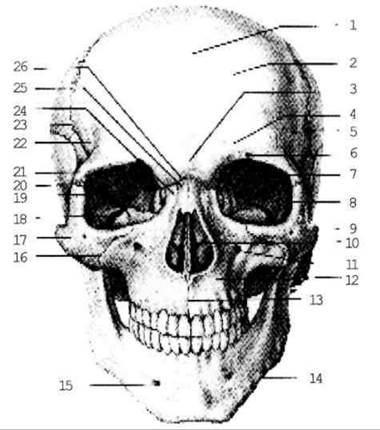
Fig. 2.7. The skull; anterior view.
Most cranial bones have a rather complex Structure, featuring numerous openings and canals for the passage of Blood Vessels and nerves. Some bones contain air-filled cavities or Cells (sinuses) within them. The shape of the skull depends on The Development of the brain and the masticatory apparatus. In humans, the neurocranium is significantly larger than the facial skeleton.
Last update: 08/08/2026
Editorial and Educational Adaptation: This material has been compiled based on the primary/original source text. The project team performed an editorial review, corrected technical inaccuracies, structured sections, and adapted the content for an educational format.
What was processed:
- elimination of formatting defects (OCR errors, structural breaks, corrupted characters);
- editorial organization of content;
- standardization of terminology in accordance with academic sources;
- verification of factual statements against the original source text.
All mentions of the author, publication year, and origin of the primary text have been preserved in accordance with the source.