Biochemical Engineering Fundamentals, Part 1 - Bailey J., Ollis D. 1989
Molecular Genetics and Regulatory Systems
Molecular Genetics
Induction and Repression; Regulation of Protein Synthesis
We already know that living Cells possess complex control systems that ensure the highly efficient use of material and energy resources. From the previous chapters, we also learned that the Activation and inhibition of enzymatic activity by metabolites allow these intermediates to be channeled along necessary pathways within the complex network of cellular reactions. In this section, we will examine another level of regulation that is fundamentally different from those mentioned above. Activation and inhibition affect the catalytic activity of Enzymes already present in The Cell, but do not alter their amounts. Thus, these modes of regulation act at the enzyme level. In contrast, The regulatory mechanisms discussed here—Induction and repression—alter the rates of Protein Synthesis (and, consequently, the amounts of enzymes contained in the cell) and operate at the Gene level. Apparently, the only similarity between these Two Types of regulation is their sensitivity to low-molecular-weight compounds.
Here, our main focus will be on the Regulation of Protein Synthesis at the genetic level in Bacteria, since the MOLECULAR MECHANISMS OF these processes have been best studied in these organisms. Similar mechanisms operate in the cells of Higher Plants and animals; however, the latter also possess a much less understood regulatory system that directs Cell Differentiation during Organism development.
Before diving into the details of the mechanisms of induction and repression, it is useful to try to appreciate The Role of protein synthesis regulation in the life of microorganisms. In Chap. 1, we already mentioned that bacteria are isolated, independently existing cells and therefore have virtually no effect on their external environment. It follows that bacteria must possess a very high capacity for adaptation; The ability to function efficiently under A wide variety of conditions may prove crucial for their survival.
Class="center">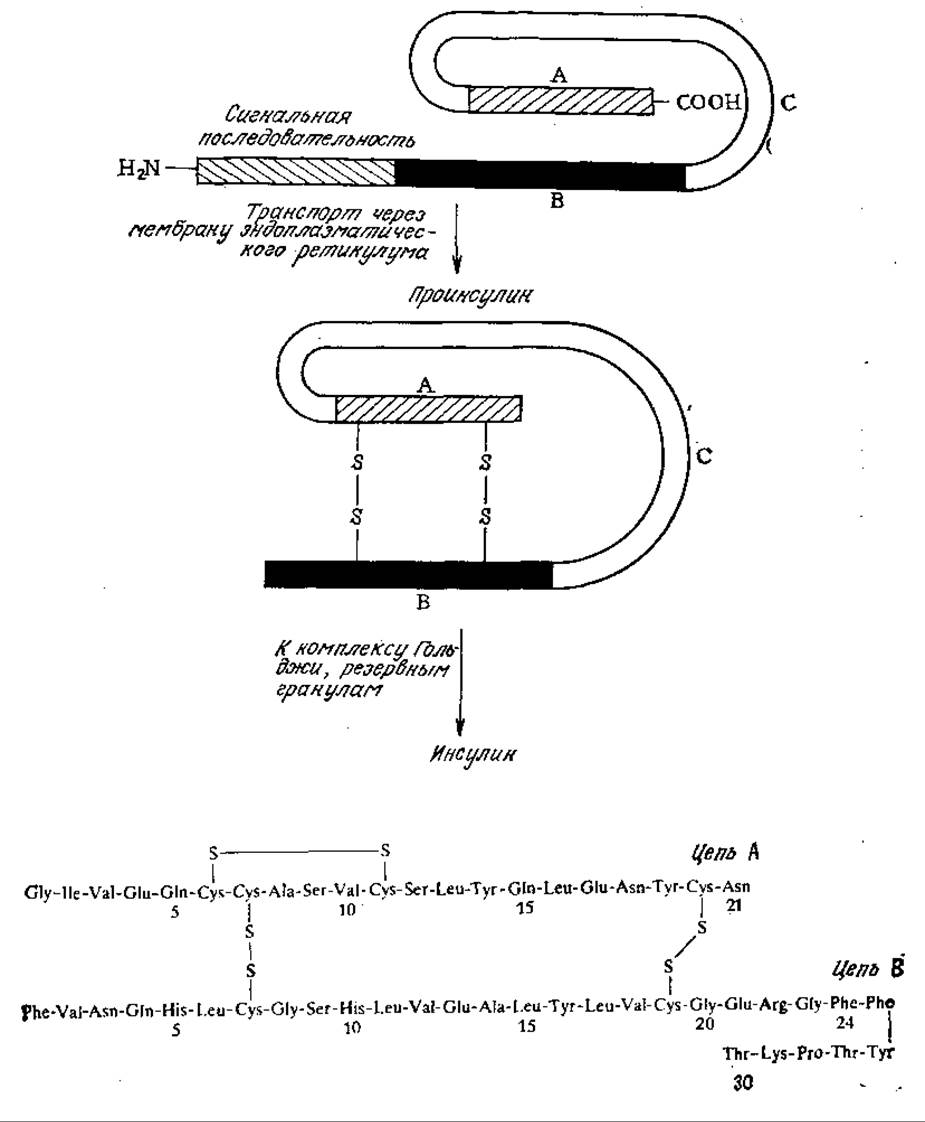
FIG. 6.8. The active form of Insulin is formed As a result of several post-translational Processing steps, including the Cleavage of the signal sequence, The formation of Disulfide Bonds, and the removal of the C-chain. The figure shows the Amino Acid Sequence of the A and B chains of human insulin.
Many bacteria indeed possess a high degree of adaptability. They can synthesize enzyme systems capable of efficiently utilizing a wide variety of nutrients. An example of a particularly versatile microorganism in this regard is the bacterium Pseudomonas multivorans, which can utilize more than 90 different compounds as its sole carbon source, including CARBOHYDRATES and their derivatives, Fatty acids, dicarboxylic and other organic acids, primary alcohols, Amino Acids and other nitrogen-containing compounds, and even cyclic compounds such as phenol. Typically, a specific enzyme is required for the assimilation of each nutrient. Consequently, the bacterium must carry Genetic information for The Structure of all required enzymes. All the genetic information contained in the cell's Chromosomes is called the cell's genotype.
However, such a bacterium does not simultaneously need all the enzymes capable of assimilating any nutrient, and the synthesis of superfluous Proteins involves a wasteful expenditure of energy and intermediate metabolites. Therefore, in a given environment and for maximum efficiency, only a fraction of the total genetic information is expressed in bacteria (i.e., manifested in the Synthesis of specific proteins). Phenotype refers to the observable traits of an organism. Considering the factors outlined above, it can be said that a given phenotype is determined by the combination of the organism's genotype and environmental conditions (its surroundings). Constitutive enzymes are synthesized independently of the composition and conditions of the environment.
In contrast, the Biosynthesis rate of inducible enzymes depends on the cell's surroundings. A typical example of such dependence is the synthesis of ß-galactosidase. This enzyme catalyzes the Hydrolysis of the disaccharide lactose into its constituent Monosaccharides, glucose and galactose. This reaction is necessary if the cell is forced to use lactose as a nutrient, since only monosaccharides can enter subsequent metabolic pathways. The E. coli bacterial cell regulates the synthesis of ß-galactosidase in accordance with the demand for this enzyme. With the appearance of lactose in the medium, the cell begins synthesizing the enzyme; this process accelerates as the lactose concentration increases, up to the maximum possible, fully induced level (Fig. 6.9). Thus, ultimately, it is the substrate that induces enzyme production.
A similar situation arises in the case of repressible enzymes. For example, E. coli can synthesize any enzymes required to produce all 20 amino acids from simpler precursors; at the same time, if the required Amino acids are present in the growth medium, the corresponding enzymes are not produced in the cell in any significant amounts. In this case, the end product of the biosynthetic pathway suppresses the synthesis of enzymes catalyzing individual steps of that same pathway. This phenomenon is also illustrated in Fig. 6.9, where Histidine synthesis is given as an example.
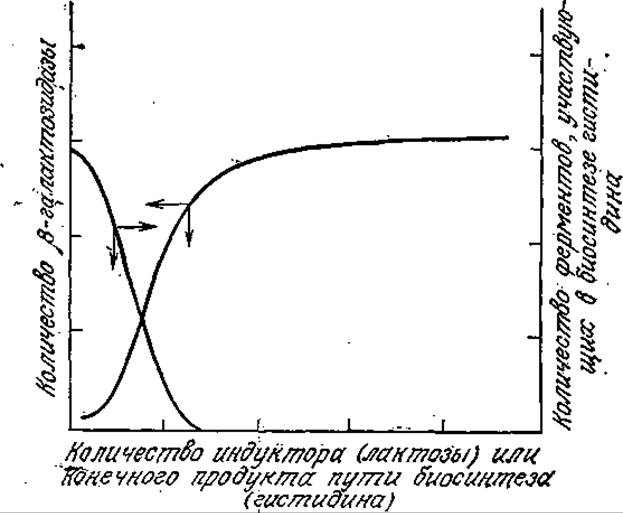
FIG. 6.9. The concentration of ß-galactosidase in the cell increases as the concentration of the inducer (lactose) in the nutrient medium rises. An increase in the concentration of the repressor (histidine) in the medium reduces the content of enzymes catalyzing The biosynthesis of the repressor in the cell. (Watson J., Molecular Biology of the Gene. — Moscow: Mir, 1978.)
Fig. 6.10 shows models of induction and repression processes developed by Monod and coworkers in France, reflecting the intrinsic similarity between these two processes. In both cases, Gene Expression is regulated at the METABOLISM/31.html">Transcription level, and the regulatory gene produces a protein that interacts with a specific DNA sequence called the operator. If the modulator protein is bound to the operator sequence, RNA polymerase cannot interact with the promoter; as a result, the transcription process is blocked, and the structural gene is not expressed.
In the induction model (Fig. 6.10, a), the regulatory gene produces a repressor molecule that can prevent enzyme synthesis. If an inducer is present in the medium, it binds to the repressor to form an inactive complex that does not interfere with subsequent Introduction/24.html">DNA Transcription.
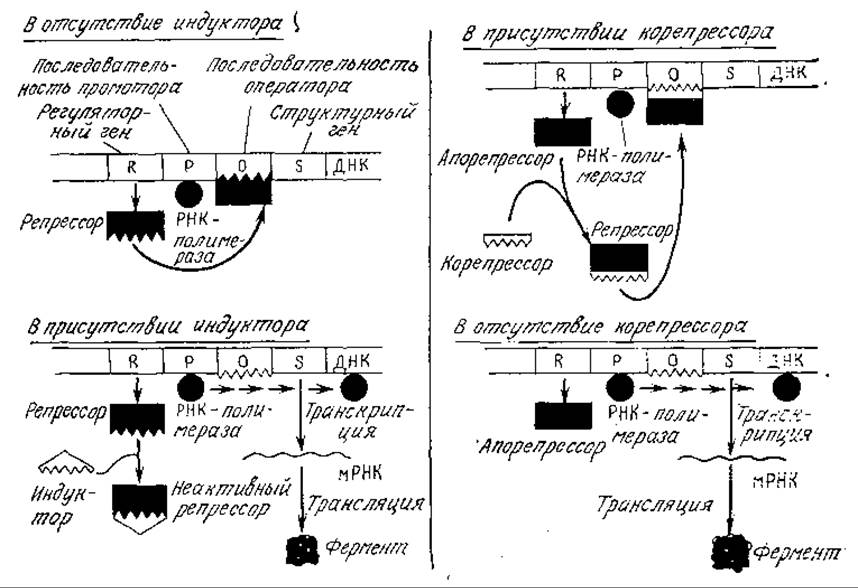
FIG. 6.10. Left: an inducer (e.g., galactose) inactivates the repressor so that the latter does not bind to the corresponding operator sequence and does not block the Transcription of the structural gene (e.g., the ß-galactosidase gene). Right: a corepressor (e.g., histidine) interacts with an aporepressor to form an active repressor, which, by binding to the operator, can block the expression of the structural gene; this is how the synthesis of repressible enzymes is regulated. [Reproduced from: Demain A. L., Theoretical and Applied Aspects of Enzyme Regulation and Biosynthesis in Microbial Cells, in Enzyme Engineering, Wingard L. B., Jr. (ed.), Interscience, New York, 1972.]
In the repression model (Fig. 6.10, b), the regulatory gene must form a complex with another molecule, resulting in the generation of a repressor. In the absence of a corepressor (histidine in the example given here), protein synthesis does not stop.
Such regulated promoters can simultaneously control the synthesis of several enzymes. During the induction of ß-galactosidase synthesis, for example, the synthesis of two other proteins is simultaneously stimulated, one of which is galactoside permease, involved in The Active Transport of ß-galactosides. Here, There is a clear logical connection between the Functions of these two proteins, so the coordination of their biosynthesis seems entirely justified. A group of jointly regulated genes is called an Operon; specifically, the system just mentioned is called the lac operon. A quantitative mathematical Analysis of the regulatory Properties of the lac promoter-operator will be discussed later in Sec. 7.5.3.
Although our Discussion focuses primarily on the Regulation of enzyme synthesis in bacteria, similar mechanisms are used to control the Synthesis of Other proteins in bacteria as well as in higher PLANT AND ANIMAL cells. In general, one should always bear in mind that the set of proteins synthesized by a cell and the associated biological and catalytic activities can change—and frequently do change—in response to variations in environmental composition and conditions. This capacity for adaptation gives rise to A number of problems when analyzing The kinetics of cellular reactions and designing bioreactors; such problems are completely atypical of Industrial processes using synthetic catalysts.
There are several variations of control at the genetic level. It is not feasible to consider all these variations here, but catabolite repression deserves mention. If E. coli bacteria are cultured in a medium containing glucose and another carbon source that is more difficult to incorporate into metabolic pathways, such as lactose, glucose is preferentially utilized. Under these conditions, lactose does not induce the synthesis of ß-galactosidase. In a cell growing rapidly on glucose, the formation of Cyclic AMP is inhibited. The concentration of cAMP (Fig. 2.8) affects The activity of the lac operon promoter in such a way that at low intracellular cAMP concentrations, induction is blocked or impaired. Because glucose catabolites lower the cAMP concentration, this mode of regulation is called catabolite repression.
It should be emphasized that catabolite repression can also occur in the absence of glucose. Typically, a bacterium growing on a mixture of carbon sources selectively utilizes the most favorable one (i.e., the one providing the highest growth rate) and catabolically suppresses the utilization of less favorable nutrients. What happens when the first carbon source is depleted? (See Chap. 7, the sections dedicated to Fermentation kinetics.)
Catabolite repression also plays an important role in the synthesis of metabolic products. During rapid cell growth, enzymes required for the Formation of secondary metabolites are frequently not synthesized. It follows that the biochemical engineer may face the very interesting and important task of minimizing catabolite repression while maximizing the accumulation of secondary metabolites. Ways to solve this problem will be discussed in Chaps. 7, 9, and 10.
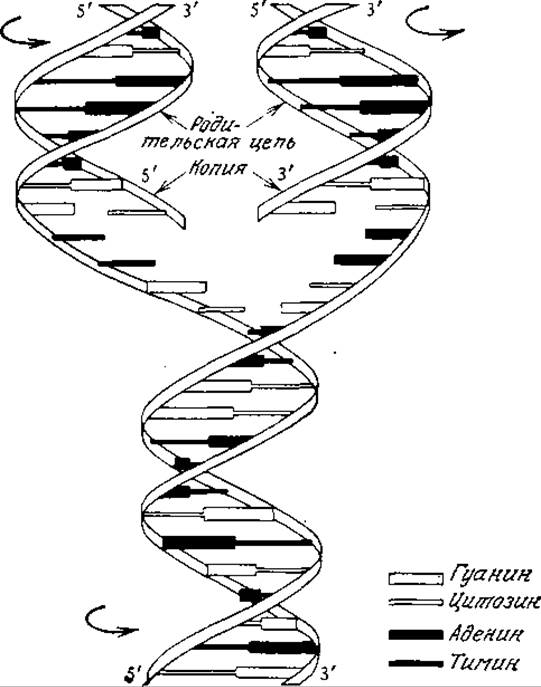
FIG. 6.11. A simplified scheme of DNA Replication. As the parental strands separate, a complementary strand is formed on each, resulting in two daughter molecules identical to the parental molecule. Note that each daughter molecule contains one strand of parental DNA. (A. Loewy, P. Siekevitz, Cell Structure and function. — Moscow: Mir, 1971.)
Last update: 06/08/2026
Editorial and Educational Adaptation: This material has been compiled based on the primary/original source text. The project team performed an editorial review, corrected technical inaccuracies, structured sections, and adapted the content for an educational format.
What was processed:
- elimination of formatting defects (OCR errors, structural breaks, corrupted characters);
- editorial organization of content;
- standardization of terminology in accordance with academic sources;
- verification of factual statements against the original source text.
All mentions of the author, publication year, and origin of the primary text have been preserved in accordance with the source.