Biochemical Engineering Fundamentals, Part 1 - Bailey J., Ollis D. 1989
Kinetics of Enzyme-Catalyzed Reactions
Other types of enzyme reaction rate dependence on substrate concentration
Activation and inhibition of enzymes by substrates
Not all enzyme-catalyzed reaction rates obey the Michaelis-Menten Equation described in Section 3.2. In this section, we will examine some of the most common deviations. The first type of deviation, typical of regulatory Enzymes, can be attributed to the binding of multiple substrate molecules to the enzyme. Next, we will describe a second type of deviation from the Michaelis-Menten equation, which occurs when the substrate is a mixture of different substances reacting with the enzyme and possessing distinct kinetic properties. Analyzing this second type of deviation helps highlight several challenges encountered when working with insufficiently purified or poorly characterized substrate mixtures.
The sigmoidal (S-shaped) curve of the reaction rate versus Substrate Concentration, characteristic of some enzymes, indicates an activation effect (Fig. 3.14). At low substrate concentrations, the binding of one substrate molecule by the enzyme increases the binding rate of the next molecule (mathematically, this means that dv/ds increases at this stage of the reaction). A model for such a process is the Cooperative binding of the substrate by protein subunits. Suppose that an enzyme, for example, with an oligomeric Structure, has several substrate-binding sites, and that the binding of the first substrate molecule to the enzyme alters The structure of the latter in such a way that the affinity of the remaining free sites for the substrate increases. The mathematical analysis of this model is analogous to the Analysis of the Hemoglobin model discussed in Exercise 2.10, and therefore we will not repeat it in the main text.
Class="center">
FIG. 3.14. Activation (a) and inhibition (b) of an enzymatic reaction by a substrate.
Sometimes, in the presence of high substrate concentrations, The rate of an enzyme-catalyzed reaction decreases as the substrate concentration increases (Fig. 3.15). This phenomenon is known as substrate inhibition. As shown in Fig. 3.15, in such cases, the reaction rate v first increases with rising substrate concentration, reaches a maximum, and then declines. If s is greater than the s corresponding to vmах, then a decrease in substrate concentration causes an increase in the reaction rate. The autocatalytic nature of this type of reaction can significantly affect the performance of biochemical reactors.
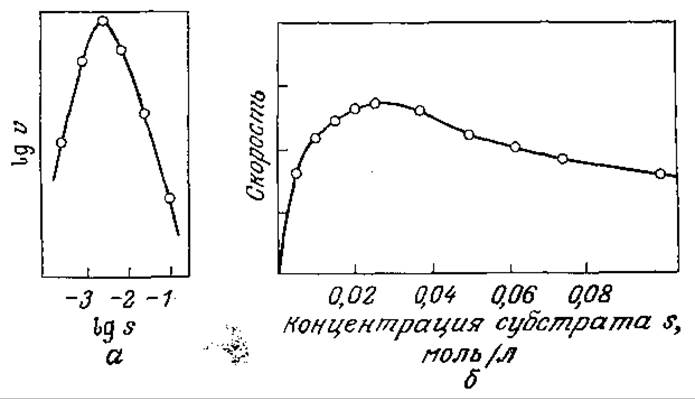
FIG. 3.15. Experimental detection of substrate inhibition. [Reproduced from: Laidler K. J., The Chemical Kinetics of Enzyme Action, p. 71, The Clarendon Press, Oxford, 1958. a — data from: Augustinsson K. D., Substrate Concentration and Specificity of Choline Ester Splitting Enzymes, Arch. Biochem., 23, 111 (1949); b — data from: Lumry R., Smith E. L., Glantz R. R., Kinetics of Carboxypeptidase Action. I. Effect of Various Extrinsic Factors on Kinetic Parameters, J. Amer. Chem. Soc., 73, 4330 (1951).]
The relationship between substrate concentration and the rate of a substrate-inhibited reaction can be quantified with high accuracy using the Michaelis-Menten approach, assuming that the enzyme can also bind a second substrate molecule, where The addition of S to ES yields an inactive intermediate. Under equilibrium conditions, the following sequential reactions will take place:

Based on these two equilibrium dissociation reactions, and taking into account the mass balance equation for the various enzyme states (analogous to Equation (3.7)), simple algebraic manipulation yields the following expression:

Experimental Determination of the parameters in this equation is straightforward. First, k can be determined by varying e0. Then, by plotting 1/v against s, the slope of the linear region of the curve at high substrate concentrations, which equals 1/K2ke0 (Fig. 3.16), can be estimated. Finally, K1 can be found using Equation (3.40); here, smax satisfies Equation (3.39) when dv/ds = 0.

Last update: 06/08/2026
Editorial and Educational Adaptation: This material has been compiled based on the primary/original source text. The project team performed an editorial review, corrected technical inaccuracies, structured sections, and adapted the content for an educational format.
What was processed:
- elimination of formatting defects (OCR errors, structural breaks, corrupted characters);
- editorial organization of content;
- standardization of terminology in accordance with academic sources;
- verification of factual statements against the original source text.
All mentions of the author, publication year, and origin of the primary text have been preserved in accordance with the source.