Biochemical Engineering Fundamentals, Part 1 - Bailey J., Ollis D. 1989
Kinetics of Enzyme-Catalyzed Reactions
Other Types of Enzymatic Reaction Rate Dependence on Substrate Concentration
Interaction of a Single Enzyme with Several Different Substrates
Many Enzymes can interact with multiple substrates. In such cases, different substrates compete for binding to the Active Site (here we assume that the active site for different substrates is the same region of the enzyme molecule). The most well-known Examples of this type of enzyme are hydrolytic depolymerases, which cleave many identical bonds, often regardless of the length of the hydrolyzed polymer segment. At the same time, the kinetic parameters of the reactions of such an enzyme with a dimer, trimer, or oligomer can differ significantly from those of a similar reaction with high-molecular-weight polymer chains. An example of such enzymes is Lysozyme, found in egg white, mucous secretions, and tears. Lysozyme hydrolyzes complex mucopolysaccharides, including Cell wall mureins, causing the death of Gram-positive Bacteria. The General Principles outlined above are supported by experimental data (Table 3.6), which shows the determined rates and dissociation constants for each lysozyme substrate in the absence of other substrates. It is easy to see that the most pronounced differences are characteristic of monomeric and oligomeric substrates.
Class="center">
FIG. 3.16. METHOD FOR DETERMINING the constant K2 from the slope of the linear plot of 1/v versus s. Data are presented for the Hydrolysis of ethyl butyrate by sheep Liver carboxypeptidase. (From: Dixon M., Webb E. Enzymes, Vols. 1–3. – Moscow: Mir, 1982, Vol. 1, p. 99.)
Table 3.6. Kinetic parameters of the reaction of lysozyme with Introduction/37.html">Bacterial cell wall components (GlcNAc—MurNAc copolymers; GlcNAc — N-acetylglucosamine, MurNAc—N-acetylmuramic acid)a

a From: Chipman D. M., A Kinetic Analysis of the Reaction of Lysozyme with Oligosaccharides from Bacterial Cell Walls; Biochemistry. 10, 1714 (1971).
In the examples above and below, each hydrolyzable bond of an oligomer or polymer can be considered an individual substrate. Moreover, a polymeric substrate such as starch is not actually an individual substrate in the strict sense, but rather a mixture of polymers of different molecular weights, which may also contain Different types of monomer-monomer bonds (Sec. 2.2.2). Fig. 3.17 illustrates the differences in the hydrolysis kinetics of various starches. An example of the Enzymatic hydrolysis kinetics of a more well-characterized system is shown in Fig. 3.18. This type of reaction is used industrially for the liquefaction of starch solutions by amylases. Similar effects are to be expected in other related reactions, such as the Hydrolysis of Proteins by Proteolytic Enzymes. Before proceeding to a quantitative assessment of competition between different substrates, it should be emphasized that in the above examples, other factors may play a role, particularly differences in the physical sizes and states of individual substrates, as well as the number of hydrolyzable bonds in each substrate present in the reaction mixture.

FIG. 3.17. Hydrolysis rate versus time curves for various amylose fractions by amyloglucosidase (25 °C; pH 4.6; s0 = 0.1 g/100 mL, e0 = 6.8∙10-8 M); molecular weights of the amylose fractions are approximately 1,650,000 (a), 1,100,000 (b), and 360,000 (c). [Reproduced with permission from: Hiromi K. et al., A Kinetic Method for the Determination of Number-Average Molecular Weight of Linear High-Polymer by Using an Exo-Enzyme, J. Biochem. (Tokyo), 60, 439 (1966).)
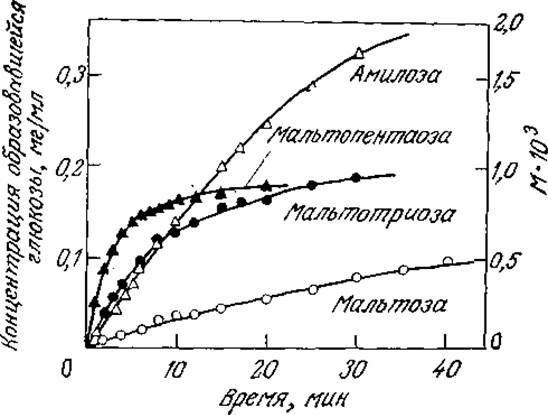
FIG. 3.18. Hydrolysis rate versus time curves for the enzymatic hydrolysis of glucose oligomers and polymers by amyloglucosidase (15 °C; pH 5.15; s0 = 0.04 M; e0 = 2.82∙10-7 M). [Reproduced from: Ono S., et al., Kinetic Studies of Gluc-amylase; J. Biochem. (Tokyo), 55, 315 (1964).]
Some hydrolytic enzymes exhibit selectivity toward different Regions of the biopolymer chain. Thus, exoenzymes cleave terminal (or near-terminal) chain bonds, whereas endohydrolases catalyze the hydrolysis of internal chain bonds. When describing The kinetics of such systems, It is important to consider both Types of Enzymatic reactions, as well as the "concentrations" of terminal and internal bonds in the biopolymer mixture. We will encounter this approach in the next chapter when studying the enzymatic hydrolysis of Cellulose.
Below, we will consider a simple but illustrative example that highlights some of the typical difficulties encountered in describing the Kinetics of Enzymatic reactions with substrate mixtures. Let reaction sequences (3.41) and (3.42) represent the interaction of two different substrates with the same enzyme:

Slow steps:

This implies that each substrate binds a certain fraction of the enzyme. If we then, as in our previous analyses of enzyme kinetics, use the total enzyme mass balance equation and equilibrium conditions, we obtain the following expressions for the reaction rates:
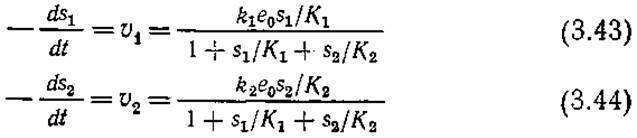
It follows from Eqs. (3.43) and (3.44) that if two reactions are catalyzed by the same enzyme, the rates of the individual reactions in the presence of both substrates are lower than in the presence of only one substrate. This fact has been successfully used to identify enzyme preparations; indeed, in this way, one can determine whether the same enzyme acts on both substrates or whether the reaction of each substrate is catalyzed by its own specific enzyme.
In experiments and Industrial processes, it is usually difficult or even impossible to determine and control the concentrations of all components in the reaction mixture. For example, the curves shown in Fig. 3.18 represent the progress of many simultaneous reactions, including the hydrolysis of maltose, maltotriose, etc. In other words, what is actually studied is not an individual reaction, but a hypothetical overall reaction of glucose polymer conversion to monomeric glucose catalyzed by the enzyme amyloglucosidase:

In this reaction, all substrates composed of glucose residues are lumped into an imaginary single substrate, the concentration of which can be determined relatively easily. This type of substrate lumping (or averaging) is widely used in all areas of chemical kinetics. Consider, for example, the catalytic cracking of gas oil. In design development or Reactor performance analysis, this process is often conveniently represented as the following two-step reaction:

although in this case, each of the reactants is obviously a mixture of compounds. In the scientific and technical literature on biology and biochemical engineering, such lumpings (or approximations), though not always so obvious, are very common in the study, modeling, and design of biological reactions and processes. In this book, we will carefully analyze the validity of these and similar simplifications used (usually implicitly) to describe biological systems. Unjustified simplifications can lead to serious errors in both theoretical research and engineering design.
Let us give an example of one such error. Suppose that sT represents the total concentration of all substrates in the mixture:

The overall conversion rate vT is then given by the expression

Clearly, the rate vT depends on The ratio of s1 and s2. For example, if the total Substrate Concentration has a fixed value sT0, the overall rate vT generally does not have a single defined value, but can vary within the following limits depending on the s1/s2 ratio:

It follows that the experimentally determined kinetic parameters vmax and Km will depend both on the mixture composition (the s1/s2 ratio) and on the total substrate concentration sT. Similarly, the performance parameters of an enzymatic reactor will change with variations in the relative amounts of substrates S1 and S2, even if the total concentration of reactants fed into the reactor is maintained at a constant level.
Last update: 06/08/2026
Editorial and Educational Adaptation: This material has been compiled based on the primary/original source text. The project team performed an editorial review, corrected technical inaccuracies, structured sections, and adapted the content for an educational format.
What was processed:
- elimination of formatting defects (OCR errors, structural breaks, corrupted characters);
- editorial organization of content;
- standardization of terminology in accordance with academic sources;
- verification of factual statements against the original source text.
All mentions of the author, publication year, and origin of the primary text have been preserved in accordance with the source.