Biochemistry - Chemical Reactions in Living Cells, Volume 2 - D. Metzler 1980
Biosynthesis: How New Molecules Are Formed
Regulation of Biosynthetic Processes
Lipogenesis
Let us consider another metabolic scenario. A high-carbohydrate diet leads to an elevation in Blood glucose concentration and replenishes Glycogen stores in Cells. The ATP content rises accordingly, inhibiting The Tricarboxylic Acid Cycle, which causes citrate to be exported from the Cell/35.html">Mitochondria (Fig. 11-11). In the extramitochondrial space, citrate is cleaved by ATP-citrate lyase [equation (7-70)] into acetyl-CoA and oxaloacetate. Next, oxaloacetate can be reduced to malate and subsequently oxidized by NADP+ to Pyruvate [equation (11-13)], which is able to re-enter the mitochondria. Through this pathway, acetyl groups are shuttled out of the mitochondria as acetyl-CoA, which can then undergo carboxylation (activated by citrate) to yield malonyl-CoA, the precursor for Fatty acids. The NADPH generated during malate oxidation supplies a portion of the reducing equivalents required for fatty acid synthesis. Additional NADPH is provided by the Pentose Phosphate Pathway. Thus, excess calories consumed in the form of CARBOHYDRATES are readily converted into fats. It is unlikely that these reactions proceed to any significant extent in most body cells; quantitatively, this process is most prominent in adipose tissue cells.
Not all mechanisms governing the REGULATION OF GLUCOSE and Lipid METABOLISM have been fully elucidated. It is clear, however, that The Cell possesses an integrated network of regulatory interactions, allowing the entire set of metabolic cycles to respond differentially to changing conditions. The Organism's response is always directed not only toward meeting the energetic demands of the cell, but also toward maintaining steady-state concentrations of cellular components within required limits.
1. a) What will be the [B]/[A] ratio at equilibrium for the reaction A → B if the standard Gibbs Free energy change ∆G' (pH 7) for this reaction at 25 °C is 25 kJ/mol?
б) Suppose that the reaction A—>В is coupled with ATP Hydrolysis and proceeds According to the scheme
Class="center">
Assume further that the group transfer potential (—∆G') for the phosphate group  at 25 °C (pH 7) is 12 kJ/mol, and that the Equilibrium Constant for the conversion
  is identical to the equilibrium constant for The conversion of A to B. Determine the equilibrium concentrations of A, B, and
  if the value of Rp (the phosphorylation potential) is 104 M-1.
2. A rat is fed palmitic acid labeled with the 14C isotope at the carboxyl group. Under these conditions, Liver glycogen levels do not increase, yet 14C appears in the glucose units of glycogen.
a) Outline the reaction sequence (using appropriate equations) by which the carbon atoms of glucose become labeled.
б) Explain why no net synthesis of new glycogen occurs from the fatty acid.
3. a) Write the reaction equations representing how the major portion of dietary tripalmitin ingested by an adult human is stored in adipose Tissues as tripalmitin.
б) What is the minimum amount of ATP (high-energy bonds) typically required to store 1 mole of dietary tripalmitin in adipose tissues? Consider only the ATP involved in tripalmitin metabolism, and account for the presence of a glycerol source in adipose tissue.
4. Describe the biochemical effects exerted by
a) Insulin, b) Glucagon, and c) adrenaline upon their administration to a normal animal.
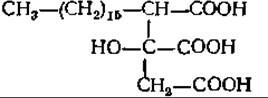
5. Consider possible biosynthetic pathways for the fungal metabolite agaricic acid:
6. The ketone palmitone, CH3(CH2)14*CO(CH2)14CH3, is synthesized by mycobacteria. It was found that when 1-14C-palmitic acid is administered in the diet, the carbon atom marked with the asterisk becomes labeled in this ketone. Consider a possible biosynthetic pathway for palmitone.
7. Reticulocytes (immature erythrocytes) contain mitochondria capable of both aerobic and anaerobic glucose oxidation. In an experiment where these cells were incubated in an oxygenated Krebs–Ringer solution containing 10 mM glucose, The addition of antimycin A led, after 15 min, to the changes in metabolite concentrations shown in the table1).
|
Metabolite |
Designation |
Concentration, µmol/L of cells |
|
|
before antimycin addition |
after antimycin addition |
||
|
Glucose-6-phosphate |
G6P |
460 |
124 |
|
Fructose-6-phosphate |
F6P |
150 |
30 |
|
Fructose-1,6-diphosphate |
FDP |
8 |
33 |
|
Triose phosphates |
TP |
18 |
59 |
|
3-Phosphoglycerate |
3PGA |
45 |
106 |
|
2-Phosphoglycerate |
2PGA |
26 |
19 |
|
Phosphoenolpyruvate |
PEP |
46 |
34 |
|
Pyruvate |
Pyr |
126 |
315 |
|
Lactate |
Lac |
1125 |
8750 |
|
ATP |
2500 |
1720 |
|
|
ADP |
280 |
855 |
|
|
AMP |
36 |
206 |
|
Explain the Observed changes in the concentrations of ATP, ADP, and AMP (see table). Express the concentration of each component after antimycin addition as a percentage of its initial concentration prior to the addition. Plot the content of each compound on the abscissa after antimycin addition, arranging them in the sequence corresponding to Glycolysis:

and the percentage changes along the ordinate, then connect the resulting points. The resulting curve is known as a crossover plot (the curve intersects the 100% line at one or more points).
8. It has been suggested that the substrate cycle involving Phosphofructokinase and fructose diphosphatase is utilized by bumblebees to warm their flight Muscles to 30 °C prior to flight initiation. Clark et al. [56] demonstrated that the maximum catalytic activities for both Enzymes are approximately 44 µmol/(min·g) of unheated tissue. In flying bees, glycolysis proceeds at a rate of approximately 20 µmol/(min·g) of tissue, without operating the substrate cycle. In resting bees at 27 °C, no substrate cycling was detected; however, at 5 °C, the substrate cycle operates at a rate of 10.4 µmol/(min·g), while glycolysis slows down to 5.8 µmol/(min·g). Assuming that the operation of the substrate cycle provides heat to warm the insect, estimate the time required for its Temperature to reach 30 °C, given that the maximum rate of the substrate cycle in a cold bee (5 °C) can reach 40 µmol/(min·g) and that the bee does not exchange heat with the environment.
1) From Ghosh A. K., Sloviter H. A., JBC, 248, 3035—3040 (1973).
Last update: 06/08/2026
Editorial and Educational Adaptation: This material has been compiled based on the primary/original source text. The project team performed an editorial review, corrected technical inaccuracies, structured sections, and adapted the content for an educational format.
What was processed:
- elimination of formatting defects (OCR errors, structural breaks, corrupted characters);
- editorial organization of content;
- standardization of terminology in accordance with academic sources;
- verification of factual statements against the original source text.
All mentions of the author, publication year, and origin of the primary text have been preserved in accordance with the source.