Biochemistry of Amino Acids - A. Majster 1961
General Biochemistry and Physiology of Amino Acid Metabolism
Synthesis of Peptide Bonds
Reactions Catalyzed by Hydrolytic Enzymes
When examining processes related to Protein Synthesis, it should first be noted that we possess a substantial body of knowledge regarding the Cleavage of Proteins into smaller Peptides and free Amino Acids. A vast number of distinct proteases have been isolated and studied. Research by Bergmann and Fruton [461–463] on synthetic peptides revealed differences between two Major Types of Enzymes: exopeptidases, whose activity is manifested only when one or more terminal groups are present in the substrate molecule, and Endopeptidases, which cleave peptide bonds located (often in the internal Regions of the protein molecule) adjacent to specific amino acid side-chain groups.
The Proteolytic Enzymes of the animal gastrointestinal tract have been studied in detail; the primary endopeptidases of this group include Pepsin, Trypsin, and Chymotrypsin. Exopeptidases, such as Carboxypeptidases and aminopeptidases, are also present in the gastrointestinal tract. Animal Tissues contain intracellular proteolytic enzymes (cathepsins) that are similar in properties to the digestive tract's proteolytic enzymes. Proteolytic enzymes are also found in plants; among them, Papain from the fruit of the melon tree Carica papaya, bromelain from pineapple, and ficin from fig latex deserve mention. Microorganisms likewise possess proteolytic systems, though they are generally less thoroughly studied than the proteases of Higher Plants and animals. It is worth noting that enzyme systems capable of breaking down Peptides and Proteins are widely distributed in nature. Many proteolytic enzymes have been obtained in crystalline form and extensively characterized regarding their Specificity, kinetics, and MECHANISM OF ACTION. These topics are thoroughly covered in the reviews by Bergmann and Fruton [461], Northrop and coworkers [464], Neurath and Schwert [465], Fruton and Bergmann [463], Smith [466, 467], and Green and Neurath [468].
The Physiological Role of the gastrointestinal proteolytic systems is clear; with the help of these enzymes, dietary proteins undergo Hydrolysis, likely yielding primarily their constituent amino acids. The proteolytic systems of certain microorganisms confer upon them the capacity to invade animal tissue. A notable example is the function of collagenase in certain spore-forming anaerobes (Clostridia). It has been established that The conversion of fibrinogen to fibrin in mammalian Blood is catalyzed by a proteolytic enzyme that cleaves a peptide from fibrinogen (p. 79). Intracellular proteolytic systems presumably catalyze the Breakdown of Proteins within The Cell. A series of studies has also investigated the possible participation of these enzymes in the Synthesis of Peptide Bonds; reactions representing the reversal of such bond hydrolysis have been achieved using various enzyme preparations.
The hydrolysis of a peptide bond by proteolytic enzyme systems typically proceeds almost to completion. Consequently, the equilibrium constants for these reactions are large, and the associated Standard Free energy changes are negative. Calculations of the Free Energy Changes involved in The formation of certain peptides (Table 25) indicate that at the concentrations of free amino acids found in most tissues (likely less than 0.01 M), the synthesis of peptide bonds via the reversal of hydrolysis is possible only to an extremely limited extent [469–471]. However, peptide bond synthesis in such systems could be promoted by (a) higher initial amino acid concentrations and (b) the removal of newly formed peptides from the system.
Class="center">Table 25. Free Energy and equilibrium constants for the synthesis of certain oligopeptides [469]

The free energy change associated with the formation of glycylglycine from Glycine is approximately 4000 cal/mol. Comparable values have been obtained for the formation of DL-alanylglycine and DL-leucylglycine. The free energy change for the formation of hippuric acid is lower than that for glycine dipeptides. Conversely, the Formation of the tetrasaccharide triglycylglycine from glycylglycine requires half as much energy as the formation of glycylglycine from glycine [472]. These data lead to the Conclusion that free energy changes decrease as the distance between electrically charged groups increases. Furthermore, the formation of benzoylglycine from benzoate and glycine requires less energy input than the formation of glycylglycine from two molecules of glycine; the free Energy Expenditure for the formation of benzoylglycylglycine from benzoate and glycylglycine is even smaller. Finally, in cases where neither reacting compound is a zwitterion—for instance, in the formation of N-benzoyltyrosylglycinamide—the free energy change is minimal. Nevertheless, the Free energy of peptide formation can be influenced by The Nature of The amino acid residues themselves (cf. The values of —∆F for DL-leucylglycine and DL-alanylglycine in Table 25). These considerations have led to the hypothesis that the free energy expenditure is greater for the formation of small peptides from amino acids than for the subsequent Condensation of these peptides into larger molecules.
The formation of peptide bonds catalyzed by hydrolytic enzymes has been observed in systems where the reaction product is insoluble and is thereby removed from the sphere of the reaction. For example, in the reaction catalyzed by chymotrypsin shown below, benzoyl-L-tyrosylglycine anilide precipitates out and can be obtained in a fairly significant yield:
Glycine anilide + Benzoyl-L-Tyrosine ⇄ Benzoyl-L-tyrosylglycine anilide + H2O.
A number of similar reactions have been described [473–477]. These include the formation of plasteins [478–482], which are insoluble high-molecular-weight peptides with molecular weights ranging from 2000 to 400,000. Plasteins are formed under specific conditions through the Introduction/43.html">Action of Certain hydrolytic enzymes (e.g., pepsin, papain, chymotrypsin) on partially hydrolyzed proteins. The exact nature and Biological Role of plasteins require further investigation. It appears that new peptide bonds are formed during plastein synthesis, and the products themselves represent complex mixtures of peptides.
Hydrolytic enzymes also catalyze other reactions that result in the creation of new peptide bonds. These include transformations known as transamidation and transpeptidation. Bergmann and Frunkel-Conrat [477] established that the papain-catalyzed reaction

proceeds via a direct displacement mechanism without prior hydrolysis of benzoylglycinamide into benzoylglycine and ammonia. This is supported by the fact that the formation of benzoylglycine anilide from benzoylglycine and aniline proceeds significantly slower than its synthesis from benzoylglycinamide and aniline. Fruton and coworkers [483–488] thoroughly investigated this phenomenon and discovered a series of analogous reactions. Fruton suggested that The Mechanism of these reactions involves the formation of an activated enzyme-substrate complex, which can react either with Water (leading to hydrolysis) or with a substituting compound (leading to a transfer reaction):
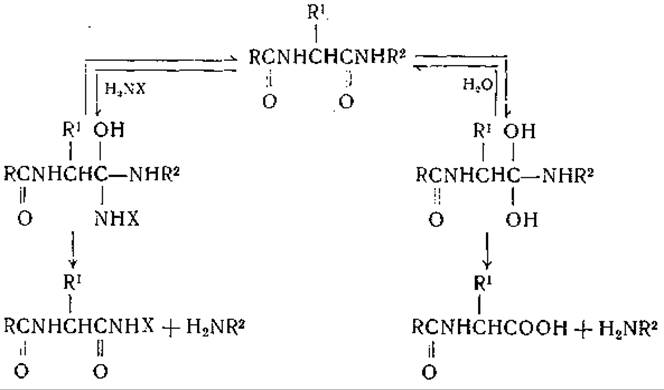
Consequently, water and substituting Reagents compete for the activated substrate. That this is not a simple competition is evidenced by the extremely high concentration of water relative to the substituting agent. The occurrence of transfer reactions accompanying Enzymatic hydrolysis is a general phenomenon observed, for example, during the action of glycosidases, amidases, and Phosphatases [489–491].
In reactions involving amides, ammonia can serve as the substituting agent. For instance, when benzoylglycinamide is incubated with papain in the presence of N15H3, isotopic nitrogen is detected in the amide group of benzoylglycinamide at various Stages of the hydrolytic process. Fruton and coworkers [483–488] also observed other displacement reactions. For example, incubating benzoyltyrosylglycinamide with glycinamide labeled with N15 in the glycine amino group in the presence of chymotrypsin yields N15-glycine-containing benzoyltyrosylglycinamide. Hydroxylamine has likewise been shown to act as a substituent in Reactions of the following type:

Such reactions have been carried out with a range of substrates (benzoylargininamide, carbobenzoxyisoasparagine) and various enzymes (papain, cathepsin C). Transpeptidation reactions leading to the elongation of the peptide chain have also been observed. For example, it was found that cathepsin C (from bovine Spleen) catalyzes the polymerization of glycyl-L-phenylalanylanilide to form an insoluble product containing octa- and decapeptides. Glycyl-L-tyrosinamide and other substrates also undergo polymerization under METABOLISM/18.html">The Influence of cathepsin C. Transformations described by Fruton and coworkers among transpeptidation reactions include:

Typically, such transfer reactions proceed at a maximal rate at pH 7–8, whereas hydrolysis occurs optimally around pH 5. In this regard, it has been suggested that The primary function of intracellular proteinases in the physiological pH range is to catalyze group transfer reactions.
Hanes and coworkers [492] described a transpeptidation system in cabbage leaves that catalyzes the following conversion:

This enzyme system also catalyzes the hydrolysis of glycyl amino acids. Trypsin and chymotrypsin were likewise found to catalyze transpeptidation reactions [493, 494].
Brenner and coworkers [499, 500] discovered that chymotrypsin, which is known to possess esterase activity [495–498], catalyzes the formation of peptides from amino acid esters. Incubation of chymotrypsin with amino acid esters leads to both hydrolysis and the formation of soluble and insoluble Peptides of the corresponding amino acids. These reactions are clearly analogous to transpeptidation (transamidation) systems.
Hanes and coworkers [492] reported that preparations from certain animal tissues are capable of catalyzing the Formation of γ-glutamyl peptides from Glutathione and free amino acids According to the equation:

In addition, these enzyme preparations catalyze the slow hydrolysis of glutathione and the resulting y-glutamyl amino acids. Glutathione could be replaced by a series of y-glutamyl amino acids, as well as certain Other Amino Acids. This reaction is catalyzed by extracts from the Kidneys and Pancreas, but not from the Liver. It was initially found that Arginine does not exhibit activity as a substituting agent; however, subsequent studies [501, 502] demonstrated the formation of y-glutamylarginine from arginine and glutathione. Hird and Springell [502] concluded that both the hydrolysis and transfer reactions are catalyzed by the same enzyme. It is possible that the formation of y-glutamyl amino acids plays a role in protein synthesis, either by stabilizing specific a-peptide bonds and thereby providing a potential source of a-peptides, or by facilitating the rearrangement of a y-glutamyl peptide into an a-glutamyl peptide. A similar rearrangement has been observed in non-enzymatic systems [503, 504]. A comparison of the incorporation rates of glycine and y-glutamylglycine into various animal tissue preparations showed that glycine is incorporated much more actively than y-glutamylglycine, whereas the Incorporation of Other amino acids upon The addition of glutamic acid or y-glutamyl derivatives increases only slightly [505]. While these studies do not rule out an essential role for y-transpeptidation in metabolism, the precise nature of its physiological Functions remains to be elucidated.
While The Role of y-glutamyl residue transfer in animal tissues is not yet fully understood, evidence indicates that the synthesis of polyglutamic acids produced by certain Bacteria, such as Bacillus subtilis, is closely linked to The transfer of these groups. Williams and Thorne [506–508] isolated an enzyme from B. subtilis culture filtrates that catalyzes the transfer of the y-glutamyl group from glutamine to D-glutamic acid or to a-D-glutamyl-D-glutamic acid, resulting in the formation of glutamic acid-containing di- and tripeptides. The enzyme appears to utilize both D- and L-isomers of glutamic acid. In the reaction between L-glutamine and D-glutamic acid, the transfer reaction proceeded more rapidly than the hydrolytic cleavage of glutamine, leading to the accumulation of peptides containing up to six amino acid residues as reaction products. The same enzyme preparation catalyzes the hydrolysis of the natural polypeptide and the transfer of y-glutamyl groups from this polypeptide to D-glutamic acid, yielding y-glutamylglutamic acid. Although the sequential steps of The Biosynthesis of this polypeptide in B. subtilis Cells require further investigation, the available data strongly support the involvement of y-glutamyl transfer reactions in this process.
Last update: 06/08/2026
Editorial and Educational Adaptation: This material has been compiled based on the primary/original source text. The project team performed an editorial review, corrected technical inaccuracies, structured sections, and adapted the content for an educational format.
What was processed:
- elimination of formatting defects (OCR errors, structural breaks, corrupted characters);
- editorial organization of content;
- standardization of terminology in accordance with academic sources;
- verification of factual statements against the original source text.
All mentions of the author, publication year, and origin of the primary text have been preserved in accordance with the source.