Biochemistry of Amino Acids - A. Meister 1961
Intermediary Metabolism of Amino Acids
Glycine, Serine, and Sarcosine
Glycine
These Amino Acids are considered together because of their close chemical Structure and metabolic interrelationship. During its METABOLISM, glycine is converted into Other Amino Acids, nucleic acid components, Porphyrins, Lipids, and CARBOHYDRATES. Although glycine is the simplest amino acid in structure, its Intermediary Metabolism presents an extremely complex picture.
It is known that glycine is relatively easily synthesized in the bodies of mammals, as well as in microorganisms and plants. However, under certain conditions, chicks require dietary glycine (p. 122). Glycine formation occurs via various pathways—the Cleavage of Serine (p. 325), The breakdown of Threonine into glycine and acetaldehyde (p. 336), the demethylation of Sarcosine (p. 330), and the amination of glyoxylic acid (see p. 225). These reactions have been detected in animal Tissues. During Photosynthesis, labeled СО2 is rapidly incorporated into glycolic acid and glycine; these findings indicate The formation of glycine from glyoxylic acid [114]. The pathways of glycine formation in microorganisms have not been studied in detail. However, data exist on the mutual conversion of glycine and serine in A number of microbes [115, 116]. In Escherichia coli, glyoxylic acid apparently does not convert into glycine [117], whereas the formation of glycine from serine likely takes place [118—120].
Weinhouse and coworkers [121—124] demonstrated that the Interconversion of Glycine and glyoxylic acid occurs in the rat Organism. Glycine, glyoxylic acid, and glycolic acid are rapidly oxidized by rat Liver slices to form СО2, oxalic acid, and hippuric acid (the latter appears in the presence of benzoic acid). Using the isotope trap method, The conversion of glycine to glyoxylic acid was proven in rat liver homogenate. It was found that oxalic acid is formed not directly from glycine, but from glyoxylic acid under conditions where the latter is present in relatively high concentrations. Further studies revealed that under normal conditions oxalic acid is probably not formed, and that the α-carbon atoms of glycine, glycolic acid, and glyoxylic acid are converted into formic acid.
These data can be summarized as follows:
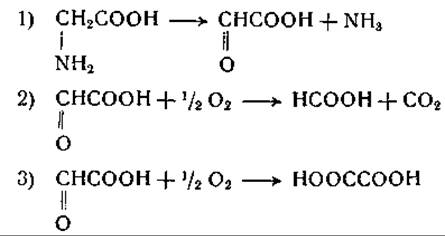
Reaction (3) can proceed with the participation of xanthine dehydrogenase [125], as well as another enzyme found in pigeon liver [123]. Reaction (2) can occur non-enzymatically with the participation of hydrogen peroxide, as well as under The Influence of an enzyme system not yet studied in detail. The conversion of glycine to glyoxylic acid occurs via Oxidative Deamination or Transamination (p. 226).
It has been proven that formic acid is rapidly oxidized to СО2:
Class="center">НСООН + Н2О2 → СО2 + 2Н2О.
This reaction, observed in PLANT AND ANIMAL tissues [126], can proceed via the peroxidase activity of catalase, utilizing hydrogen peroxide generated during other reactions [123].
Other pathways for the formation of glyoxylic acid (other than from glycine) remain yet to be fully elucidated. In certain Bacteria, glyoxylic acid is produced through the cleavage of isocitric acid [127, 128]. The formation of glycine from ribose-5-phosphate has been observed in spinach leaf extracts. This process apparently proceeds via glycolaldehyde, glycolic acid, and glyoxylic acid as intermediate products [129–131].
Glyoxylic acid is also formed through the action of Glycine Oxidase (p. 192) on sarcosine, According to the following equation:
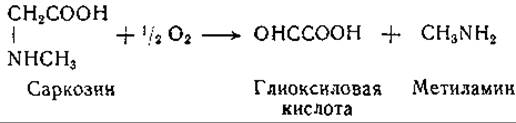
The physiological significance of this reaction, as well as of the analogous conversion of glycine, has been questioned [132], since this oxidase system appears to function only at very high substrate concentrations. Glyoxylic acid is also produced during The oxidation of ethanolamine [123, 133] via its deamination to glycolaldehyde followed by the further oxidation of the latter.
The carbon atoms of glycine are incorporated into Purines (p. 283), porphyrin (p. 322), Glutathione [134] (p. 268), glycocholic acid, hippuric acid [135] (p. 266), and creatine. Isotope tracer studies have established that creatine synthesis proceeds via a transamidination reaction between Arginine and glycine, followed by the methylation of guanidinoacetic acid (glycocyamine) [136, 137] (p. 372):
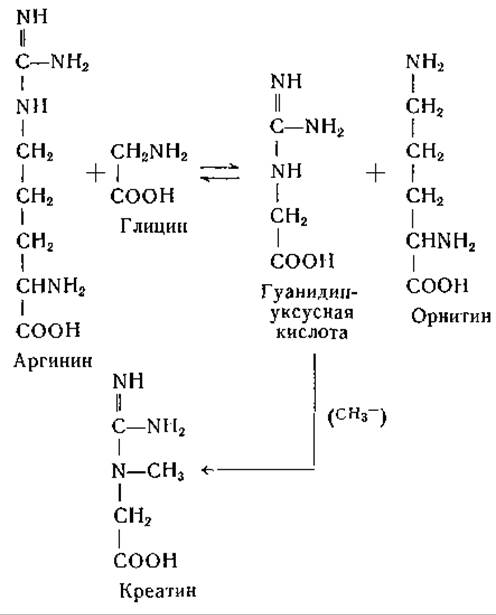
It has recently been demonstrated that the transamidination reaction is reversible [138]. This reaction takes place in the Kidneys, whereas the Methyl group transfer reaction occurs predominantly in the liver. Patients with progressive muscular dystrophy are characterized by The excretion of large amounts of creatine in the urine, resulting from the inability of the Muscles to utilize creatine; the urinary creatine is synthesized not in the muscles, but in the liver [139]. Phosphocreatine formed in muscles appears to be the precursor of urinary creatinine, which is generated through the cyclization of phosphocreatine accompanied by the cleavage of its phosphate group [140]:
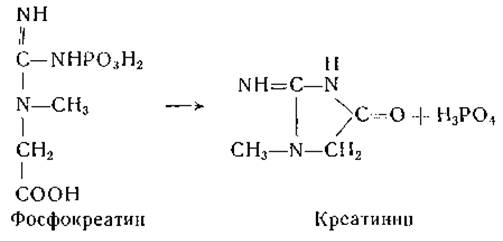
The synthesis of creatine appears to be irreversible; for instance, the methyl group incorporated into creatine is no longer labile. In humans, Dietary intake of Methionine and glycine does not affect urinary creatinine excretion. Interestingly, in chicks, the dietary requirement for glycine (p. 122) can be reduced by the administration of creatine [141].
An anaerobic conversion of glycine into acetic acid has been observed in Diplococcus glycinophilus. Based on isotopic studies, it is believed that this process involves the Condensation of two molecules of glycine followed by the decarboxylation (cleavage of carboxyl groups) [142]. An Achromobacter strain was found to oxidize glycine with the formation of ammonia and hydrogen peroxide [143]. This pathway of glycine metabolism appears to be analogous to its oxidation in mammalian tissues, yielding glyoxylic and formic acids as intermediates (see also [144]).
Last update: 06/08/2026
Editorial and Educational Adaptation: This material has been compiled based on the primary/original source text. The project team performed an editorial review, corrected technical inaccuracies, structured sections, and adapted the content for an educational format.
What was processed:
- elimination of formatting defects (OCR errors, structural breaks, corrupted characters);
- editorial organization of content;
- standardization of terminology in accordance with academic sources;
- verification of factual statements against the original source text.
All mentions of the author, publication year, and origin of the primary text have been preserved in accordance with the source.