Biochemistry of Amino Acids - A. Meister 1961
General Biochemistry and Physiology of Amino Acid Metabolism
Oxidative Deamination
Non-Oxidative Deamination
Reactions of non-oxidative AMINO ACID DEAMINATION have been discovered in microorganisms and animal Tissues. The Enzymes catalyzing these reactions exhibit a relatively high Specificity, each acting on one specific amino acid. During the deamination of Serine, Threonine, homoserine, Cysteine, and homocysteine, Water or hydrogen sulfide elements are removed from The amino acid molecule, leading to The formation of a double bond between the α- and β-, or β- and γ-carbon atoms. The rearrangement of the intermediate product into the corresponding imino acid is followed by Hydrolysis to yield an α-keto acid and ammonia. For instance, the deamination of homoserine can be represented as follows:
Class="center">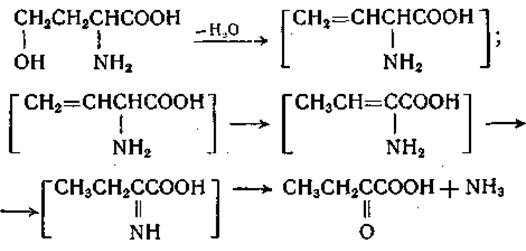
The deamination of serine, threonine, homocysteine, and cysteine can be represented in a similar manner. These reactions are discussed in the relevant sections of Chapter IV. The involvement of Pyridoxal phosphate has been established for Reactions Catalyzed by L-cysteine and L-homocysteine desulfhydrases and by L- and D-serine dehydratases. It is hypothesized that desulfurization and dehydration reactions proceed via a Schiff base intermediate, in the formation of which the aldehyde group of pyridoxal participates (p. 245). It should be noted that the desulfurization of cysteine can also occur indirectly through a Transamination pathway. In this pathway of hydrogen sulfide formation, catalyzed by the desulfurization enzyme system, pyridoxal phosphate is required for the transamination step. The formation of hydrogen sulfide from cysteine is discussed in the relevant section of Chapter IV.
During The breakdown of Histidine, with urocanic acid (β-imidazoleacrylic acid) as an intermediate (p. 393), the first step involves the deamination of histidine. Various authors have used different names for the enzyme carrying out this reaction: histidase deaminase, deaminohistidase, histidine α-deaminase, and histidase. The latter term was previously used to denote an enzyme system causing a more extensive degradation of histidine with the Cleavage of the imidazole ring. It was subsequently discovered that preparations of "histidase," the isolation of which was described in earlier works, contained Urocanase and possibly Other Enzymes as well. The reaction catalyzed by histidase is analogous to that carried out by aspartase:

These reactions are also discussed in other sections [p. 312 (aspartase) and p. 390 (histidase)].
The reaction catalyzed by tryptophanase represents another example of non-oxidative deamination. In this reaction, Tryptophan is broken down without oxygen uptake into indole, pyruvic acid, and ammonia (p. 408).
Reactions Involving the simultaneous deamination of Two Amino Acids through their mutual Oxidation and reduction have been found in certain anaerobic microorganisms. In Clostridium sporogenes and some other Bacteria, reactions of this type serve as the sole source of energy. This phenomenon was first described by Stickland and is now known as the "Stickland reaction" [185]. Microorganisms exhibiting the Stickland reaction mostly belong to the family Clostridiaceae, although this reaction is not found in all Clostridium species [185, 186]. Stickland found that Cl. sporogenes Cells catalyze the reduction of methylene blue and benzyl viologen in the presence of Certain amino acids acting as hydrogen Donors. He also established that Cl. sporogenes cells, during the reaction catalyzed by histidase, are analogous to those carried out by aspartase:
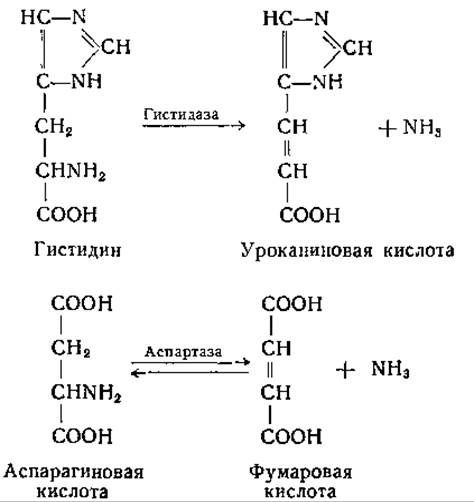
These reactions are also discussed in other sections [p. 312 (aspartase) and p. 390 (histidase)].
The reaction catalyzed by tryptophanase represents another example of non-oxidative deamination. In this reaction, tryptophan is broken down without oxygen uptake into indole, pyruvic acid, and ammonia (p. 408).
Reactions involving the simultaneous deamination of two amino acids through their mutual oxidation and reduction have been found in certain anaerobic microorganisms. In Clostridium sporogenes and some other bacteria, reactions of this type serve as the sole source of energy. This phenomenon was first described by Stickland and is now known as the "Stickland reaction" [185]. Microorganisms exhibiting the Stickland reaction mostly belong to the family Clostridiaceae, although this reaction is not found in all Clostridium species [185, 186]. Stickland found that Cl. sporogenes cells catalyze the reduction of methylene blue and benzyl viologen in the presence of certain amino acids acting as hydrogen donors. He also established that Cl. sporogenes cells, with the participation of another group of amino acids acting as hydrogen acceptors (Table 19), catalyze the Oxidation of reduced Dyes.
Table 19 Behavior of amino acids in the Stickland reaction
|
Hydrogen donors |
Hydrogen acceptors |
|
L-Aspartic acid |
|
|
L-Leucine |
|
|
L-Isoleucine |
L-Proline |
|
L-Valine |
L-Hydroxyproline |
|
L-Alanine |
L-Arginine |
|
L-Phenylalanine L-Cysteine L-Serine L-Histidine L-Glutamic acid |
L-Tryptophan |
When both a donor Amino Acid and an acceptor amino acid are simultaneously present in the system, ammonia and carbon dioxide are formed. The reaction between glycine and alanine proceeds as follows:
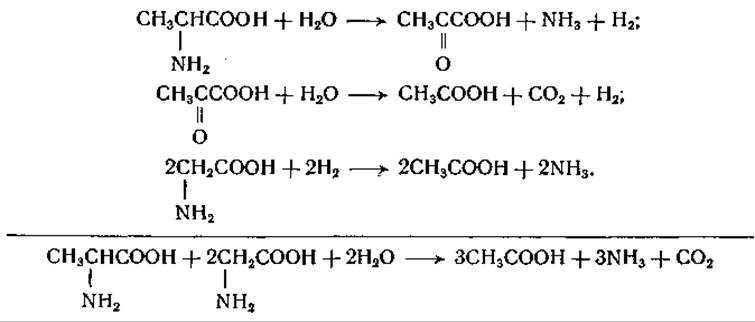
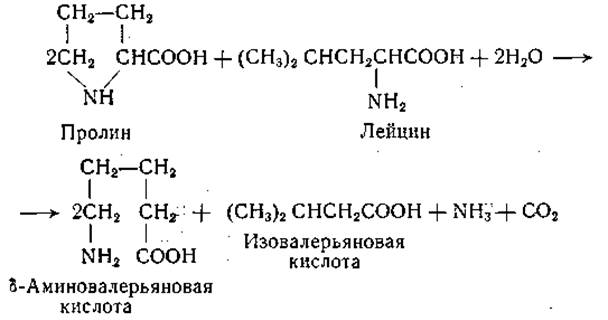
Similar reactions are observed among Other Amino Acids, one of which always acts as a hydrogen acceptor and the other as a hydrogen donor [187–190]. Proline is converted into 5-aminovaleric acid as a reaction product, while Isoleucine, Leucine, and Valine yield α-methylbutyric, isovaleric, and isobutyric acids, respectively. The overall equation for the reaction between proline and leucine is expressed as:
Nisman and Vinet [191] discovered that under aerobic conditions, amino acids serving as hydrogen donors are converted predominantly into the corresponding Fatty acids; however, small amounts of the corresponding α-keto acids also appear alongside them. Based on these observations, The Mechanism of the Stickland reactions can be represented by the following scheme:
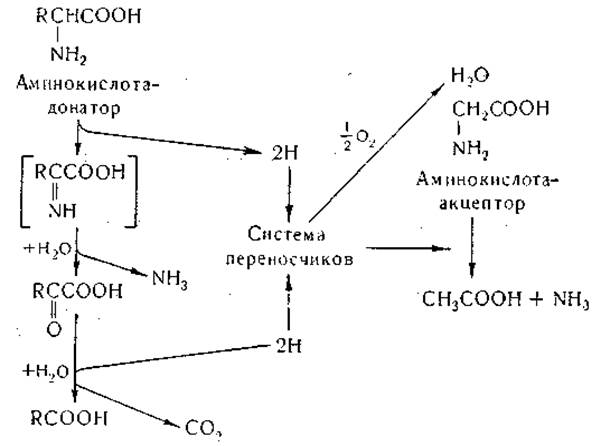
According to Nisman, under aerobic conditions, acceptor Amino Acids and oxygen compete for the hydrogen split off from the donor amino acid. Evidence indicates that diphosphopyridine nucleotide participates as a hydrogen carrier in the Stickland reaction [187, 188]; specifically, it has been established that diphosphopyridine nucleotide can be reduced by alanine, and the reduced coenzyme is reoxidized by proline or glycine. Recent studies show that the coupled oxidative and reductive deamination process described by Stickland consists of a complex series of intermediate reactions; certain aspects of this process, such as The Nature of the systems involved in hydrogen transfer, require further study. Currently available data are compatible with Nisman's scheme presented above [187].
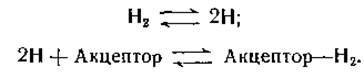
Certain Clostridium species are also capable of degrading individual amino acids, such as serine, histidine, glutamic acid, Methionine, and Tyrosine; the degradation products include ammonia, hydrogen, and carbon dioxide. It is also known that Cl. sporogenes can catalyze the reduction of certain amino acids in the presence of gaseous hydrogen, According to the equation:

The generation and utilization of gaseous hydrogen in these reactions are mediated by the action of Hydrogenase [187]:
Last update: 06/08/2026
Editorial and Educational Adaptation: This material has been compiled based on the primary/original source text. The project team performed an editorial review, corrected technical inaccuracies, structured sections, and adapted the content for an educational format.
What was processed:
- elimination of formatting defects (OCR errors, structural breaks, corrupted characters);
- editorial organization of content;
- standardization of terminology in accordance with academic sources;
- verification of factual statements against the original source text.
All mentions of the author, publication year, and origin of the primary text have been preserved in accordance with the source.