Biochemistry of Amino Acids - A. Meister 1961
Intermediary Metabolism of Amino Acids
Isoleucine, Leucine, and Valine
Catabolism of Branched-Chain Monoaminocarboxylic Acids
The Catabolic pathways of valine, isoleucine, and leucine have been investigated in experiments using mammalian Tissues. Apparently, the transformations of these Amino Acids are similar: all undergo Transamination to yield the corresponding α-keto acids, followed by irreversible oxidative decarboxylation, which converts their carbon skeletons into the corresponding acyl-CoA derivatives. Early studies established that the METABOLISM of leucine and isovaleric acid in mammals gives rise to Ketone Bodies [413–415]. Specific steps in The conversion of leucine to acetoacetic acid were elucidated using isotopic Methods and, more recently, through enzymatic studies. Experiments with isotopic carbon demonstrated that the C-1 and C-2 atoms of isovaleric acid—corresponding to the α- and β-carbon atoms of the leucine molecule—give rise to two-carbon fragments that can condense to form acetoacetic acid [416–419]. The carbon atoms of the isopropyl methyl groups become the methyl and methylene carbon atoms of acetoacetic acid. The γ-carbon atom of the leucine molecule (or the C-3 atom of isovaleric acid) is converted into the carbonyl carbon of acetoacetic acid. These studies also proved the incorporation of CO2 into the carboxyl group of acetoacetic acid [418, 420]. Enzymatic experiments conducted by Coon and co-workers [421–423, 1102] led to the identification of the intermediates and reactions shown below:
Class="center">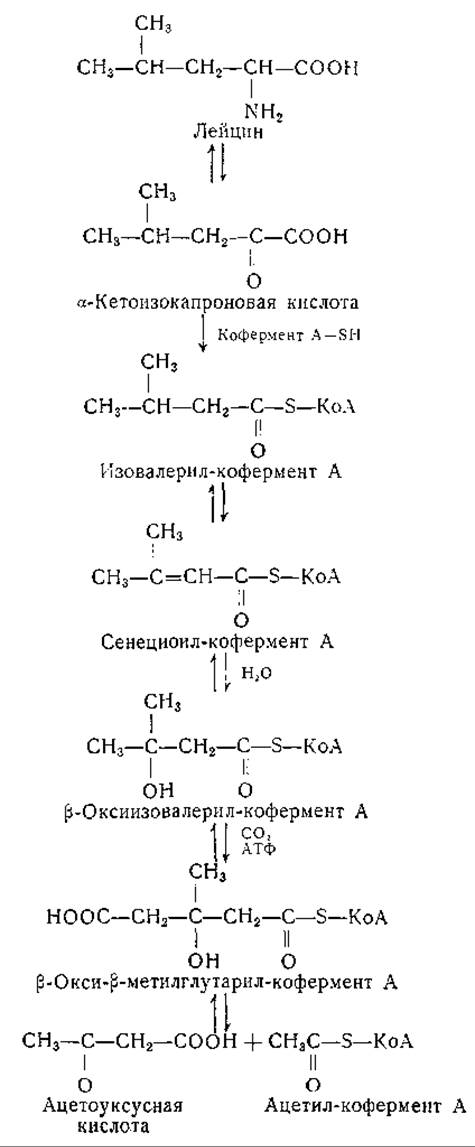
By analogy with the conversion of Pyruvate to acetyl-CoA, it is postulated that the decarboxylation of α-ketoisocaproic acid yields isovaleryl-CoA, which is subsequently oxidized to senecioyl-CoA (analogous to the reactions of straight-chain Fatty acids [424, 425]). The conversion of senecioyl-CoA to β-hydroxyisovaleryl-CoA was demonstrated in experiments using Heart Muscle preparations and purified Liver crotonase, an enzyme that catalyzes the interconversion of crotonyl-CoA and β-hydroxybutyryl-CoA. The addition of CO2 to β-hydroxyisovaleryl-CoA to form β-hydroxy-β-methylglutaryl-CoA apparently proceeds with the participation of ATP. β-Hydroxy-β-methylglutaryl-CoA has been synthesized chemically; it is cleaved by pig heart preparations (in the presence of Cysteine or Glutathione) to yield acetoacetic acid and acetyl-CoA [426]. The outlined pathway of leucine degradation is consistent with the well-known ketogenic properties of this amino acid. Because the decarboxylation step in this process is irreversible, this scheme agrees with the fact that animals cannot synthesize leucine from any metabolic intermediates other than its corresponding α-keto acid (or α-hydroxy acid).
According to Coon [421], ATP may react with CO2 to form an "activated" carbon dioxide species capable of adding to β-hydroxyisovaleryl-CoA to yield β-hydroxy-β-methylglutaryl-CoA ∆1:

1 In 1959, F. Lynen and co-workers established that the "activated carbon dioxide" generated during reversible enzymatic decarboxylation-carboxylation processes is a labile addition product of CO2 and the biotin residue in biotin-containing Enzymes. The conversion of leucine to acetoacetic acid described above involves a biotin enzyme (β-methylcrotonyl-CoA carboxylase); its carboxy derivative (COO--biotin-enzyme) transfers the carboxyl group to β-methylcrotonyl-CoA (senecioyl-CoA in the scheme above) to form methylglutaconyl-CoA, which then adds a molecule of Water to yield β-hydroxy-β-methylglutaryl-CoA (F. Lynen et al., Angewandte Chemie, 71, 481, 1959). — Transl. Note.
The breakdown of valine proceeds via a series of enzymatic reactions similar to those involved in leucine metabolism, although the final products of these amino acid transformations differ. It has long been known that valine serves as a precursor for Glycogen formation [427–430]. Judging by isotope-labeling experiments, valine is degraded to yield a three-carbon acid that can participate in glycogen synthesis [429, 430]. The pathway of valine transformation shown below is consistent with these experimental findings [421, 423, 431]:

The formation of methacrylyl-CoA is postulated by analogy with the intermediate reactions of leucine degradation. Experiments with enzyme preparations indicate that this compound can be hydrated to form β-hydroxyisobutyryl-CoA. The isobutyryl moiety of this compound is presumably converted into propionic acid [432], the carbon atoms of which originate from the isopropyl group of valine. β-Hydroxyisobutyryl-CoA is apparently converted into β-hydroxyisobutyric acid, which can be transformed into methylmalonate semialdehyde. The latter compound may undergo transamination to yield β-aminoisobutyric acid (which is also a degradation product of thymine) or oxidation to methylmalonic acid. The carboxylation of propionyl-CoA in the presence of CO2 has also been described [433].
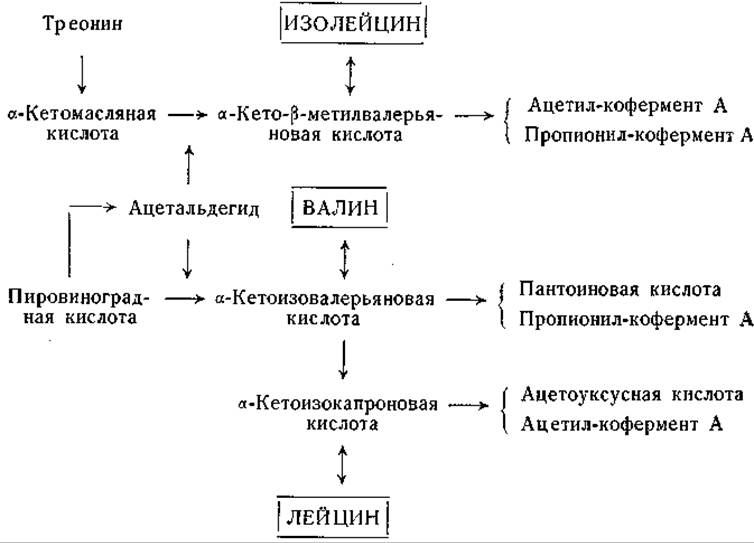
Fig. 15. Summary scheme of the transformations of isoleucine, leucine, and valine.
Under certain conditions, isoleucine exhibits ketogenic properties, whereas under others it is converted into CARBOHYDRATES [434–436]. Coon and co-workers [421, 423, 437–439] established in their studies that both two-carbon and three-carbon fragments are formed during the breakdown of leucine in liver slices. Further investigations by these authors support the isoleucine degradation pathway presented below:

Isoleucine is converted into an α-keto acid, The oxidative decarboxylation of which yields α-methylbutyryl-CoA. Coon and his colleagues found that tiglic acid (cis-2-methylcrotonic acid) is hydrated by liver and heart preparations or by purified crotonase. The conversion of tiglyl-CoA to acetyl-CoA is inferred from the formation of citric acid in systems containing oxaloacetate and DPN. The last two reactions in the scheme above appear plausible by analogy with the intermediate steps in The oxidation of straight-chain fatty acids [440] and have recently been proven experimentally [439]. A purified coenzyme A transferase catalyzing the following reaction has been isolated from pig heart:

Branched-chain amino acids likely serve as precursors for several structurally related natural compounds. For instance, in E. coli [441, 442], α-ketoisovaleric acid gives rise to pantoic acid:

There is a report on the presence of an α-amino analogue of pantoic acid in E. coli hydrolysates [433], although Maas and Davis [444] dispute these findings.
The Biosynthesis of pantothenic acid has been studied using a purified enzyme isolated from E. coli [445, 446], which catalyzes the formation of pantothenate from ATP, pantoate, and β-Alanine. Experimental data indicate that this reaction proceeds via an enzyme-bound complex of pantoic and adenylic acids as an intermediate (see p. 311). It is worth noting that at least six amino acids are involved in the construction of the coenzyme A molecule [1103]:
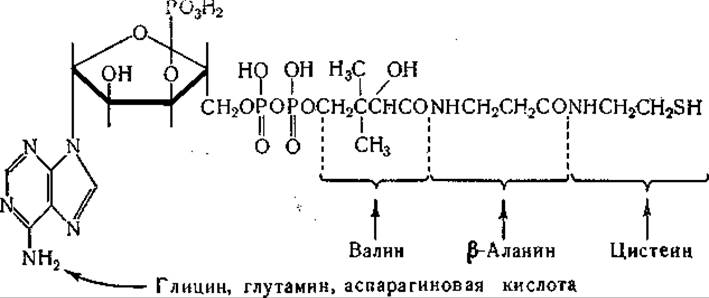
Valine also serves as a precursor of penicillin (p. 273). The Role of leucine, isoleucine, and valine in the Formation of Branched-chain compounds involved in the synthesis of Cholesterol and rubber was discussed at a symposium dedicated to this problem [447]. It was also noted that these amino acids may participate in the formation of carotenoids [448]. Recently, β-methylbutyric and d-α-methylbutyric acids were detected in the wool grease of dogs, and it is suggested that these acids originate from leucine and isoleucine, respectively [449].
Hassan and Greenberg [450] investigated the metabolism of 14C-labeled DL-norleucine and DL-norvaline in the rat. Judging by the evolution of radioactive CO2, these amino acids were degraded quite rapidly, but they apparently were not incorporated into Proteins. Greenberg [451] proposes the following catabolic pathway for norvaline and norleucine:
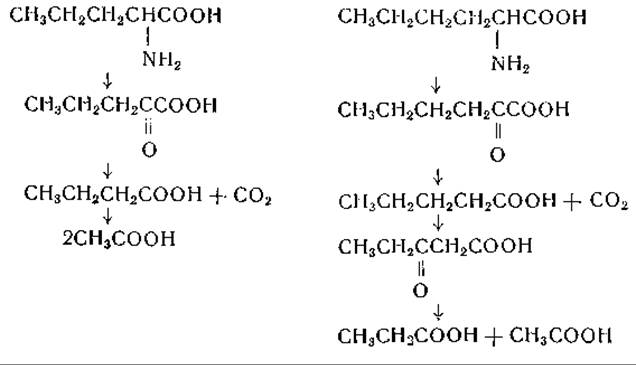
The initial step in these reaction sequences is transamination, leading to the formation of α-keto acids; these reactions have been demonstrated in A number of systems (Table 22). The remaining stages are analogous to Fatty acid oxidation and the oxidative degradation of branched-chain amino acids.
Last update: 06/08/2026
Editorial and Educational Adaptation: This material has been compiled based on the primary/original source text. The project team performed an editorial review, corrected technical inaccuracies, structured sections, and adapted the content for an educational format.
What was processed:
- elimination of formatting defects (OCR errors, structural breaks, corrupted characters);
- editorial organization of content;
- standardization of terminology in accordance with academic sources;
- verification of factual statements against the original source text.
All mentions of the author, publication year, and origin of the primary text have been preserved in accordance with the source.