Biochemistry of Amino Acids - A. Majster 1961
General Biochemistry and Physiology of Amino Acid Metabolism
Oxidative Deamination
Amino Oxidases
The oxidation processes of amines have been studied using a wide range of BIOLOGICAL OBJECTS AND various substrates. A number of amines are formed from Amino Acids as a result of their decarboxylation (p. 199). Amine oxidation proceeds via the following reactions:
Class="center">
The studies by Zeller [168] and Blaschko [169, 170] led to the discovery of Two Types of amine oxidases, namely monoamine oxidases and diamine oxidases. The Nature of the Coenzymes required for the action of these Enzymes has not yet been definitively established. Evidence has been obtained indicating that Pyridoxal phosphate serves as a coenzyme for diamine oxidase [701].
Monoamine oxidase is very widely distributed; it has been found in various animal Tissues and in plants [171–174]. The Liver is the most abundant source of monoamine oxidase, which in this tissue is associated with cytoplasmic granules [171]. Monoamine oxidase oxidizes primary aliphatic amines, although methylamine and ethylamine are oxidized slowly or not at all [173–175]. There are certain Species Differences in the substrate Specificity of the enzyme. Primary amines with a branched carbon chain are oxidized more slowly than straight-chain amines. Secondary and tertiary amines appear to be oxidized to yield the corresponding aldehydes and methylamine or dimethylamine, respectively. In particular, monoamine oxidase oxidizes hordenine and adrenaline. Substrates of monoamine oxidase include
nilethylamine, tyramine, mescaline, oxytyramine, and arterenol [168]. Monoamine oxidase also oxidizes diamines with a 14-, 16-, or 18-membered carbon chain [176].
Tabor and co-workers [177] isolated an amine oxidase from bovine Blood and purified it 150–200-fold. This enzyme oxidizes spermine [N,N'-bis(3-aminopropyl)-1,4-butanediamine], spermidine [N-(3-aminopropyl)-1,4-butanediamine], and a number of other amines, but does not act on adrenaline; consequently, it is distinct from liver monoamine oxidase.

The physiological Functions of monoamine oxidase appear to be related to the METABOLISM of pressor substances, although the specific role of this enzyme is still unknown. It is suggested that monoamine oxidase is responsible, at least in part, for The breakdown of adrenaline, as well as for the destruction of toxic amines absorbed from the intestine; it is known that the intestinal mucosa contains highly active monoamine oxidase. Evidence that this enzyme exhibits its activity in vivo is provided by experiments in which mice were injected with labeled tryptamine—the administered isotope was excreted from the Organism almost quantitatively as conjugated derivatives of indoleacetic acid [178].
Diamine oxidase is also widely distributed in nature. This enzyme was discovered by Zeller [179] in pig Kidneys and subsequently found in other animal tissues, plants, and microorganisms [180, 181]. Diamine oxidase appears to be identical to histaminase; its suitable substrates include agmatine, spermidine, histamine, spermine, cadaverine, putrescine, and ethylenediamine. Interestingly, straight-chain diamines containing from 14 to 18 carbon atoms in the molecule are oxidized by monoamine oxidase rather than diamine oxidase. Tabor's studies [182] provided convincing support for the aforementioned mechanism of Reactions Catalyzed by diamine oxidase (p. 192). This author isolated the enzyme from pig Kidney in a purified form and demonstrated that the oxidation products of histamine are imidazole acetaldehyde, ammonia, and hydrogen peroxide. It was established that the aldehyde is further oxidized to imidazoleacetic acid by aldehyde oxidase in the presence of diphosphopyridine nucleotide or by milk xanthine oxidase and oxygen. Putrescine, cadaverine, and apparently other diamines are converted into the corresponding amino aldehydes. Upon cyclization of the aldehyde derived from cadaverine, N-piperidine is formed; from this, it can be concluded that Lysine may serve as a precursor of piperidine [183, 184]:
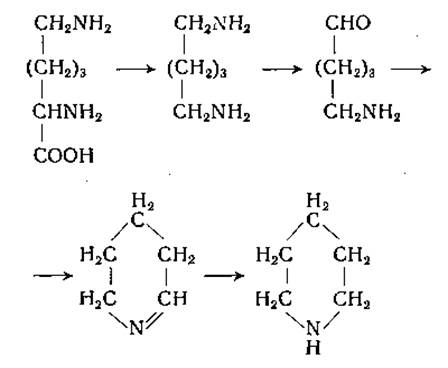
Experiments with labeled putrescine have recently established that this amine is utilized in the synthesis of spermine and spermidine in the rat Prostate Gland and in certain microorganisms [702].
Last update: 06/08/2026
Editorial and Educational Adaptation: This material has been compiled based on the primary/original source text. The project team performed an editorial review, corrected technical inaccuracies, structured sections, and adapted the content for an educational format.
What was processed:
- elimination of formatting defects (OCR errors, structural breaks, corrupted characters);
- editorial organization of content;
- standardization of terminology in accordance with academic sources;
- verification of factual statements against the original source text.
All mentions of the author, publication year, and origin of the primary text have been preserved in accordance with the source.