Chemistry and Biology of Proteins - F. Haurowitz 1953
Electrochemistry of Proteins
Amino acids as dipoles
For a long time, it was widely believed that Amino Acids In aqueous solutions existed as neutral molecules with the general formula H2N ∙ R ∙ СООН. The fact that amino acids in acidic or alkaline solutions migrate toward the cathode or anode was attributed to the following reactions:
Class="center">
Adams [1] and Bjerrum [2] were the first to suggest that the neutral amino acid formula H2N ∙ R ∙ СООН should be replaced by a dipolar formula — H3N ∙ R ∙ COO, and that only a negligible fraction of amino acids exists in solution as uncharged neutral molecules. If we accept this perspective, equations (1a) and (2a) must be updated as follows:

According to traditional views, hydrogen ions combine with the uncharged amino group NH2, thereby converting it into a positively charged ammonium group
 (equation 1a); under the modern view, however, hydrogen ions interact with the negatively charged COO- group to form COOH. Similarly, hydroxyl ions OH- react with COOH or with
  according to contemporary concepts (see equations 2a and 2b).
Comparing equations (1a) with (1b) and (2a) with (2b), we can see that their right-hand sides are identical. Indeed, in acidic solutions, amino acids exist as cations with the formula  whereas in alkaline solutions, they exist as anions with the formula
This is supported by the aforementioned data on the migration of amino acid ions in an electric field; however, these observations do not resolve whether amino acids dissolved in pure Water exist as compounds corresponding to the neutral formula H2N ∙ R ∙ СООН or as dipolar ions — 
Due to their positive and negative groups, dipolar ions are attracted with equal force to both the anode and the cathode. Consequently, unlike true anions and cations, they do not migrate toward either electrode. Therefore, dipolar ions (zwitterions, hybrid ions) have no effect on the electrical conductivity of the solution—meaning they behave as if they were genuinely neutral, uncharged molecules. Consequently, measurements of amino acid solution conductivity cannot determine whether these solutions contain neutral molecules H2N ∙ R ∙ СООН or dipolar ions 
This question was definitively resolved using other Physicochemical Methods that unquestionably proved the dipolar Structure of Amino acids. One of the earliest methods applied for this purpose was the calorimetric Determination of the heat of ionization of amino acids in acidic and alkaline solutions [3]. It had long been established that the heat of the reaction  which is approximately +1,000 cal/mol for aliphatic carboxylic acids, differs significantly from the heat of ionization of aliphatic amines:

which amounts to +12,000 cal/mol. Subsequent measurements revealed that the heat of ionization of amino acids in acidic solution ranges from —1,300 to +2,100 cal/mol, while in alkaline solution it varies from +10,000 to +13,300 cal/mol. These data clearly demonstrate that Hydrochloric acid reacts with the carboxyl groups of amino acids, whereas sodium hydroxide reacts with their ammonium groups.
Additional confirmation of the dipolar structure of amino acids comes from data showing an increase in the Dielectric Constant of water when Amino acids are dissolved in it (see Chapter VII). These findings could not be explained by the classical view of a neutral amino acid structure. Furthermore, the presence of  groups rather than COOH groups in neutral amino acid solutions is also evidenced by Raman spectra, which depend on vibrational characteristics and, consequently, on The structure of the molecular groupings within The amino acid molecule [4].
Finally, the dipolar structure of amino acids in aqueous solutions is supported by electrostriction—the significant volume contraction observed when solid amino acids dissolve in water. Other substances typically exhibit only a slight change in volume. For instance, dissolving 1 mole (75 g) of glycolamide CH2OH ∙ CONH2 in water increases the volume by 56.2 ml, whereas dissolving 1 mole (75 g) of isomeric Glycine H3N ∙ СН2∙ СОО results in a volume increase of only 43.5 ml. This pronounced striction is caused by strong electrostatic attraction between the ionized amino acid groups and water molecules, leading to their densification [5].
The fact that solid amino acids most likely exist as dipoles rather than neutral molecules is also indicated by their high density and melting point. Both properties point to strong electrostatic attraction between oppositely charged ionized groups of adjacent molecules, making their Separation considerably more difficult than that of adjacent neutral molecules. While glycolamide has a density of 1,390 and a melting point of 117°, isomeric glycine has a density of 1,607 and a melting point of 232° [5].
The primary advantage of the Modern concept of the dipolar structure of amino acids is that the dissociation constants of their acidic and basic groups genuinely correspond to those of aliphatic acids and aliphatic amines. Calculating dissociation constants using the old equations (1a) and (1b) yielded values vastly different from typical dissociation constants of aliphatic acids and aliphatic amines. For example, such calculations yielded constants on the order of 10-9 for the acidic groups of Amino Acids and 10-11 for the basic groups, whereas the dissociation constant of acetic acid is 1.8∙10-5 and that of ethylamine is 1.2∙10-3. Thus, calculations based on the classical view suggested that the dissociation of the carboxyl groups in amino acids is significantly lower than that of carbonic acid (ka = 4.5 ∙ 10-7). This contradiction is resolved entirely by adopting the dipolar formula for amino acids.
Before proceeding with a further Discussion of the dissociation of acidic and basic groups in amino acids, equation (2b) must be modified in accordance with the Brønsted-Lowry theory of acids and bases. Brønsted defines acids as proton Donors and bases as proton acceptors. Accepting this definition, the  and NH2 groups should be regarded as basic groups because they combine with a proton H+; similarly, the COOH and
  groups should be considered acidic groups as they act as proton donors. Accordingly, equation (2b) can be replaced by the equation

Although designating  as a base and
  as an acid raises no objections from this standpoint, the traditional Definitions of the carboxyl group as acidic and the amino group as basic remain widely used. Consequently, terminology must be handled with care to avoid confusion.
The Brønsted theory regarding The Nature of acids and bases has the distinct advantage over older concepts in that it explains acid-base reactions in non-aqueous Solvents where hydroxyl ions OH- are not formed. When considering aqueous solutions, one must account for the dual Role of water: it can act as an acid, i.e., a proton donor (Н2О → Н+ + ОН-), and as a base, i.e., a proton acceptor (Н2О + Н+ → Н3О+), yielding the hydronium ion H3O+ in the latter case. Therefore, the reaction of amino acids with bases in aqueous solutions can also be described using equation (2b). In the absence of water, however, only equation (2v) is valid. Nevertheless, one must keep in mind that the proton on the right-hand side of the equation is not free, but bound to the added base, meaning equation (2v) can also be written as follows:

Since, according to Brønsted's theory, the presence of a hydroxyl ion is not required for bases, and acids and bases are defined simply as proton donors and acceptors, we can express the dissociation of acidic and basic groups by the general formula:

where A represents the acid (proton donor) and B represents the base (proton acceptor). The dissociation constant of acid A is derived from equation (3) using the following formula:
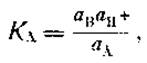
Where  are the activities of the acid, base, and hydrogen ion, respectively. According to equation (1b), the dissociation constant of the amino acid carboxyl group should be expressed as follows:
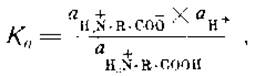
and, according to (2c), the dissociation constant of the amino group is

If equation (2c) is used instead of equation (2b) to calculate the dissociation of the amino group, we obtain
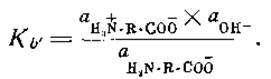
In dilute solutions, where activity coefficients are close to unity, they can be neglected, and activities in the above equations can be replaced by molar concentrations. Thus, the last equation, based on equation (2b), can be written as follows:

Since the concentrations of hydrogen and hydroxyl ions are determined by the equation

the [OH-] term in the above equation can be replaced by Kw/[H+], and the equation based on (3a) and (4) can be represented as

Kb in dilute solutions, according to equations (2s) and (2g), is equal to

therefore, The ratio of Kb' to Kb can be expressed (see equations 2b, 3, and 4) by the equation 
where Kw is the dissociation constant of water, approximately equal to 10-14. When the dissociation constants Ka of the carboxyl group, as well as the dissociation constants Kb and Kb' of the amino groups, were calculated from these equations, it turned out that the value of Ka (the dissociation constant of the carboxyl group) ranges from 10-2 to 10-3; for the dissociation constants of the amino groups, values of Kb' from 10-4 to 10-5 and Kb from 10-9 to 10-10 were obtained. The meaning of these dissociation constants becomes clearer if we consider the case where the concentration of the proton donor A equals the concentration of the proton acceptor B. If [A] = [B], the dissociation constant K equals the hydrogen ion concentration:
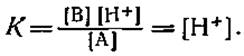
Under these conditions, the hydrogen ion concentration is a measure of the dissociation of the acid or base. It indicates the point at which the ratio 
or  equals unity. Since it is customary to express the hydrogen ion concentration as the negative logarithm pH = —lg[H+], we can apply the same method to express the dissociation constant and write pKa = —lgKa and pKb = —lgKb. Consequently, pKa and pKb are equal to the pH value at which 50% of the amino acid exists as zwitterions and 50% as cations or anions. These constants are determined by electrometric titration of amino acids with hydrochloric acid or sodium hydroxide [6]. If the pH change is plotted against The amount of acid or base added to the amino acid, The values of pKa or pKb will equal the pH value on The titration curve that corresponds to 0.5 equivalents of added acid or alkali per mole of amino acid.
While the dissociation of the amino group was previously expressed in terms of Kb', currently Kb is preferred because it directly indicates the pH value at 50% dissociation, whereas Kb' refers to the hydroxyl ion concentration, which is usually not determined directly but can be easily obtained by subtracting the pH from 14. However, the main advantage of the new method of expressing dissociation constants is that we are able to determine these constants even when the Nature of the reacting groups is unknown. Thus, until now, it remained unclear whether the pK value of 9.1 found by electrometric titration for Tyrosine refers to the dissociation of the phenolic hydroxyl group into a hydrogen ion and an anion, or to the dissociation of the ammonium group  into an NH2 amino group and a hydrogen ion. It is quite obvious that electrometric titration does not reveal the nature of the underlying reaction; it only indicates the number of protons bound at various pH values. At the same time, there is no need to use different symbols Ka and Kb for the carboxyl and amine groups; it is more convenient to number the dissociation constants in order of increasing pK values — pK1, pK2, pK3, etc. This method of denoting dissociation constants is used in Table 6. This table shows that the acidic and basic ionization constants of aliphatic monoamino acids vary very slightly.
Table 6. Ionization constants of monoamino acids and Peptides [7]
|
Substance |
pK1 |
pK2 |
Isoelectric point |
|
Glycine |
2.35 |
9.78 |
6.1 |
|
Glycylglycine |
3.12 |
8.07 |
5.6 |
|
2.34 |
9.87 |
6.1 |
|
|
Alanylalanine |
3.17 |
8.42 |
5.8 |
|
Valine |
2.32 |
9.62 |
6.0 |
|
Leucine |
2.36 |
9.60 |
6.0 |
|
Hexaglycine |
3.05 |
7.60 |
5.32 |
|
2.21 |
9.15 |
5.68 |
|
|
1.99 |
10.60 |
6.30 |
|
|
2.38 |
9.39 |
5.89 |
The aliphatic side chains of the amino acids listed in the table apparently do not exert a significant influence on the dissociation of either carboxyl or amine groups. Furthermore, it follows from the table that for peptides, the pK1 value is higher by 0.8 pH units, while the pK2 value is lower by 1.4–1.7 pH units than those of the corresponding amino acids. This means that the acidity of peptides is slightly decreased, and their basicity is significantly decreased compared to the corresponding amino acids. Thus, it becomes clear that peptides exhibit stronger acidic properties than amino acids, As a result of which peptide Hydrolysis is accompanied by a decrease in solution acidity, which can be measured manometrically in a carbon dioxide atmosphere (see Chapter III).
Since amino acids migrate toward the anode in alkaline solutions and toward the cathode in acidic solutions, there exists a pH value at which no migration occurs at all. This pH value is called the isoelectric point. It can be easily calculated from the ionization constants According to the equation

The pHI values for various amino acids are given in the last Column of Table 6.
If the acidic and basic groups of an amino acid were ionized to the same extent, a salt-free solution of such an amino acid would have the same pH value as pure water. Since The ionization of the carboxyl group in monoamino monocarboxylic acids exceeds that of the amino group, they act as weak acids with an isoelectric point of approximately pH 6.0. Consequently, in aqueous solutions of monoamino acids, alongside a large quantity of dipolar ions 
 , There are also certain amounts of hydrogen ions and anions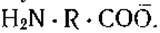
The fact that amino acids function simultaneously as weak acids and weak bases makes it possible to use their mixtures with strong acids and alkalis as Buffer solutions. Fig. 9 shows the pH values in mixtures of glycine with hydrochloric acid and sodium hydroxide. If the volumes of hydrochloric acid or sodium hydroxide indicated in the diagram are designated as v, the added volume of a 0.1 N glycine solution will be (10 — v) ml.
When amino acids contain other ionized groups In addition to a-amino and a-carboxyl groups, the titration curves exhibit additional inflection points. The ionization constants of such amino acids, containing functional groups in their side chains, are listed in Table 7. This table demonstrates that aminodicarboxylic acids possess a stronger acidic group than monoamino acids, which aligns with the well-known fact that organic dicarboxylic acids are strong acids. The table also shows that the pK value of the hydroxyl group in the phenolic ring of tyrosine is approximately 10.1. Consequently, this group exhibits very weak acidic properties, remains virtually uncharged in neutral solutions, and ionizes exclusively in alkaline media.

Fig. 9. Buffer action of glycine [8].
Table 7 Ionization constants of amino acids containing functional groups in the side chain
|
Amino acid |
pK1 |
pK2 |
pK3 |
Isoelectric point |
|
Aspartic acid |
2.09 (COOH) |
3.87 (COOH) |
9.82 (NH3+) |
3.0 |
|
Glutamic acid |
2.19 (COOH) |
4.28 (COOH) |
9.66 (NH-3) |
3.2 |
|
Tyrosine |
2.20 (COOH) |
9.11 (NH+3) |
10.1 (OH) |
5.7 |
|
1.96 (COOH) |
8.18 (NH+3) |
10.28 (SH) |
5.07 |
|
|
2.02 (COOH) |
9.04 (NH+3) |
12.48 (guanidine) |
10.8 |
|
|
2.18 (COOH) |
8.95 (a-NH+3) |
10.53 (ε-NH+3) |
9.7 |
|
|
1.77 (COOH) |
6.10 (imidazole) |
9.18 (NH+3) |
The guanidine group of arginine and the ε-amino group of lysine (pK 12.48 and 10.53) are strong bases, and their ionization is more pronounced than that of the amino groups in monoamino acids, whereas the imidazole group of histidine exhibits only weak basic properties. Distant molecular groupings exert only a minor influence on the dissociation constants of amino acids. Therefore, it can be expected that the ionization constants of Proteins will also be close to those of amino acids.
Last update: 06/08/2026
Editorial and Educational Adaptation: This material has been compiled based on the primary/original source text. The project team performed an editorial review, corrected technical inaccuracies, structured sections, and adapted the content for an educational format.
What was processed:
- elimination of formatting defects (OCR errors, structural breaks, corrupted characters);
- editorial organization of content;
- standardization of terminology in accordance with academic sources;
- verification of factual statements against the original source text.
All mentions of the author, publication year, and origin of the primary text have been preserved in accordance with the source.