LEHNINGER PRINCIPLES OF BIOCHEMISTRY - VOLUME 1. THE FOUNDATIONS OF BIOCHEMISTRY: STRUCTURE AND CATALYSIS - 2011
PART I. STRUCTURE AND CATALYSIS
2. WATER
2.4. The Fitness of Water as a Medium for Life
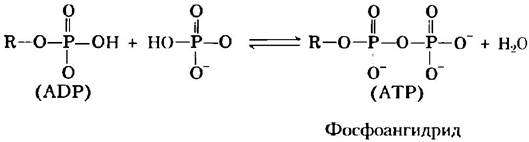
Water is far more than an inert medium for biochemical reactions; it is an active reactant in many metabolic processes. The formation of ATP from ADP and inorganic phosphate is a classic example of a Condensation reaction, which releases a molecule of water (Fig. 2-22). Conversely, the reverse reaction—Hydrolysis—consumes a water molecule. Hydrolysis reactions drive the enzymatic Breakdown of Proteins, CARBOHYDRATES, and Nucleic Acids. Hydrolysis Reactions Catalyzed by Hydrolases are almost invariably exergonic, as splitting one molecule into two increases the Entropy of the system. By contrast, the reverse reactions—the synthesis of cellular polymers from monomer units (condensation)—are endergonic and cannot proceed spontaneously. As we will see later, The Cell overcomes these thermodynamic barriers by coupling endergonic condensation reactions to exergonic processes, such as the Cleavage of the anhydride bond in ATP.
Class="center">Fig. 2-22. The Role of water in biological reactions. ATP is a phosphoanhydride formed via a condensation reaction (loss of a water molecule) between ADP and phosphate. In this diagram, R represents adenosine monophosphate. This condensation reaction requires an energy input. The reverse reaction—the hydrolysis (addition of a water molecule) of ATP to yield ADP and phosphate—releases an equivalent amount of heat. These ATP condensation and hydrolysis reactions are just one illustration of water's function as a reactant in biological processes.
As you read this book, you are consuming oxygen (at least we sincerely hope so!). The oxidation of fuel molecules (such as glucose) produces water and carbon dioxide. The overall reaction is:
С6Н12О6 + 6О2 —> 6СО2 + 6Н2О
Glucose
Certain desert-dwelling animals (such as gerbils, kangaroo rats, and camels) rely entirely on this metabolic water, generated through the oxidation of food and stored fats, allowing them to survive for long periods without drinking water.
In erythrocytes, carbon dioxide produced during glucose oxidation is converted into the more soluble HCO3- in a reaction catalyzed by the enzyme Carbonic anhydrase:
СО2 + Н2О ⇄ НСО3 + Н+
In this reaction, water acts not only as a substrate but also facilitates proton transfer by forming networks of hydrogen-bonded molecules through which protons rapidly "hop" (Fig. 2-13).
Green plants and Algae harness solar energy to split water during Photosynthesis:

Here, A represents electron-accepting molecules, which vary among Different types of photosynthetic organisms. In this reaction, water serves as the electron donor in the redox chain (Fig. 19-57), which plays a fundamental role in All living organisms.
Summary. 2.4 The Fitness of Water as a Medium for Life
■ Water plays a dual role in biological systems: it provides the medium for metabolic reactions and actively participates in numerous biological processes, including hydrolysis, condensation, and oxidation-reduction reactions.
Last update: 06/08/2026
Editorial and Educational Adaptation: This material has been compiled based on the primary/original source text. The project team performed an editorial review, corrected technical inaccuracies, structured sections, and adapted the content for an educational format.
What was processed:
- elimination of formatting defects (OCR errors, structural breaks, corrupted characters);
- editorial organization of content;
- standardization of terminology in accordance with academic sources;
- verification of factual statements against the original source text.
All mentions of the author, publication year, and origin of the primary text have been preserved in accordance with the source.