Practical Protein Chemistry - A. Darbre 1989
Methods of solid-phase amino acid sequencing
Cleavage on a solid-phase sequencer
Column
The design of the instrument has been described previously [27—29, 35].
Both ends of a thin Glass tube (length 230 mm, internal diameter 2.5 mm) are polished to obtain a flat end surface. The connections are made of Teflon and Kel-F [27]. The column is placed in a heated aluminum block thermostated at 45 °C.
12.5.1.1. Microcolumn. For the analysis of Peptides in amounts <20 nmol, downsized columns (e.g., 15X2 mm) packed with peptidyl-glass beads mixed with glass filler are used. A column design made of Teflon tubing (Fig. 12.4), whose internal volume corresponds to The amount of peptidyl-glass used, is known. A porous Teflon filter (pore size 2 µm) is placed under the tapered lower end of the tube, resting in an adapter that seals the end of the column. The dead volume at the top of the column is minimized by inserting a short piece of narrow Teflon tubing. The assembled column is placed in a glass thermostat (Fig. 12.6).
Class="center">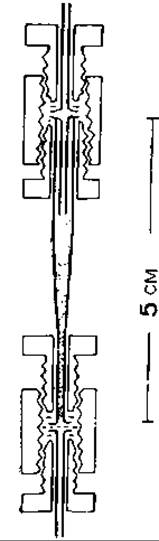
FIG. 12.4. Column for peptide analysis at the micro-level. The column material is Teflon tubing, the internal volume of which depends on the amount of support used. A narrow Teflon tube is inserted into the upper part of the column, and the lower end of the column is closed with a porous Teflon filter with a pore diameter of 2 µm (Zitex, Chemplast Inc.). The column is placed in a thermostated glass tube (see Fig. 12.1) [52, 69].
Last update: 06/08/2026
Editorial and Educational Adaptation: This material has been compiled based on the primary/original source text. The project team performed an editorial review, corrected technical inaccuracies, structured sections, and adapted the content for an educational format.
What was processed:
- elimination of formatting defects (OCR errors, structural breaks, corrupted characters);
- editorial organization of content;
- standardization of terminology in accordance with academic sources;
- verification of factual statements against the original source text.
All mentions of the author, publication year, and origin of the primary text have been preserved in accordance with the source.