Biochemistry of Amino Acids - A. Maister 1961
Intermediary Metabolism of Amino Acids
Glycine, Serine, and Sarcosine
Interconversion of Glycine and Serine
The interconversion of Glycine and Serine plays a significant role in the tissue METABOLISM of mammals and microorganisms. Shemin [165] was the first to demonstrate The conversion of serine into glycine by administering N15-serine labeled with C13 in the carboxyl group to rats and guinea pigs along with benzoic acid; in the hippuric acid isolated from the animals' urine, the C13 content in the carboxyl group of glycine was nearly identical to that of the original serine. The conversion of glycine into serine has also been established [163]. Numerous reports [166–170] point to the reversible interconversion of glycine and serine, which involves a single-carbon unit represented in the following scheme as formic acid:
Class="center">
This reaction has been observed in Liver slices and in the intact rat. Experiments with pigeons demonstrated that the ß-carbon atom of serine can serve as a precursor for the carbon of the ureide groups of uric acid [171]; it is known that these carbon atoms of uric acid are derived from formic acid. The ß-carbon atom of serine is also a precursor of the ß-carbon atom of ethanolamine in the liver lipid fraction [172]. Lactic acid Bacteria have been shown to require pyridoxal for the synthesis of serine from glycine and formic acid [173]. A requirement for vitamin B6 in this process has likewise been established in chicks. In experiments using liver preparations from B6-avitaminotic chicks or chicks pretreated with deoxypyridoxine, a decrease in serine synthesis from glycine was observed compared to control chicks [174, 175]. The addition of Pyridoxal phosphate to such preparations resulted in a partial restoration of activity.
1 This conversion proceeds via uroporphyrinogen III, which is subsequently oxidized to uroporphyrin III—the common precursor of the porphyrin nuclei of hemin and chlorophyll. — Transl. note
Several laboratories [132, 174, 176–178] have investigated The Nature of the biologically active single-carbon unit generated from formic acid. Evidence indicates that under certain conditions, formaldehyde is utilized for serine synthesis more actively than formic acid. Formaldehyde is known to be a product of The oxidation of Sarcosine and other N-Methylamino Acids [179]; sarcosine, in turn, can serve as a source of single-carbon units for the synthesis of serine [178]. Meanwhile, the addition of unlabeled formaldehyde to a rat liver-derived system synthesizing serine from labeled formic acid produced no decrease in the radioactivity of the resulting serine [176]. This and other evidence [180, 181, 1082] indicate that the active single-carbon unit is neither formic acid nor formaldehyde. This active compound may represent an intermediate metabolic product common to both formic acid and formaldehyde [182]. Various studies have made it clear that Folic acid participates in serine synthesis. For instance, in folic acid-deficient rats, The rate of incorporation of formic acid into serine was found to be reduced [183]. The interconversion of glycine and serine is likewise impaired in various animals suffering from Folic acid deficiency [171, 184–187]. Data obtained from studies on microorganisms [173, 188, 189] further confirm the involvement of folic acid derivatives in the interconversion of glycine and serine. Additional confirmation is provided by findings showing that at least two folic acid derivatives ("Streptococcus lactis R factor" and the "citrovorum factor") contain formyl residues and can thus participate in formyl group transfer [182, 190–200].
This hypothesis was confirmed in experiments using a pigeon liver preparation that catalyzes the interconversion of Serine and Glycine. Treatment of the pigeon liver preparation with Dowex-1 anion exchange resin in the chloride form, followed by dialysis, led to the inactivation of the incorporation of C14-glycine into serine; the addition of tetrahydrofolic acid to such preparations restored their activity [201]. Similar results were obtained with enzyme preparations from rat liver [174, 202]. Tetrahydrofolic acid also stimulated The formation of serine from glycine and formaldehyde. However, tetrahydrofolic acid alone does not restore the capacity for serine synthesis from glycine and formic acid in inactivated pigeon liver preparations. In this system, activity is restored by the addition of tetrahydrofolic acid, adenosine triphosphate, diphosphopyridine nucleotide, glucose-6-phosphate, and magnesium ions [201, 202]. From these results, it can be concluded that in the presence of ATP, formic acid is converted into a derivative of the citrovorum factor, which, in the presence of diphosphopyridine nucleotide in the system, is reduced to hydroxymethyltetrahydrofolic acid. Folic acid exhibits some activity in the enzyme system utilizing formic acid for serine synthesis, but its activity is lower than that of tetrahydrofolic acid. During the synthesis of serine from formaldehyde and glycine, dihydrofolic acid activates the enzyme system to a lesser extent than tetrahydrofolic acid; if ATP, diphosphopyridine nucleotide, glucose-6-phosphate, and magnesium ions are added simultaneously with dihydrofolic acid, the synthesis is activated to the same degree as in samples with tetrahydrofolic acid. These data demonstrated that tetrahydrofolic acid participates in the conversion of formaldehyde into glycine and in the incorporation of glycine into serine. Additional reactions are required for the utilization of formic acid in the formation of serine from glycine.
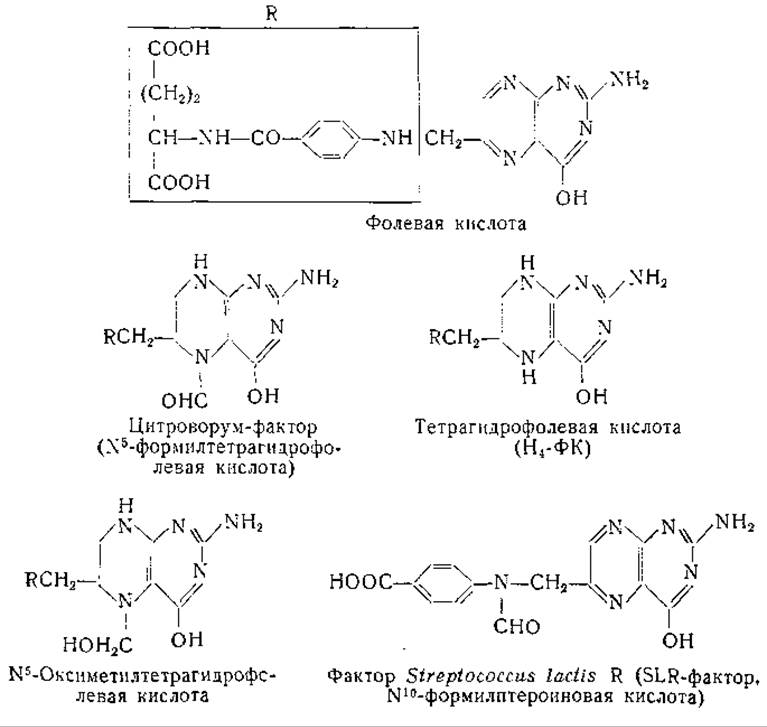
The incorporation of glycine into serine can occur via an exchange reaction involving tetrahydrofolic acid as a coenzyme, without an increase in the total amount of serine. The Role of vitamin B6 in this reaction consists in activating the a-carbon atom of glycine (p. 246), which reacts with hydroxymethyltetrahydrofolic acid; subsequent Cleavage of the reaction product yields serine. Sakami [174] proposed the following scheme for single-carbon unit transformations (see also [203, 204]):
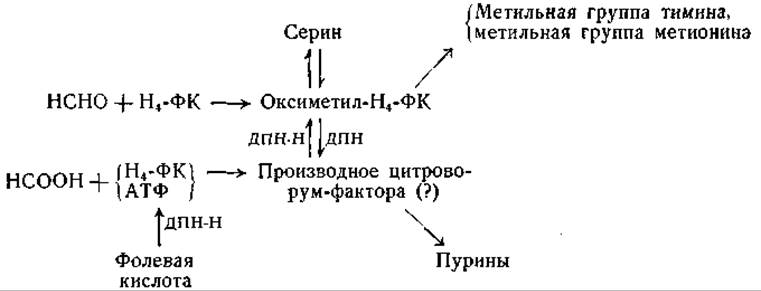
The ß-carbon atom of serine, along with its attached hydrogen atoms, can be transferred to the methyl groups of thymine and Choline [210–214] and can serve as a precursor for the methyl group of Methionine.
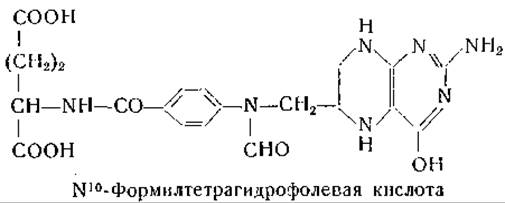
Enike [205] demonstrated that upon transfer of the ß-carbon atom of serine, an N10-substituted derivative of tetrahydrofolic acid is formed as the initial product [206]. This author proved the enzymatic formation of N10-formyltetrahydrofolic acid and established that this compound can serve as a single-carbon donor in the synthesis of serine, Purines, and Histidine. According to this view, N15-formyltetrahydrofolic acid is regarded as a side-reaction product. Greenberg et al. [207] showed that N10-formyltetrahydrofolic acid participates directly in purine synthesis by transferring a formyl residue to 5-amino-4-imidazolecarboxamide-5-phosphoriboside. The results of studies conducted with a pigeon liver system can be expressed by the following equations [1083]:

Reaction (1) requires phosphopyridoxal and manganese ions; reaction (2) proceeds more slowly with DPN than with TPN.
Data have been published indicating that the conversion of serine to glycine in extracts of a Clostridium species occurs in the presence of diphosphopyridine nucleotide, manganese ions, pyridoxal phosphate, orthophosphate, and a novel factor designated as coenzyme C. This factor differs from the aforementioned folic acid derivatives. Five groups of pteridine compounds possessing coenzyme C activity were isolated from C. cylindrosporum; some of these were found to contain glutamic acid, glycine, serine, and Alanine [208, 209]. There are indications that vitamin E may also be involved in single-carbon metabolism [215]. For instance, upon administration of C14-formic acid to vitamin E-deficient rabbits, the label was incorporated into Nucleic Acids and Proteins significantly more actively than in control animals; conversely, when 1-C14-glycine was administered, isotope incorporation was reduced in the vitamin E-deficient animals.
It has been found that in the tobacco plant, formaldehyde and the ß-carbon atom of serine are utilized as precursors of the N-methyl group of nicotine, with formaldehyde being more effective in this process [216–218]. The methyl group of methionine can serve as a precursor for the methoxyl groups of Lignin, acting as a significantly more effective donor in this conversion than formic acid [219]. The a-carbon atom of glycolic acid can serve as a source for both the N-methyl group of nicotine and the methoxyl groups of lignin [1084].
Serine also participates in the synthesis of Tryptophan from indole and serine; this reaction is discussed in the section dedicated to Tryptophan Metabolism.
Last update: 06/08/2026
Editorial and Educational Adaptation: This material has been compiled based on the primary/original source text. The project team performed an editorial review, corrected technical inaccuracies, structured sections, and adapted the content for an educational format.
What was processed:
- elimination of formatting defects (OCR errors, structural breaks, corrupted characters);
- editorial organization of content;
- standardization of terminology in accordance with academic sources;
- verification of factual statements against the original source text.
All mentions of the author, publication year, and origin of the primary text have been preserved in accordance with the source.