Principles of Biochemistry, Volume 1 - A. Lehninger 1985
Biomolecules
Enzymes
Enzymes can be inhibited by specific chemical compounds
The action of most Enzymes can be suppressed, or inhibited, by specific chemical Reagents. The Study of Enzyme Inhibitors provides valuable insights into enzyme substrate Specificity, The Nature of functional groups within the Active Site, and the MECHANISMS OF ENZYME catalytic activity. Enzyme inhibitors also serve as highly useful tools in investigating cellular metabolic pathways. Furthermore, the MECHANISM OF ACTION of certain drugs relies precisely on their ability to inhibit specific enzymes in dysfunctional Cells.
Class="center">
Fig. 9-9. Substrate specificity of Chymotrypsin. A. Although chymotrypsin Functions as a peptidase in biological systems, it is also capable of hydrolyzing amides, esters, and certain synthetic non-biological compounds, provided they possess a bond susceptible to enzymatic Cleavage and an orienting hydrophobic group. B. Some synthetic compounds hydrolyzed by chymotrypsin. Each contains a hydrophobic orienting group and a cleavable acyl bond (both shown in red).
There are two MAIN TYPES OF inhibitors: irreversible and reversible. Irreversible inhibitors bind to or destroy a functional group of the enzyme molecule that is essential for its catalytic activity. An example of an irreversible inhibitor is diisopropyl fluorophosphate (DFP), which inhibits acetylcholinesterase, an enzyme that plays a critical role in Nerve Impulse transmission. Acetylcholinesterase catalyzes the Hydrolysis of acetylcholine (Fig. 9-10), which functions as a neurotransmitter in certain regions of The Nervous system. Acetylcholine is released by a stimulated nerve Cell (neuron) into a synapse, the junction between one neuron and another. At the synapse, acetylcholine binds to receptors on the postsynaptic neuron, triggering a nerve impulse. However, before a second impulse can be transmitted across the synapse, the acetylcholine released following the initial impulse must be hydrolyzed by acetylcholinesterase at the neural junction. Its breakdown products—acetate and Choline—are unable to act as Neurotransmitters (Fig. 9-10). The highly reactive irreversible inhibitor DFP covalently attaches to the hydroxyl group of a Serine residue at the Active Site of acetylcholinesterase, yielding a catalytically inactive derivative. As a result, the enzyme ceases to function. DFP, one of the earliest nerve agents, induces functional disorders in animal experiments because the affected Neurons lose their ability to transmit nerve impulses. Nevertheless, DFP also has useful Applications. It has served as the basis for developing A number of insecticides with relatively low toxicity to humans and animals, such as malathion. Malathion itself is inactive and is metabolized in higher animals into products considered harmless. In contrast, within the insect Organism, malathion is enzymatically converted into an active inhibitor of their own acetylcholinesterase.
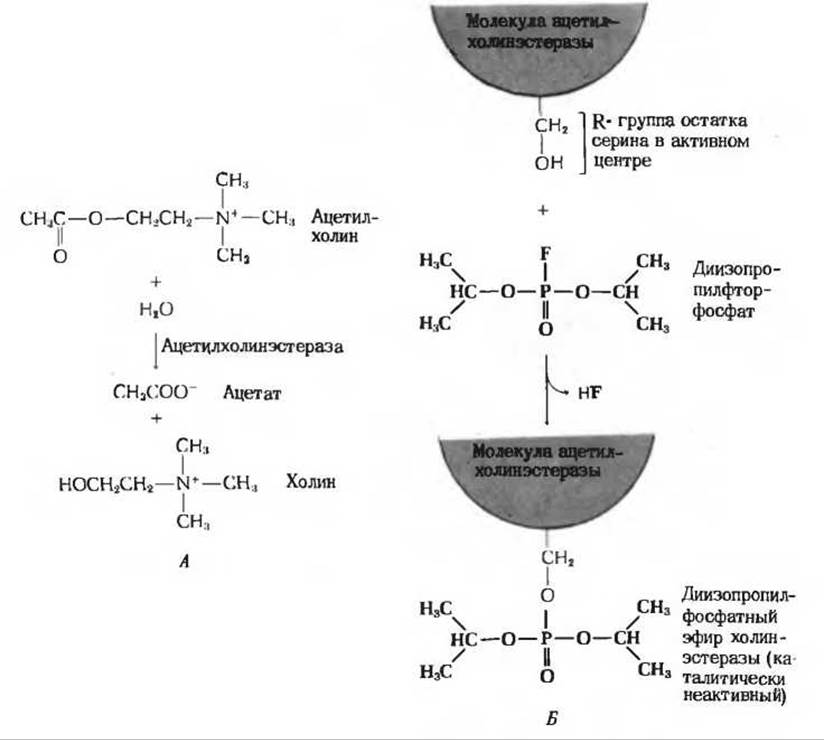
Fig. 9-10. Irreversible inhibition of acetylcholinesterase by diisopropyl fluorophosphate. A. Reaction catalyzed by acetylcholinesterase. B. Reaction between diisopropyl fluorophosphate and the serine hydroxyl group.
It has been found that DFP inhibits an entire class of enzymes, many of which catalyze the hydrolysis of peptide or ester bonds. These enzymes include not only acetylcholinesterase, but also Trypsin, chymotrypsin, Elastase, phosphoglucomutase, and cocoonase (an enzyme secreted by silkworm larvae to hydrolyze silk threads and emerge from the cocoon). A distinctive feature of all DFP-inhibited enzymes is that they contain a serine residue in their active site, which participates in the catalytic act (Fig. 9-10).
Another irreversible inhibitor of certain enzymes, iodoacetamide (Fig. 9-11), can react with the sulfhydryl (—SH) groups of Cysteine residues or the imidazole groups of Histidine residues located in the active sites of these enzymes. Such inhibitors have helped establish that the serine hydroxyl group, cysteine thiol group, and histidine imidazole group are involved in the catalytic activity of enzymes belonging to various classes.
Last update: 06/08/2026
Editorial and Educational Adaptation: This material has been compiled based on the primary/original source text. The project team performed an editorial review, corrected technical inaccuracies, structured sections, and adapted the content for an educational format.
What was processed:
- elimination of formatting defects (OCR errors, structural breaks, corrupted characters);
- editorial organization of content;
- standardization of terminology in accordance with academic sources;
- verification of factual statements against the original source text.
All mentions of the author, publication year, and origin of the primary text have been preserved in accordance with the source.