Principles of Biochemistry, Volume 1 - A. Lehninger 1985
Biomolecules
Carbohydrates: Structure and Biological Functions
There are two families of monosaccharides: aldoses and ketoses
Monosaccharides are colorless, crystalline solids that dissolve readily in Water but are insoluble in nonpolar Solvents. As a rule, they have a sweet taste.
As mentioned above, most monosaccharides have the empirical formula (CH2O)n, where n is three or more. The backbone of a monosaccharide is an unbranched carbon chain in which all the carbon atoms are linked by single bonds. One of the carbon atoms is double-bonded to an oxygen atom to form a carbonyl group; each of the other carbon atoms has a hydroxyl group attached to it. If the carbonyl group is at the end of the carbon chain, the monosaccharide is an aldehyde (Sec. 3.4) and is called an aldose; if the carbonyl group is at any other position, the monosaccharide is a ketone (Sec. 3.4) and is called a ketose. The simplest monosaccharides are two trioses (three-carbon sugars): the aldotriose glyceraldehyde and the ketotriose dihydroxyacetone (Fig. 11-1).
Monosaccharides with 4, 5, 6, or 7 carbon atoms in their backbones are called tetroses, pentoses, hexoses, and heptoses, respectively. Each of these monosaccharides can exist in two forms, giving rise to aldotetroses and ketotetroses, aldopentoses and ketopentoses, aldohexoses and ketohexoses, and so on. The most abundant hexoses in nature are the aldohexose D-glucose and the ketohexose D-fructose (Fig. 11-2). The aldopentoses D-ribose and 2-deoxy-D-ribose (Fig. 11-3) are constituents of Nucleic Acids.
Class="center">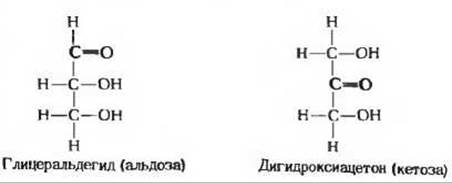
Fig. 11-1. Two trioses. Carbonyl groups are highlighted in red.
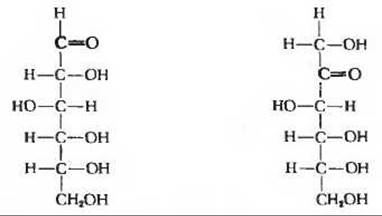
Fig. 11-2. Two common hexoses (D-glucose and D-fructose).
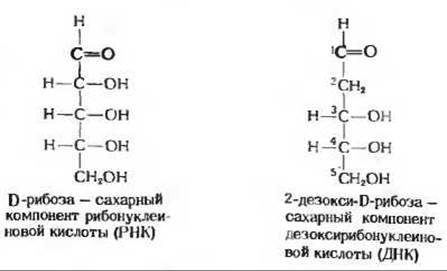
Fig. 11-3. Pentose Components of nucleic acids.
Last update: 06/08/2026
Editorial and Educational Adaptation: This material has been compiled based on the primary/original source text. The project team performed an editorial review, corrected technical inaccuracies, structured sections, and adapted the content for an educational format.
What was processed:
- elimination of formatting defects (OCR errors, structural breaks, corrupted characters);
- editorial organization of content;
- standardization of terminology in accordance with academic sources;
- verification of factual statements against the original source text.
All mentions of the author, publication year, and origin of the primary text have been preserved in accordance with the source.