Principles of Biochemistry Volume 1 - A. Lehninger 1985
Biomolecules
Enzymes
There are two types of reversible inhibitors: competitive and non-competitive
The Study of reversible Enzyme Inhibitors has also provided crucial insights into The Structure of the active sites of various Enzymes.
Class="center">
Fig. 9-11. Irreversible inhibition of an SH-enzyme by iodoacetamide.
A competitive inhibitor competes with the substrate for binding to the Active Site, but unlike the substrate, the enzyme-bound competitive inhibitor does not undergo enzymatic conversion. A distinctive feature of competitive inhibition is that it can be reversed or diminished simply by increasing the Substrate Concentration. For example, if at given concentrations of substrate and competitive inhibitor the enzyme activity is inhibited by 50%, we can reduce the degree of inhibition by raising the substrate concentration.
In its three-dimensional structure, a competitive inhibitor usually resembles the substrate of the given enzyme. Because of this similarity, the competitive inhibitor manages to "trick" the enzyme and bind to it. Competitive inhibition can be studied quantitatively using the Michaelis-Menten theory. A competitive inhibitor I simply reversibly binds to the enzyme E, forming a complex with it
Е + 1 ⇄ ЕІ.
However, unlike the substrate, the inhibitor does not undergo the action of the enzyme, and no new reaction products are formed.
A classic example of competitive inhibition is the inhibition of succinate dehydrogenase by the malonate anion (Fig. 9-12). Succinate dehydrogenase is part of the group of enzymes catalyzing the reactions of The Tricarboxylic Acid Cycle—the terminal metabolic pathway for the oxidative degradation of Introduction/36.html">CARBOHYDRATES and Lipids in Cell/35.html">Mitochondria. This enzyme catalyzes the removal of two hydrogen atoms from succinate—one from each of the two methylene (—СН2 —) groups. Succinate dehydrogenase is inhibited by malonate, which resembles succinate in that it also contains two carboxyl groups that assume an ionized (deprotonated) form at pH 7.0. However, it differs from succinate in having only three carbon atoms in its molecule. Succinate dehydrogenase is unable to remove hydrogen from malonate, but malonate occupies the Active Site of the enzyme, preventing it from interacting with the normal substrate. Malonate is a reversible inhibitor because increasing the substrate concentration at a given malonate concentration decreases the degree of Enzyme Inhibition.
Other Compounds containing two negatively charged groups separated by a suitable distance can also act as Competitive Inhibitors of succinate dehydrogenase. These include, for example, oxaloacetate, an intermediate in the tricarboxylic acid cycle (Fig. 9-12). Studying the Structural Features of all these inhibitors led to the Conclusion that the catalytic center of succinate dehydrogenase contains two specifically positioned positively charged groups capable of attracting the two negatively charged carboxyl groups of the succinate anion. Thus, the catalytic center of succinate dehydrogenase proves to be complementary to the structure of its substrate (Fig. 9-12).
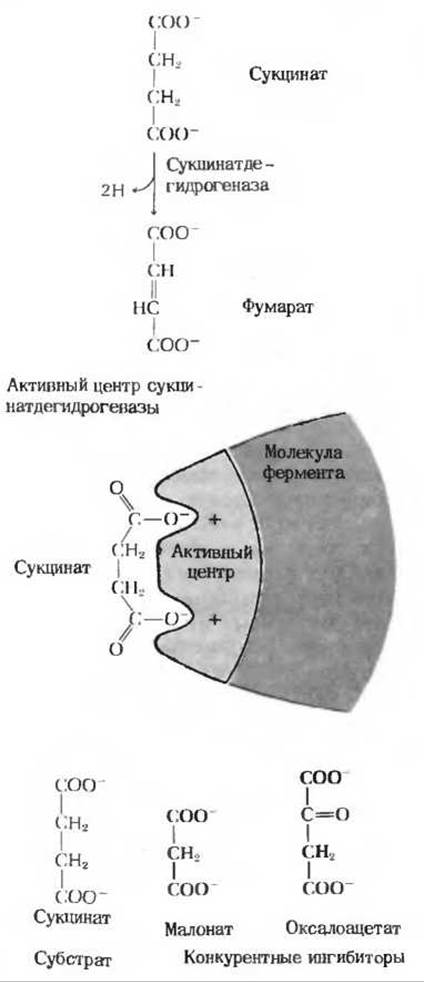
Fig. 9-12. The reaction catalyzed by succinate dehydrogenase and its competitive inhibition. Note that competitive inhibitors structurally resemble succinate: they contain two spatially oriented negatively charged groups that match the conformation of the active site.
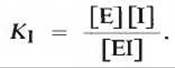
Competitive inhibition is most easily identified experimentally by determining The Effect of inhibitor concentration on the dependence of initial reaction rate on substrate concentration. To determine whether reversible enzyme inhibition is competitive or noncompetitive (Box 9-3), it is very useful to linearize the Michaelis-Menten Equation. The double-reciprocal plot is most commonly used for this purpose. From plots constructed in double-reciprocal coordinates, one can also determine the dissociation constant of the enzyme-inhibitor complex. For the dissociation reaction
EІ ⇄ Е + I
the dissociation constant is
Last update: 06/08/2026
Editorial and Educational Adaptation: This material has been compiled based on the primary/original source text. The project team performed an editorial review, corrected technical inaccuracies, structured sections, and adapted the content for an educational format.
What was processed:
- elimination of formatting defects (OCR errors, structural breaks, corrupted characters);
- editorial organization of content;
- standardization of terminology in accordance with academic sources;
- verification of factual statements against the original source text.
All mentions of the author, publication year, and origin of the primary text have been preserved in accordance with the source.