Principles of Biochemistry, Volume 1 - A. Lehninger 1985
Biomolecules
Enzymes
Noncompetitive inhibition is also reversible, but it cannot be reduced or overcome by increasing the substrate concentration
In uncompetitive inhibition, the inhibitor binds to the enzyme not at the Active Site where the substrate binds, but at a completely different Location. This alters the conformation of the enzyme molecule, leading to the reversible inactivation of its catalytic center. Non-Competitive Inhibitors bind reversibly to both the free enzyme and the ES complex, forming inactive EI and ESI complexes.
Class="center">Е + I ⇄ EI,
ES + I ⇄ ESI.
The Use of double-reciprocal plots to analyze data from Enzyme Inhibition studies makes it easy to distinguish competitive inhibitors from non-competitive ones. Two series of experiments are conducted to determine the reaction velocity at a constant Enzyme Concentration. In one series, the Substrate Concentration is also kept constant, and appropriate experimental Methods are used to determine The Effect of increasing inhibitor concentration on the initial reaction velocity v0. In the other series, conversely, the inhibitor concentration is held constant while varying substrate concentrations are used. Using the data obtained from both series of experiments, plots are constructed in coordinates of {1 / [S]; 1/v0}.
Fig. 1 shows such plots obtained in the absence of an inhibitor and at two different concentrations of a competitive inhibitor. In the case of competitive inhibitors, a family of lines with different slopes is obtained, intersecting at a single point on the 1/v0 axis. Since the intercept on the 1/v0 axis is numerically equal to 1/Vmах, it is clear that Vmах remains unchanged in the presence of competitive inhibitors. This means that regardless of the concentration of the competitive inhibitor, a sufficiently high substrate concentration can always be chosen at which the substrate will displace the competitive inhibitor from the active site.
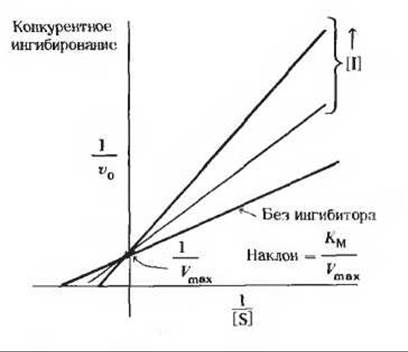
Fig. 1.
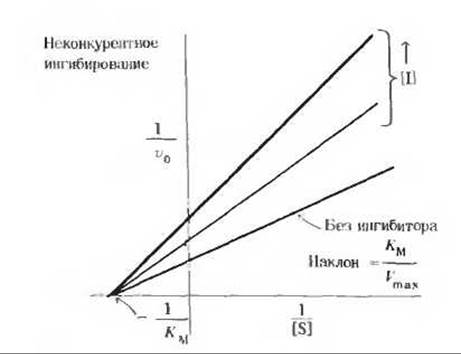
Fig. 2.
Box 9-3. Kinetic Tests for Distinguishing Competitive from Non-Competitive Inhibition
In non-competitive inhibition, similar plots form a family of lines (Fig. 2) that intersect the 1/[S] axis at a single point, cutting off an intercept numerically equal to 1/КМ. This indicates that the value of KM does not change with varying concentrations of the non-competitive inhibitor, whereas the value of Vmax decreases accordingly.
Non-competitive enzyme inhibition can be distinguished from competitive inhibition by analyzing kinetic data plotted in double-reciprocal coordinates, as illustrated in Box 9-3.
The most important non-competitive inhibitors are metabolic intermediates produced in living organisms that can reversibly bind to specific sites On the surface of certain regulatory Enzymes, thereby altering The activity of their catalytic centers. An example is the inhibition of L-Threonine dehydratase by L-isoleucine, as discussed in Section 9.18.
Last update: 06/08/2026
Editorial and Educational Adaptation: This material has been compiled based on the primary/original source text. The project team performed an editorial review, corrected technical inaccuracies, structured sections, and adapted the content for an educational format.
What was processed:
- elimination of formatting defects (OCR errors, structural breaks, corrupted characters);
- editorial organization of content;
- standardization of terminology in accordance with academic sources;
- verification of factual statements against the original source text.
All mentions of the author, publication year, and origin of the primary text have been preserved in accordance with the source.