Molecular Biology: Protein Structure and Function - Stepanov V.M. 2005
Enzymes
Enzyme Inhibition
Inhibition, i.e., the complete or partial suppression of enzyme activity while preserving their primary and Spatial Structure, is one of the most crucial pathways for regulating biochemical processes and, at the same time, a productive method for studying biocatalysis. Inhibitors are generally classified into reversible and irreversible.
Irreversible inhibitors are those that inactivate an enzyme by forming a bond with it that is sufficiently stable and practically non-dissociating under the conditions typical of its activity. Usually, this is a covalent bond with one of the Functional groups of the catalytic center.
Note that it is often possible to select conditions under which the inactivating group is cleaved off and the enzyme is reactivated; however, since these conditions are fundamentally different from those under which the inhibition took place, the inhibition is still considered irreversible.
For example, let us consider the inhibition of the proteolytic enzyme Papain, which has a Cysteine thiol group in its catalytic center, by mercury compounds. The reaction of a divalent mercury ion with this thiol group leads to The formation of a poorly dissociating mercaptide:
Class="center">
As a result of this reaction, the enzyme loses its activity, and the inhibition under these conditions is irreversible. However, in the presence of an excess of other thiol compounds, such as mercaptoethanol, mercury ions are redistributed between them and the cysteine residue in the active center of papain, causing the latter to be released, and papain fully restores its activity:

This sequence of transformations is used in practice as a method for storing papain to prevent its self-Cleavage, or autolysis. Nevertheless, the inhibition of papain by mercury ions is regarded as irreversible.
The potential action of irreversible inhibitors must be accounted for, in particular, during the isolation of Enzymes. For instance, ions of mercury, lead, copper, and several other heavy metals can inactivate certain enzymes by blocking their sulfhydryl groups, which requires their thorough removal from solutions and occasionally The Use of complexones.
Among irreversible inhibitors, specific Reagents targeting the functional groups of the enzyme's catalytic center stand out. The selectivity of their action is enhanced if they contain structures that promote their binding to the active center or, even more effectively, mimic The structure of the transition enzyme-substrate complex. For example, upon the action of diisopropyl fluorophosphate on Trypsin or other Serine proteinases, the inhibitor acylates the active serine hydroxyl group in the enzyme's active center; however, the resulting compound, being a structural analogue of the Transition State, is resistant to further Hydrolysis, so the enzyme cannot regenerate and remains irreversibly inhibited. Diisopropyl fluorophosphate also irreversibly inhibits cholinesterases, making it a potent poison.
Irreversible inhibition also occurs in nature. This is precisely how Penicillins inactivate D,D-carboxypeptidase—an enzyme involved in The Biosynthesis of murein, a polymer that forms part of the Introduction/37.html">Bacterial Cell wall structure. Penicillins, which to a certain extent mimic the structure of this enzyme's substrate, bind to it and, through the opening of the ß-lactam ring, acylate the serine hydroxyl group in the enzyme's active center, causing its irreversible inhibition.
The interaction of reversible inhibitors with an enzyme According to the scheme

is described by the inhibition constant Ki, which represents the dissociation constant of the enzyme-inhibitor complex EI:
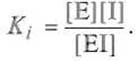
Obviously, Ki is numerically equal to the inhibitor concentration at which half of the enzyme molecules are bound into the enzyme-inhibitor complex.
Reversible inhibitors, in turn, are subdivided into Competitive and non-competitive. Competitive Inhibitors are those that interact with the same region of the enzyme surface that binds the substrate and, consequently, are able to compete with it for the enzyme. However, the binding sites for the substrate and the competitive inhibitor do not necessarily coincide—partial overlap is sufficient for competitive relations. Therefore, chemically, the inhibitor may not even resemble the substrate, since binding zones are frequently multivalent. For instance, indole and ß-naphthol competitively inhibit the proteinase a-Chymotrypsin, although it is difficult to spot any analogy with Peptides in them. This presumably involves the utilization of the same hydrophobic patch of chymotrypsin in both cases.
The rate equation for an enzymatic reaction in the presence of a competitive inhibitor is somewhat more complex than the Michaelis-Menten Equation:
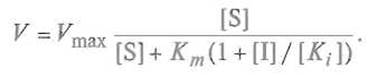
Introducing the "apparent" Michaelis constant K'm = Km(1 + [I]/ [Ki]) reduces the equation to the canonical Michaelis-Menten form. Thus, the presence of a competitive inhibitor in the system is equivalent to an increase in the Michaelis constant, with the degree of this increase determined by The ratio of the inhibitor concentration to the inhibition constant, i.e., the parameter characterizing the binding strength of the given inhibitor with the enzyme.
It is clear that the maximum velocity and the corresponding constant kcat characterize The rate of conversion into product of the already formed enzyme-substrate complex, and therefore the presence of a competitive inhibitor cannot affect them. Meanwhile, The change in the apparent Michaelis constant accounts for the decrease in the effective Enzyme Concentration, since the enzyme-competitive inhibitor complex does not interact with the substrate:

Competitive inhibition is widespread in nature and is utilized for practical purposes to regulate enzyme activity. Natural proteinase and amylase inhibitors act via this mechanism; their complementarity to the respective active centers is so great and their binding so tight that their action often appears as practically irreversible inhibition due to the extremely low dissociation constants of the enzyme-inhibitor complexes. Many pharmaceutical drugs designed to suppress unwanted enzyme activity are engineered as competitive inhibitors, with structures selected to match the enzyme's binding pocket as closely as possible in order to lower Ki. For instance, analogues of the substrates of renin—a proteinase involved in Blood Pressure Regulation—which contain a hydrolysis-resistant structure such as —CO—CH2— instead of the peptide bond —CO—NH— cleaved by the enzyme, have a Ki on the order of 1 ∙ 10-9 M and may hold therapeutic significance.
Non-competitive inhibition differs fundamentally from competitive inhibition: in this case, the inhibitor does not affect the substrate-binding site, but instead attaches to the enzyme via a different pathway, causing the inactivation of the catalytic center. Since the inhibitor and substrate bind to different Regions of the enzyme in this scenario, the inhibitor can attach to both the free enzyme and the enzyme-substrate complex, inactivating the enzyme in both cases. It is precisely this independence of the binding sites that makes competition between the substrate and the inhibitor impossible; consequently, non-competitive inhibition cannot be overcome by an excess of substrate.
Thus, the following scheme holds true for non-competitive inhibition:

The rate equation for an enzymatic reaction in the presence of a non-competitive inhibitor is as follows:

As previously mentioned, The Nature of substrate binding to the enzyme in the presence of a non-competitive inhibitor remains unchanged, hence the preservation of Km. In contrast, the value of Vmах is adjusted by the factor Ki/([I] + Ki), which decreases as the inhibitor concentration increases relative to the inhibition constant. Here again, the concentration of the active substance—in this case, the inhibitor—is compared with its characteristic inhibition constant. The decrease in the effective maximum velocity corresponds to a reduction in the catalytic center activity upon binding of the non-competitive inhibitor.
Non-competitive inhibition can result from several modes of interaction between the enzyme and the inhibitor. It is possible that the inhibitor binding to the functional groups of the catalytic center is small enough not to interfere with substrate binding. For example, hydrogen ions may act in this manner by protonating functional groups involved in catalysis.
The inhibitor may bind at a site adjacent to the catalytic center and block it while practically leaving the substrate-binding zone unaffected. Such situations are particularly likely for multi-substrate enzymes, where each substrate binds to its own site. Finally, especially in complex enzymes, binding of the inhibitor to a site remote from the catalytic center may induce Conformational Changes in the enzyme that are transmitted to the Active Site, disrupting its structure and leading to Enzyme inactivation. This is a specific case of allosteric enzyme inhibition—a very common mechanism for regulating enzymatic activity.
The operating principles common to all enzymes are manifested in each specific case through the enzyme-specific mode of substrate binding and catalytic mechanism. While substrate binding and the resulting Enzyme Specificity have been described in considerable detail in recent years, the mode of action of the catalytic center remains virtually unestablished as final in almost any case, although mechanisms very close to the actual ones have been proposed for several enzymes. We will examine data on the functioning mechanism of certain enzymes, paying special attention to features of general significance that are typical of biological catalysts of various origins.
Last update: 13/08/2026
Editorial and Educational Adaptation: This material has been compiled based on the primary/original source text. The project team performed an editorial review, corrected technical inaccuracies, structured sections, and adapted the content for an educational format.
What was processed:
- elimination of formatting defects (OCR errors, structural breaks, corrupted characters);
- editorial organization of content;
- standardization of terminology in accordance with academic sources;
- verification of factual statements against the original source text.
All mentions of the author, publication year, and origin of the primary text have been preserved in accordance with the source.