BIOLOGY Volume 2 - A Guide to General Biology - 2004
14. TRANSPORT IN ANIMALS
14.7. The Heart
14.7.7. Regulation of Blood Pressure
Blood pressure depends on a variety of factors, notably: 1) Heart rate; 2) stroke volume; 3) resistance to blood flow exerted by the Blood Vessels (peripheral resistance); and 4) the force of cardiac contractions. Heart rate and stroke volume were discussed in the previous section.
Resistance to blood flow changes depending on the contraction or relaxation of the smooth Muscle in blood vessel walls, particularly in the arterioles. Constriction of the vessels (vasoconstriction) increases peripheral resistance, whereas their dilation (vasodilation) decreases it. An increase in resistance leads to a rise in blood pressure, while a decrease in resistance causes it to fall. All these changes are regulated by the vasomotor center in the Medulla Oblongata.
Nerve fibers extend from the vasomotor center to all the arterioles in the body. The change in diameter of these vessels depends primarily on the tone of vasoconstrictor Muscles (which narrow the vessels); vasodilator muscles (which widen them) play a minor role.
The activity of the vasomotor center is regulated by impulses it receives from pressure receptors (baroreceptors) located in the walls of the aorta and the carotid sinuses of the common carotid Arteries (Fig. 14.26). Stimulation of parasympathetic fibers in these areas, caused by an increase in Cardiac Output, leads to widespread vasodilation throughout the body, resulting in a drop in blood pressure and a decrease in heart rate. A decrease in blood pressure produces the opposite effect: stimulation of sympathetic fibers occurs, leading to generalized vasoconstriction and an increase in blood pressure.
Class="center">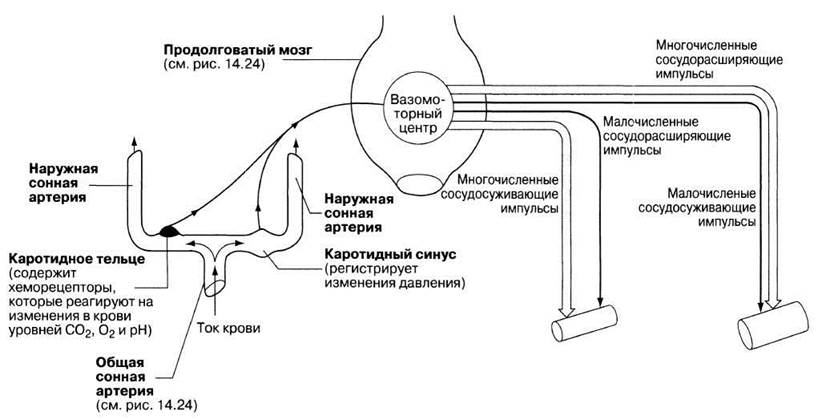
Fig. 14.26. Regulation of Blood pressure. The relationships among the carotid body, carotid sinus, vasomotor center, and the general Circulatory system are shown.
Chemical Regulation of the Vasomotor Center
Chemoreceptors are located in the carotid bodies at the branching point of the carotid arteries; they are stimulated by high carbon dioxide levels in the incoming blood and send impulses to the vasomotor center in the medulla oblongata (Fig. 14.26). Nerve fibers originating from these baroreceptors join with fibers from the carotid sinus baroreceptors and travel in a single bundle to the vasomotor center in the medulla oblongata. Upon receiving signals along this common pathway, the vasomotor center sends impulses to the blood vessels, causing them to constrict and blood pressure to rise. Increased activity of Tissues and Organs is usually accompanied by elevated CO2 production, and thanks to this mechanism, CO2-laden blood is transported to the Lungs more rapidly and, consequently, oxygenated faster.
Carbon dioxide can also directly affect the smooth muscle of blood vessels. When a tissue's activity sharply increases, it produces a large amount of CO2, which acts on the blood vessels in that region, causing them to dilate. This enhances blood flow, supplying more oxygen and glucose to the active Cells. It should be borne in mind, however, that carbon dioxide entering the general Circulation will affect the activity of the vasomotor center, promoting vasoconstriction in other PARTS OF THE body. This is a clear illustration of how dynamically and flexibly blood pressure—and consequently the entire process of Blood Circulation and distribution—is regulated.
Other factors, such as emotional stress (anxiety, pain, annoyance, etc.), increase sympathetic Nervous system activity, resulting in an elevation of blood pressure. The release of adrenaline, triggered by stimulation of The adrenal medulla via impulses from higher centers of the Central Nervous System, leads to an increased heart rate and higher blood pressure. Structure/19.html">The Importance of regulating heart rate and blood pressure is discussed in more detail in Section 19.1.
14.4. When an animal is wounded, its overall blood pressure increases, yet localized Swelling (edema) develops around the wound As a result of local vasodilation. Explain the potential benefits of these responses to the Organism.
14.5. Describe the main adaptive changes occurring in The Cardiovascular system immediately before, during, and right after a 100-meter dash.
Last update: 06/08/2026
Editorial and Educational Adaptation: This material has been compiled based on the primary/original source text. The project team performed an editorial review, corrected technical inaccuracies, structured sections, and adapted the content for an educational format.
What was processed:
- elimination of formatting defects (OCR errors, structural breaks, corrupted characters);
- editorial organization of content;
- standardization of terminology in accordance with academic sources;
- verification of factual statements against the original source text.
All mentions of the author, publication year, and origin of the primary text have been preserved in accordance with the source.