Review of Medical Physiology - William F. Ganong 2002
Functions of the Nervous System
Central Regulation of Visceral Functions
Medulla Oblongata
Regulation of Respiration, heart rate, and Blood pressure
The Regions of the medulla oblongata containing the centers for autonomic REFLEX REGULATION OF Circulation, Cardiac Activity, and respiration are referred to as vital, or medullary, centers because their damage typically has fatal consequences. Afferent fibers project to these centers from specialized visceral receptors located not only in, for example, the carotid bodies, carotid sinus, and aortic arch, but also within the medulla oblongata itself. Motor Reflexes are precisely coordinated and encompass both somatic and visceral components. These reflexes are described in detail in the chapters dedicated to The regulation of circulation and respiration.
Other autonomic reflexes regulated by medullary centers
Swallowing, coughing, sneezing, and vomiting are also reflex acts integrated at the level of the medulla oblongata. Swallowing is regulated by the medullary central pattern generator. It begins with the voluntary act of propelling food from the Oral Cavity toward the posterior wall of the Pharynx (see Chapter 26), which initiates precisely coordinated reflex movements of a series of Organs belonging to both the respiratory and digestive systems. Irritation of the tracheal lining and extrapulmonary Bronchi triggers coughing. The glottis closes, contraction of the Respiratory Muscles generates high intrapulmonary pressure, and the glottis then suddenly opens, expelling air from the Lower Respiratory Tract (see Chapter 35). Sneezing is a somewhat similar reflex, provoked by irritation of the nasal mucosal epithelium or initiated by pain signals transmitted via sensory fibers of the Trigeminal nerve.
Vomiting
Vomiting is another example of a visceral reflex integrated within the centers of the medulla oblongata, involving the precise coordination of both somatic and visceral components. It is preceded by salivation and a feeling of nausea. Reverse peristalsis causes the Contents of the upper Small Intestine to move back into The Stomach. The glottis closes to prevent vomitus from entering the Trachea. Respiration is arrested midway through inspiration. The abdominal wall muscles contract, and with the Thorax fixed, intra-abdominal pressure rises. The lower esophageal sphincter and the muscular walls of the Esophagus relax, allowing the gastric contents to be expelled.
The vomiting center in the medullary reticular formation (Fig. 14-1) actually consists of distinct, scattered clusters of Neurons that regulate specific Components of the vomiting act.
Afferent pathways
Irritation of the mucosa in the upper gastrointestinal tract induces vomiting. Nerve impulses travel from the mucosa to the medulla oblongata via visceral afferent pathways within the sympathetic and vagus nerves. Afferent fibers from the vestibular nuclei transmit signals that provoke nausea and induce vomiting. Other sensory pathways project to areas of the Diencephalon that regulate the vomiting act, as well as to the limbic system—which is understandable given the known correlation between emetic agents and emotional stimuli. Hence, we speak of "sickening odors" and "sickening sights."
Class="center">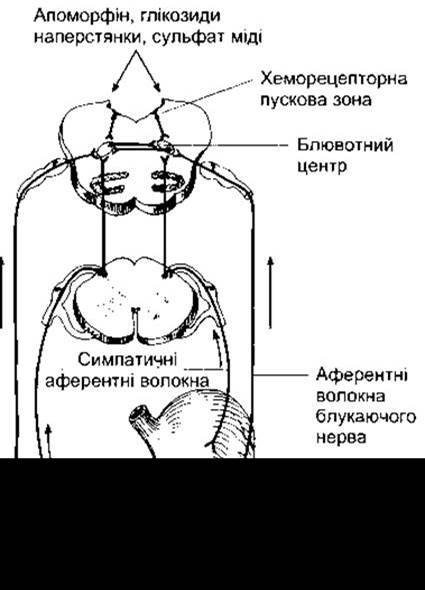
Fig. 14-1. Afferent Pathways of the vomiting reflex and the chemoreceptor trigger zone in the medulla oblongata (reproduced with permission from Research in the Service of Medicine. Vol 44. Searle & Co, 1966).
Chemoreceptor Cells in the medulla oblongata initiate vomiting when stimulated by certain chemical agents circulating in the blood. The chemoreceptor trigger zone, which contains these cells (see Fig. 14-1), is located within or near the area postrema—a V-shaped strip on the lateral wall of the Fourth ventricle near the obex. It belongs to the circumventricular organs (see Chapter 32) and is more permeable to many substances than the underlying medullary tissue. Lesions of the area postrema have little effect on the emetic response to gastrointestinal irritation or motion sickness, but they prevent vomiting caused by injections of apomorphine or other drugs, and also diminish vomiting associated with uremia and radiation, which may be mediated by blood-borne endogenous substances.
The small intestine contains 5-HT3 receptors, and serotonin (5-HT) released by enterochromaffin cells initiates impulses in afferent fibers that trigger vomiting. In addition, dopamine D2 and 5-HT3 receptors are present in the area postrema and The Nucleus tractus solitarii. 5-HT3 antagonists, such as ondansetron, and D2 antagonists, such as chlorpromazine or haloperidol, are effective antiemetic drugs. The Use of corticosteroids, cannabinoids, and benzodiazepines, either alone or in combination with 5-HT3 and D2 antagonists, is also indicated for Chemotherapy-induced emesis. The MECHANISM OF ACTION of corticosteroids and cannabinoids remains unknown, whereas benzodiazepines presumably reduce chemotherapy-related anxiety.
Last update: 10/08/2026
Editorial and Educational Adaptation: This material has been compiled based on the primary/original source text. The project team performed an editorial review, corrected technical inaccuracies, structured sections, and adapted the content for an educational format.
What was processed:
- elimination of formatting defects (OCR errors, structural breaks, corrupted characters);
- editorial organization of content;
- standardization of terminology in accordance with academic sources;
- verification of factual statements against the original source text.
All mentions of the author, publication year, and origin of the primary text have been preserved in accordance with the source.