Principles of Biochemistry, Volume 2 - A. Lehninger 1985
Bioenergetics and Metabolism
The ATP Cycle and Cellular Bioenergetics
The change in standard free energy of a chemical reaction can be calculated
Every chemical reaction is characterized by a specific change in Standard Free energy, ∆G0. [As will be shown below, the value of ∆G0 differs from ∆G, which is derived from equation (1).] For a given chemical reaction, the standard free energy change is a constant; it can be calculated from the reaction's Equilibrium Constant under standard conditions, i.e., a Temperature of 25 °C (298 K) and a pressure of 1 atm (760 mm Hg). The equilibrium constant Keq' for the reaction A + B ⇄ C + D is given by (sec. 4.5)
Class="center">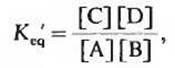
where [A], [B], [C], and [D] are the molar concentrations of the reactants and products at equilibrium under standard conditions. The equation for a reaction involving more than one molecule of reactants and products has the form
аА + bВ ⇄ сС + dD,
where a, b, c, and d are the numbers of molecules of reactants A, B, C, and D, respectively. In this case, the equilibrium constant is
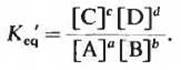
Now that we have defined the equilibrium constant of a chemical reaction, we can calculate the standard free energy change for that reaction, which is conventionally expressed in calories per mole of reacting substance. The calorie is the unit most commonly used in biology to measure energy. Numerically, it equals The amount of energy in the form of heat required to heat 1.00 g of Water from 15 to 16 °C. The standard free energy change ∆G0 is calculated from the equation
∆G0 = -2,303 RTlg K'eq,
where R is the gas constant [1.987 cal/(mol·K)] and T is the absolute temperature, in this case 298 K. For a chemical reaction with an equilibrium constant of 1.0, the standard free energy change is ∆G0 = 0, because the logarithm of 1.0 is zero. If the equilibrium constant of a given reaction is greater than 1.0, the value of ∆G0 is negative; if it is less than 1.0, the value of ∆G0 is positive.
It is also helpful to define the standard free energy change from another perspective. ∆G0 is the difference between the Free energy of the reactants and the free energy of the products under standard conditions—that is, at a temperature of 298 K, a pressure of 1 atm, and initial concentrations of all reaction components of 1.0 M. A negative value of ∆G0 means that the reaction products contain less free energy than the reactants; consequently, under standard conditions, the equilibrium will be shifted to the right (toward The formation of products), since all reactions tend to proceed in the direction that minimizes the free energy of the system. A positive value of ∆G0 means that the products contain more free energy than the reactants. Therefore, with initial component concentrations of 1.0 M, the reaction will proceed in the reverse direction, from right to left. To state this more precisely: at initial concentrations of 1.0 M for all components, reactions with a negative ∆G0 proceed from left to right until equilibrium is established. Conversely, reactions with a positive ∆G0 under the same conditions proceed in the reverse direction (from right to left) until equilibrium is reached. Table 14.1 illustrates the dependence of the reaction direction on the sign of ∆G0. In essence, the standard free energy change of any chemical reaction is simply one of the ways to express its equilibrium constant mathematically. Table 14.2 shows the relationship between numerical values of ∆G0 and K'eq.
Table 14-1. Relationship between K'eq and ∆G0 values and the direction of Chemical Reactions under standard conditions
|
K'еq |
∆G0' |
Reaction direction at initial component concentrations of 1.0 M |
|
> 1,0 |
Negative |
Left to right |
|
1,0 |
Zero |
Equilibrium state |
|
< 1,0 |
Positive |
Right to left |
Table 14-2. Relationship between equilibrium constants and standard Free Energy Changes for chemical reactions
|
∆С0', cal/mol |
|
|
0,001 |
+ 4089 |
|
0,01 |
+ 2726 |
|
0,1 |
+ 1363 |
|
1,0 |
0 |
|
10,0 |
- 1363 |
|
100,0 |
-2726 |
|
1000,0 |
-4089 |
Two important points should be noted. Because biochemical reactions typically occur at pH values close to 7.0 and are frequently accompanied by the production or consumption of H+ ions, biochemical energetics adopts pH 7.0 as the standard state. The standard free energy change in biochemical systems at pH 7.0 is denoted by the symbol ∆G0', which we will use throughout the rest of this book.
The second point concerns units of energy. In the International System of Units (SI), the joule (J) is the standard unit of energy. This name honors the English physicist James Joule (1818–1889), who first obtained experimental proof of The First Law of Thermodynamics—the law of conservation of energy. However, in medicine and biology, energy is traditionally expressed in calories, and we will use these units in our book. Calories are easily converted to joules: 1.00 cal = 4.184 J.
Last update: 06/08/2026
Editorial and Educational Adaptation: This material has been compiled based on the primary/original source text. The project team performed an editorial review, corrected technical inaccuracies, structured sections, and adapted the content for an educational format.
What was processed:
- elimination of formatting defects (OCR errors, structural breaks, corrupted characters);
- editorial organization of content;
- standardization of terminology in accordance with academic sources;
- verification of factual statements against the original source text.
All mentions of the author, publication year, and origin of the primary text have been preserved in accordance with the source.