Molecular Biology: Protein Structure and Function - Stepanov V.M. 2005
Enzymes
Basic Principles of Enzyme Catalysis Kinetics
The foundations of enzyme kinetics were laid by L. Michaelis and M. Menten back in 1913. The equation they proposed, which relates reaction velocity to the concentrations of the enzyme and substrate, has undergone modifications over time, yet the fundamental approach remains intact, and the equation continues to bear their names.
According to the Michaelis-Menten model, enzyme E and substrate S interact at a rate characterized by the rate constant k+1, forming an enzyme-substrate complex ES, known as the Michaelis complex. In this complex, the substrate—attached to the enzyme by non-covalent bonds—retains its chemical identity and can either dissociate back into the enzyme and substrate with a rate constant k-1, or convert into product (or products) P, releasing the enzyme E at a rate characterized by the rate constant k+2.
Class="center">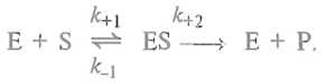
As a rule, the enzyme-substrate complex ES is much more likely to dissociate back into its initial components than to proceed with The formation of the reaction product P, i.e., k+1 ≫ k+2. Naturally, The conversion of substrate into product is of primary interest when studying enzymatic reactions. The reaction rate is determined by the accumulation of product per unit of time.
When deriving the Michaelis-Menten Equation, it is first necessary to establish the relationship between the concentration of the enzyme-substrate complex and the concentrations of the enzyme and substrate, since The rate of product formation is proportional to the concentration of the ES complex. The rate of ES formation is given by k+1 [Е] [S]. Its rate of breakdown, in turn, is determined by the sum of two processes: the dissociation of the enzyme-substrate complex into its components at a rate of k-1[ES], and its breakdown to form the product at a rate of k+2[ES],
Thus, the overall rate of breakdown of the ES complex via both pathways equals the sum of these rates (k-1 + k+2)[ES]. Michaelis-Menten kinetics is applicable to established, steady-state processes where the rates of formation and breakdown of the Michaelis complex are equal, meaning its concentration remains constant. For such a process, the following equality holds

rearranging which gives
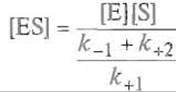
The fraction
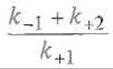
is called the Michaelis constant Km. It is easy to see that it characterizes The ratio of the breakdown rates (numerator) to the formation rate (denominator) of the Michaelis complex ES. If k+2 is small compared to k-1—that is, if the dissociation of the complex into its initial components (enzyme and substrate) is significantly more probable than its breakdown to form product P—then k+2 can be neglected, and the Michaelis constant becomes equal to the dissociation constant of the substrate
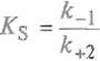
As already noted, this relationship often holds true, which is why the Michaelis constant Km is frequently equated to KS. However, one should bear in mind the provisional nature of this simplification. Substituting Km for the fraction in the denominator of the previous equation yields

Note that the equation above involves the current concentrations of free enzyme and substrate, which, strictly speaking, do not coincide with their initial concentrations (the latter being much easier to determine). However, the difference between the initial [ST] and current substrate concentrations can be neglected by assuming [ST] ≈ [S], since the Michaelis-Menten equation is valid only for low degrees of substrate conversion (a fact that must not be overlooked when determining enzyme activity). Conversely, the current concentration of the enzyme differs significantly from its total concentration [ЕT] due to the binding of a greater or lesser fraction of the enzyme molecules into the Michaelis complex:

Substituting this expression for the current Enzyme Concentration into the equation given above, and after rearrangement, we obtain
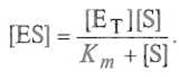
This equation describes the dependence of the enzyme-substrate complex concentration on the initial concentrations of the enzyme and substrate. Since the rate of reaction product formation V equals k+2[ES], then
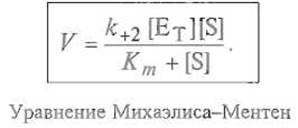
It should be kept in mind that this equation defines the initial velocity of a steady-state reaction, V0 (the subscript "0" is omitted for simplicity). It follows from the derived equation that the reaction rate is proportional to the total enzyme concentration, whereas its dependence on Substrate Concentration is considerably more complex.
Let us examine what this dependence looks like in the most characteristic cases. Recall that

and if k+2 ≪ k-1 (which is observed quite frequently), then as a first approximation Km ≈ KS; in other words, the Michaelis constant is equal to the dissociation constant of the enzyme-substrate complex—the "substrate constant."
1. If the substrate concentration is much lower than Km, i.e., [S] ≪ Km (a condition corresponding to a truly low substrate concentration or poor binding by the enzyme—reflected by a large Km value), the term [S] in the denominator of the Michaelis-Menten equation can be neglected. Consequently, the reaction rate becomes proportional to the concentrations of both the substrate and the enzyme, and the equation simplifies to

This expression corresponds to the rate equation for a bimolecular reaction. The fraction  , which represents the bimolecular rate constant, is sometimes called the bimolecular rate constant and is used to compare the catalytic efficiency of similar Enzymes
2. If the substrate concentration is much higher than Km, [S] ≫ Km (either because the substrate concentration itself is high or the enzyme has a high affinity for the substrate, corresponding to a low Km), the term Km in the denominator can be neglected, and the reaction rate V = k+2[ET] becomes proportional to the enzyme concentration while remaining independent of the substrate concentration. In other words, the enzyme is saturated with the substrate, and no free enzyme is left in the reaction mixture. It is worth noting that substrate concentration in enzymatic reactions is significant not on an absolute scale, but relative to the Michaelis constant, which characterizes the affinity of a given enzyme for that specific substrate.
This relationship is illustrated in Fig. 10.1. At low substrate concentrations, the reaction rate is directly proportional to its amount in the mixture; then, an increasingly pronounced deviation from linearity is observed; and finally, at substrate concentrations significantly exceeding Km, the dependence of the reaction rate on substrate concentration practically vanishes, with the rate reaching its maximum value (for a given enzyme concentration):
Vmax = k+2[ET]
Therefore,

This is an alternative form of the Michaelis-Menten equation.
3. If the substrate concentration is equal to the Michaelis constant, then Km + [S] = 2[S] and V = Vmax/2.
This relationship reveals the physical meaning of the Michaelis constant for an enzyme-substrate pair: it is numerically equal to the substrate concentration at which the reaction rate reaches half of its maximum value.
It should be kept in mind that Michaelis-Menten kinetics holds true for many, but not all, enzyme-catalyzed reactions. Significant deviations are exhibited, in particular, by enzymes whose activity increases with rising substrate concentration.
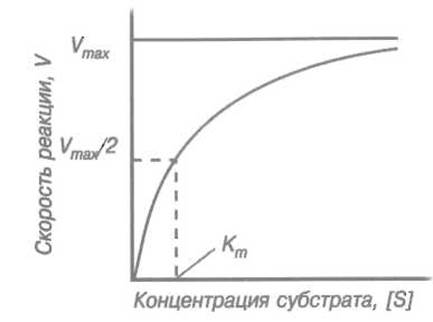
Fig. 10.1. Dependence of the velocity V of an enzyme-catalyzed reaction on the substrate concentration
The parameters Vmax and Km are crucial for characterizing enzymatic reactions, and a variety of Methods have been developed to determine them. The most popular approach is data Processing using the transformed Michaelis-Menten equation, known as the double-reciprocal method proposed by H. Lineweaver and D. Burk. The Michaelis-Menten equation is rearranged to express the reciprocal of the reaction rate, 1/V (i.e., the time required to convert a specific amount of substrate), as a function of the reciprocal of the substrate concentration (its dilution), 1/S:
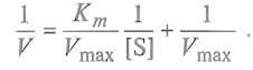
In this form, the Michaelis-Menten equation is equivalent to the linear equation y = ax + b, where y = 1/V, x = 1/S,

meaning it describes a straight line that intercepts the coordinate axes (Fig. 10.2). If, as the substrate concentration increases to very high values, 1/[S] approaches zero, then 1/V becomes equal to 1/Vmax. Thus, by measuring the intercept of the line on the 1/V axis, Vmax can be calculated. If, on the other hand, 1/V = 0, then

and Km equals — [S].
Other Transformations of the Michaelis-Menten equation also exist, some of which are more convenient for data processing and are described in specialized manuals. Recently, computer-based calculations have been replacing graphical methods.
The application of the Michaelis-Menten equation makes it possible to quantitatively characterize the catalytic efficiency of enzymes and compare their action on various substrates. As already mentioned, —1/Km is the intercept on the x-axis, and 1/Vmax is the intercept on the y-axis; with certain caveats, the Km value allows us to estimate the affinity of various enzymes for their substrates. Km values span a very wide range of concentrations, typically starting in the millimolar range. Significantly higher Km values are also encountered, which may be due to The Use of substrates that do not fully match the enzyme's Specificity. Understandably, for small substrates such as HCO3, establishing a sufficiently developed interaction system with the enzyme is not easy, and therefore Km values are likely to be high.

Fig. 10.2. Dependence of the reciprocal reaction rate 1/V (time spent on the conversion of a unit of substance) on the reciprocal substrate concentration 1/[S] (dilution).
The Michaelis constants become significantly lower and binding becomes more efficient for an extended substrate, as a larger number of non-covalent contacts can be established with it. For instance, pancreatic Elastase (an enzyme whose natural substrates are Proteins or Peptides) binds the simplest model substrate—acetyl-L-Alanine methyl ester—very weakly. In this case, Km is 170 mM. As the peptide chain lengthens, Km decreases rapidly and binding improves. Thus, for acetyl-alanyl-alanine methyl ester, Km is 22 mM, and for acetyl-alanyl-alanyl-alanine methyl ester, it is 0.4 mM.
However, one should not assume that enzyme evolution is driven by factors aimed at continuously lowering Km and improving substrate binding. Apparently, an optimal binding affinity is achieved, characteristic of each specific enzyme-substrate pair. Within The Cell, the substrates of many enzymes are present at concentrations substantially lower than Km, and consequently, enzymes do not operate under saturation conditions. Thus, for natural systems, it is typical for the rate of an enzymatic reaction to depend on substrate concentration, meaning that an increase in the latter does not necessarily require enhanced enzyme Biosynthesis.
A. Fersht and co-workers, while studying The properties of tyrosyl-tRNA synthetase, noted that Km for one of its substrates, ATP, is 2.5 mM, which is several orders of magnitude higher than the dissociation constants known for ATP complexes with other proteins. For example, the Km of Myosin for ATP is 10-10 mM. It is quite obvious that tight binding of such a large molecule as adenosine triphosphate—which is capable of forming an extensive network of non-covalent bonds with the protein—is entirely feasible. This possibility is not realized in tyrosyl-tRNA synthetase not because the enzyme is imperfect, but presumably because tight binding of ATP involving A large number of enzyme-substrate contacts would result in a rigid system in which the movement of the substrate relative to the catalytic center would be severely hindered, thereby reducing catalytic efficiency. Furthermore, such "perfection" is redundant since the intracellular concentration of ATP is close to 2–3 mM; consequently, an "ideal" enzyme with tighter binding would hardly gain any serious advantage through a lower Km.
An important characteristic of enzyme efficiency is the rate constant k+2, which describes The breakdown of the enzyme-substrate complex to form the reaction product. As shown above, Vmах = k+2 [ЕT]. Knowing the total concentration [ЕT] (which requires not just knowing the protein concentration in solution, but determining the concentration of active sites using specially developed methods), one can calculate the number of substrate molecules converted into product per unit time (1 s) at full enzyme saturation with the substrate. This value, referred to as the turnover number, varies widely among different enzymes. For instance, it is 60,000 for Carbonic anhydrase, but only 0.5 for Lysozyme. It should be emphasized that the turnover number characterizes the maximum possible operating speed of an enzyme, rather than its efficiency under real conditions where substrate saturation is absent.
If The Mechanism of ES conversion into product is more complex, specifically multi-step, the constant k+1 is replaced by the first-order reaction constant kcat.
A more accurate measure of efficiency under near-physiological conditions is provided by the bimolecular rate constant k+2/Кm. Substituting Km = (k-1 + k+2)/k+1 into this expression, we obtain

Analyzing this expression, one can see that its value depends significantly on k+1, i.e., on the rate of Michaelis complex formation. The latter has an upper limit determined by the diffusion rate of particles in solution and cannot exceed the collision frequency between substrate and enzyme. Indeed, there are known enzymes, such as carbonic anhydrase and acetylcholinesterase, for which the kcat/Кm value approaches this limit and is restricted solely by the frequency of enzyme-substrate collisions.
Last update: 13/08/2026
Editorial and Educational Adaptation: This material has been compiled based on the primary/original source text. The project team performed an editorial review, corrected technical inaccuracies, structured sections, and adapted the content for an educational format.
What was processed:
- elimination of formatting defects (OCR errors, structural breaks, corrupted characters);
- editorial organization of content;
- standardization of terminology in accordance with academic sources;
- verification of factual statements against the original source text.
All mentions of the author, publication year, and origin of the primary text have been preserved in accordance with the source.