Principles of Biochemistry, Volume 1 - A. Lehninger 1985
Biomolecules
Enzymes
Factors Determining the Catalytic Efficiency of Enzymes
Enzymes increase the rates of the reactions they catalyze by a factor of 108 to 1020. For example, urease accelerates the Hydrolysis of urea by a factor of 1014 at pH 8 and 20°С. How do enzymes manage to exhibit such extraordinarily high catalytic activity under such mild conditions?
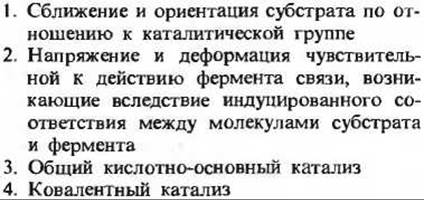
There are four main factors (Table 9-7) that determine the ability of enzymes to accelerate Chemical Reactions.
Proximity and Orientation. An enzyme is able to bind a substrate molecule in such a way that the bond attacked by the enzyme is not only positioned in close proximity to the catalytic group but is also properly oriented relative to it. As a result, the probability of the ES complex reaching the Transition State is greatly increased (Fig. 9-13).
Class="center">Table 9-7. Factors influencing the catalytic efficiency of enzymes
Strain and distortion: induced fit. Substrate binding can induce Conformational Changes in the enzyme molecule that cause strain in The Structure of the Active Site and somewhat distort the bound substrate, thereby facilitating the attainment of the transition state by the ES complex.
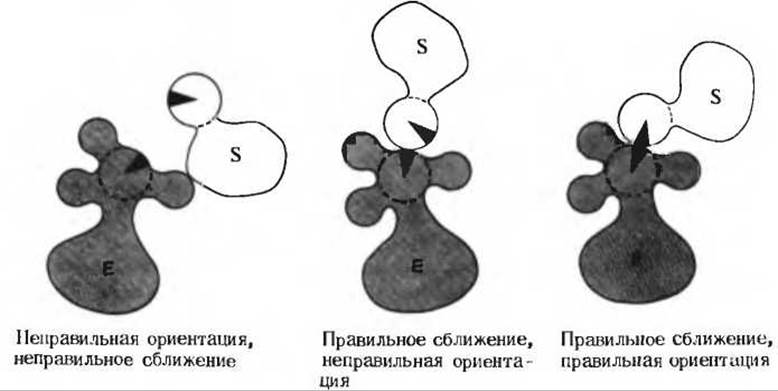
Fig. 9-13. Schematic representation of the proximity and orientation processes during the Interaction of a substrate molecule S with a catalytic group in the Active Site of enzyme E.

Fig. 9-14. Induced fit between the active site of the enzyme and the strained form of the substrate molecule.
This gives rise to the so-called induced fit of the enzyme to the substrate (Fig. 9-14). Thus, minor Changes in the tertiary or Quaternary Structure of a relatively large enzyme molecule can act as a mechanical lever for the substrate molecule. This may be precisely why enzymes are Proteins and, consequently, significantly larger than most substrate molecules.
General Acid-Base Catalysis. The active site of an enzyme may contain specific amino acid residues that serve as effective proton Donors or acceptors (Fig. 9-15). Such general acid or base groups are powerful catalysts for many organic reactions occurring in aqueous systems.

Fig. 9-15. Many organic reactions are accelerated by proton donors or acceptors, i.e., general acids or bases. The active sites of several enzymes contain Functional groups of amino acid residues that participate in catalytic processes as proton donors or acceptors. Some of these groups are shown here. The —SH group belongs to Cysteine, and the imidazole group to Histidine.

Fig. 9-16. One of the models of Covalent Catalysis. In some enzymatic reactions, the enzyme displaces the functional group R in the substrate RX, resulting in The formation of a covalent EX complex. This complex is unstable and undergoes hydrolysis much faster than RX. Enzymes that perform covalent catalysis include Chymotrypsin (Box 9-4, B).
Covalent catalysis. Some enzymes react with their substrates to form highly unstable, covalently linked enzyme-substrate complexes, which subsequently yield reaction products much faster than uncatalyzed reactions (Fig. 9-16).
The four factors listed above apparently make varying contributions to the rate enhancement of chemical reactions by Different types of enzymes; however, the precise mechanism responsible for accelerating any specific reaction remains unknown for any enzyme to date.
Last update: 06/08/2026
Editorial and Educational Adaptation: This material has been compiled based on the primary/original source text. The project team performed an editorial review, corrected technical inaccuracies, structured sections, and adapted the content for an educational format.
What was processed:
- elimination of formatting defects (OCR errors, structural breaks, corrupted characters);
- editorial organization of content;
- standardization of terminology in accordance with academic sources;
- verification of factual statements against the original source text.
All mentions of the author, publication year, and origin of the primary text have been preserved in accordance with the source.